The consumer is the engine of most modern economies, and retail sales is the clearest monthly read on how hard that engine is running. As a high-impact data release, it can move a currency sharply — but, as always in macro, it's the gap between the number and what was expected that does the moving. Understanding retail sales is understanding one of the most-watched windows into an economy's health. This guide covers retail sales and forex: what the data is, how it moves currencies, and why the forecast matters most.
It's one of the key releases in economic indicators for forex, a component of GDP, and a perfect example of why the surprise versus expectations drives price.
Key takeaways
Q: What is retail sales data?
A: Retail sales measures the total value of goods sold by retailers over a period — essentially a snapshot of consumer spending. Released monthly in major economies, it's a closely watched economic indicator because consumer spending makes up a large share of overall economic activity. Strong retail sales suggest a healthy, growing economy with confident consumers; weak sales suggest the opposite. Analysts often focus on 'core' retail sales, which strips out volatile components like auto sales.
Q: How does retail sales affect a currency?
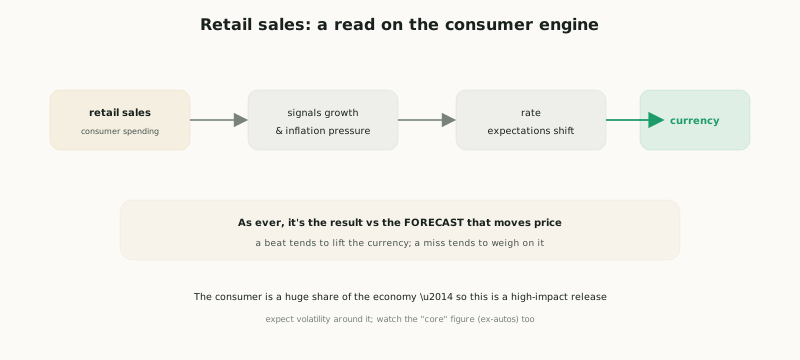
A: Through growth and interest-rate expectations. Strong retail sales signal economic strength and potential inflation pressure, which raises the odds the central bank keeps rates higher or hikes — supportive for the currency. Weak sales suggest a slowing economy, raising the chance of rate cuts, which tends to weaken the currency. The data feeds into the market's view of the economy and monetary policy, and the currency adjusts accordingly.
Q: Why does the forecast matter more than the number itself?
A: Because markets price in expectations ahead of the release. The forecast is already reflected in the currency's price, so what moves it is the surprise — how the actual figure compares to what was expected. A strong number that merely meets a strong forecast may barely move the currency, while a number that beats or misses expectations causes the sharp reaction. Always read retail sales (and any data) relative to the forecast, not in isolation.
What it is
Retail sales measures the total value of goods sold by retailers over a period — essentially a snapshot of consumer spending. Released monthly in major economies, it's a closely watched economic indicator because consumer spending makes up a large share of overall economic activity (in many developed economies, consumption is the majority of GDP). That makes retail sales a timely, high-frequency read on the demand side of the economy: strong retail sales suggest a healthy, growing economy with confident consumers who are spending; weak sales suggest the opposite — caution, belt-tightening, a possible slowdown. Analysts often focus on "core" retail sales, which strips out volatile components like auto sales (and sometimes fuel), to see the underlying trend without the noise of a few big-ticket categories. Because it arrives monthly and reflects real behaviour (people actually spending money), retail sales is valued as a relatively fresh, tangible gauge of economic momentum, sitting alongside jobs, inflation and business surveys in the macro dashboard.
Retail sales at a glance
How it moves a currency, and the forecast
Retail sales affects a currency through growth and interest-rate expectations — the standard transmission for most economic data. Strong retail sales signal economic strength and potential inflation pressure (busy consumers can push prices up), which raises the odds the central bank keeps rates higher or hikes — and higher-rate expectations are supportive for the currency (see interest rates and forex). Weak sales suggest a slowing economy, raising the chance of rate cuts, which tends to weaken the currency. In short, the data feeds into the market's view of the economy and monetary policy, and the currency adjusts accordingly — retail sales is read, ultimately, as a clue about what the central bank will do, because (as ever) the central bank is the channel through which the economy reaches the currency. This is why a single consumer-spending number can jolt a currency: it shifts, however slightly, the expected path of rates.
The crucial subtlety — true of all economic data — is why the forecast matters more than the number itself. Markets price in expectations ahead of the release: economists publish forecasts, traders position for them, and the forecast is already reflected in the currency's price before the data even comes out. So what moves the currency is the surprise — how the actual figure compares to what was expected, not whether it's "good" or "bad" in absolute terms. A strong number that merely meets an already-strong forecast may barely move the currency (the strength was anticipated and priced); a number that beats expectations tends to lift the currency, and one that misses tends to weigh on it — sometimes sharply, regardless of the headline level. This is the single most important thing to internalise about trading data releases, and it's why two "good" retail sales reports can produce opposite currency reactions depending on what was expected. Always read retail sales (and any data) relative to the forecast, not in isolation — the consensus estimate is the benchmark, and the deviation from it is the signal (the idea formalised by the economic surprise index). Practically, this also means expecting volatility around the release (see news and event risk) and being wary of trading the knee-jerk move, which can be choppy and prone to reversal. The honest framing: retail sales measures consumer spending, a monthly high-impact release that matters because consumption is a huge share of the economy (watch the "core" ex-autos figure). It moves a currency via growth and rate expectations — strong sales imply growth/inflation and firmer rates (currency-supportive), weak sales the reverse — because it's read as a clue to central-bank policy. Crucially, the forecast is already priced, so it's the result versus expectations (the surprise) that moves price: a beat lifts the currency, a miss weighs on it, regardless of the absolute level. Always read it relative to the forecast, and expect volatility.
Reading it in context
No single data point should be read in isolation, and retail sales is no exception. One month is noisy — retail figures are volatile and heavily revised (the previous month's number is often restated when the new one comes out), so the trend over several months matters far more than any single print, and a "beat" that's accompanied by a big downward revision to the prior month can be less bullish than it looks. Retail sales also feeds into broader gauges — it's a major component of GDP and sits alongside jobs, inflation and business surveys in the data mosaic — so it's read as one tile in a bigger picture of the economy, confirming or contradicting the other indicators rather than standing alone.
The most sophisticated point is that the currency's reaction depends on the prevailing regime — the same number can be bullish or bearish for the currency depending on what the market currently cares about. In an inflation-fighting regime (where the central bank is battling high inflation and the market is focused on rate hikes), strong retail sales are typically read as hawkish — robust demand means more inflation pressure, more reason to hike — which is currency-supportive. But in a growth-scare regime (where the market fears recession), strong retail sales can be greeted as relief (the economy is holding up), while weak sales stoke recession fears. And occasionally the logic inverts entirely: in a "good news is bad news" environment, very strong data can weigh on risk sentiment (by implying yet more rate hikes), producing counterintuitive moves. The lesson is that you must read retail sales (and all data) through the lens of what the market is currently focused on — inflation, growth, or policy — because the same figure transmits to the currency differently depending on the regime. This is why mechanically assuming "strong data = strong currency" misleads: the interpretation is contextual, which is exactly why experienced macro traders spend as much effort understanding the current market narrative as the data itself. The honest reminder: read retail sales in context — one month is noisy and heavily revised, so watch the multi-month trend, and treat it as one tile in the mosaic with GDP, jobs, inflation and surveys; crucially, the currency's reaction depends on the prevailing regime — strong sales are hawkish/supportive when the market fears inflation, but read as growth relief (or even "good news is bad news") in other regimes — so interpret the same number through what the market currently cares about, never mechanically as "strong data = strong currency."
Treat each retail sales release, then, not as a verdict in itself but as one more clue about where the consumer — and through them the economy, the central bank, and the currency — is heading next.
Retail sales measures consumer spending — a monthly, high-impact release that matters because consumption is a huge share of the economy (watch the "core" ex-autos figure for the trend). It moves a currency via growth and rate expectations: strong sales imply growth and inflation pressure → firmer rates → currency-supportive; weak sales the reverse — because it's read as a clue to central-bank policy. Crucially, the forecast is already priced, so it's the result versus expectations (the surprise) that moves price — a beat lifts, a miss weighs, regardless of the absolute level (two "good" reports can move oppositely). Always read it relative to the forecast (see the surprise index), and expect volatility on release.