A calm market can turn violent in a single second when a big number drops or a central bank speaks. News and event risk is the danger that a scheduled (or unscheduled) event blows your trade apart — through a volatility spike, a widened spread, a gap, or a stop that fills nowhere near where you set it. It's the defensive flip side of news trading: where the news trader seeks the move, the risk manager makes sure it can't wreck them. This guide explains news and event risk: what happens around events, why stops get unreliable, and how to defend your account.
It's closely tied to gap risk, slippage and liquidity risk, which all spike around events.
Key takeaways
Q: What is news and event risk?
A: News and event risk is the danger that an economic release, central-bank decision, political event or unexpected headline causes a sudden, violent price move that works against your position or makes it hard to manage. Around such events, volatility spikes, spreads widen, prices can gap, and stop-losses may be filled well away from their intended level. It applies to scheduled events (data, central banks) and unscheduled shocks alike.
Q: Why are stops unreliable around news?
A: Because the move can be so fast and liquidity so thin that there's no order at your stop level to fill against. When a big surprise hits, price can jump straight through your stop, which then fills at the next available price — potentially far worse (slippage), or after a gap. So a stop set to risk 1% might actually lose considerably more during a violent news spike. Only a guaranteed stop (where offered) fully caps this.
Q: How do you manage news and event risk?
A: Know the calendar — be aware of upcoming high-impact releases and central-bank meetings. Then choose a stance: reduce position size or close positions ahead of major events, or simply stand aside until the dust settles. If you do hold through, accept that stops may slip and size accordingly. Avoid entering fresh trades into the teeth of a big release unless that's your deliberate strategy, and never assume normal conditions around event time.
What happens around events
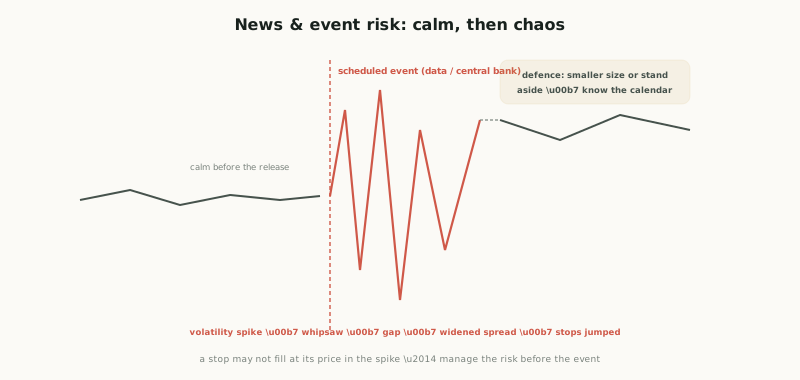
News and event risk is the danger that an economic release, central-bank decision, political event or unexpected headline causes a sudden, violent price move that works against your position or makes it hard to manage. The forex market reacts instantly and often dramatically to new information (see economic indicators and the surprise-versus-expectations principle), and around a major event several things happen at once: volatility spikes (price can move a large distance in seconds), spreads widen sharply (liquidity providers pull back, so the cost to trade balloons), prices can gap (jump with no trading in between), and the move can whipsaw (spike one way, then violently reverse) as the market digests the news. This applies to scheduled events — high-impact data (inflation, employment, GDP), central-bank meetings, elections — whose timing is known even if the outcome isn't, and to unscheduled shocks (surprise headlines, geopolitical events) that hit without warning. The scheduled ones are, in a sense, the easier to manage, because you know they're coming — the failure is not preparing for them.
Why stops slip, and how to defend
A crucial, often-painful lesson: stops become unreliable around news. A normal stop-loss is not a guaranteed exit price — when triggered, it becomes a market order, filled at the next available price. Most of the time, in liquid conditions, that's fine. But around a violent news move, the price can be moving so fast and liquidity so thin that there's no order at your stop level to fill against — so price jumps straight through your stop, which then fills far worse (heavy slippage) or after a gap. The consequence: a stop you set to risk 1% might actually lose considerably more in a news spike, because the stop didn't fill where you intended. This breaks the comforting assumption that "my stop caps my loss" — it usually does, but not reliably in violent event conditions. Only a guaranteed stop (where offered, usually for a fee) fully caps this; an ordinary stop does not.
Defending against news and event risk is mostly about preparation and stance. The table below frames the core risks against their defences:
| The risk | The defence |
|---|---|
| Volatility spike / whipsaw | Reduce size or stand aside; don't trade the chaos uninvited |
| Spreads widen sharply | Avoid entering/exiting in the seconds around the release |
| Gaps & jumped stops | Smaller size; guaranteed stop if holding through |
| Being caught unaware | Know the economic calendar — always |
The foundation is knowing the calendar: be aware of upcoming high-impact releases and central-bank meetings (an economic calendar flags these), so you're never surprised by a scheduled event — being blindsided by a known release is an avoidable, unforced error. Then choose a deliberate stance: many traders reduce position size or close positions ahead of major events, removing or shrinking exposure to the unpredictable spike; others simply stand aside until the dust settles and conditions normalise, then trade the clearer picture afterwards. If you do hold through an event, do so knowingly — accepting that stops may slip and sizing accordingly (smaller, so even a worse-than-expected fill is survivable), and considering a guaranteed stop. Avoid entering fresh trades into the teeth of a big release unless trading the news is your deliberate, practised strategy (and even then, with the risks fully understood). The universal rule: never assume normal conditions around event time — spreads, slippage, gaps and volatility are all elevated, so the comfortable assumptions of quiet-market trading don't hold. Handled with awareness, news and event risk is very manageable; the danger is almost always in being unprepared — caught in normal-sized positions, with normal-sized assumptions, when the market suddenly isn't normal. The honest framing: news and event risk is the danger that a scheduled release, central-bank decision or surprise headline causes a violent move — volatility spike, widened spreads, gaps and whipsaws — that hurts your position or jumps your stop (a normal stop can fill far past its level in the chaos, so it may not cap your loss). Defend by knowing the economic calendar, then reducing size or standing aside around major events; if holding through, size smaller, consider a guaranteed stop, and never assume normal conditions at event time. The risk is mostly in being unprepared.
A simple event playbook
Turning awareness into a habit is easiest with a simple, repeatable routine. Check the calendar daily: at the start of your session, scan an economic calendar for the day's (and week's) scheduled events affecting your pairs, and note the times of any high-impact ones — so nothing surprises you. Classify by impact: not all events are equal. High-impact events (major central-bank decisions, key inflation and employment releases, elections) can move markets violently and deserve real caution; medium ones warrant awareness; low-impact data rarely needs special action. Match your response to the impact rather than treating every release the same. Decide your stance per event, in advance: for a high-impact release, will you go flat (close out beforehand), reduce size, or hold through knowingly? Deciding before the event — calmly, as part of the plan — beats reacting in the heat of the spike.
A few specific rules sharpen the playbook. Avoid the seconds around the release: don't enter or exit in the immediate moments of a high-impact print, when spreads are widest and slippage worst — let the initial chaos pass. Be patient on re-entry: after a big event, the first move often whipsaws before a clearer trend emerges, so waiting for the dust to settle and trading the considered direction usually beats chasing the initial spike. Treat central-bank days with extra respect: the decision plus the press conference/guidance can produce two separate waves of volatility (and the surprise-versus-expectations reaction can defy the "obvious" interpretation), so they're among the riskiest scheduled events to hold through carelessly. Finally, prepare for the unscheduled: surprise shocks (geopolitical headlines, unexpected announcements) can't be calendared, so the standing defences — always using stops, never over-leveraging, and keeping position sizes survivable — are what protect you against the events you didn't see coming. A trader with a simple event routine is rarely blindsided; the ones who get hurt are almost always those who didn't check, didn't decide, and were caught full-size when the market erupted. The honest reminder: run a simple routine — check the calendar daily, classify events by impact, and decide in advance whether to go flat, reduce or hold for each high-impact one; avoid trading the seconds around releases, be patient on re-entry, treat central-bank days (decision plus guidance) with extra care, and guard against unscheduled shocks with the standing defences of always using stops, never over-leveraging, and survivable sizing.
Ultimately, news and event risk is one of the clearest examples of a risk you can largely neutralise with preparation. Markets will always lurch on new information — that's not going away — but whether those lurches hurt you is mostly within your control. The trader who knows what's on the calendar, sizes and positions deliberately around it, and never assumes calm conditions at event time will rarely be the one nursing a shock loss from a spike they didn't see coming. Respect the events, plan around them, and they become just another manageable feature of the market rather than a recurring source of damage.
News and event risk is the danger that a scheduled release, central-bank decision or surprise headline causes a violent move — volatility spike, widened spreads, gaps and whipsaws — that hurts your position or jumps your stop. Crucially, a normal stop is not guaranteed: in a fast, thin news move it can fill far past its level (slippage/gap), so it may not cap your loss — only a guaranteed stop does. Defend: know the economic calendar (never be blindsided by a known event), then reduce size or stand aside around major releases; if holding through, size smaller, consider a guaranteed stop, and never assume normal conditions at event time. The danger is almost always in being unprepared — it's the defensive flip side of news trading.