
Forex is the most liquid market in the world — most of the time. But liquidity is not constant, and when it thins out, spreads widen, slippage bites, and you may not be able to exit at the price you expect. Liquidity risk is the quiet danger of a market that isn't always there when you need it — and, cruelly, it tends to vanish at exactly the worst moments. This guide explains liquidity risk in forex: what it is, when liquidity dries up, and how to manage it.
It's the underlying cause of slippage and a close companion of gap risk and event risk.
Key takeaways
Q: What is liquidity risk in forex?
A: Liquidity risk is the danger that you can't execute a trade at or near the price you expect because there aren't enough buyers and sellers at that moment. Even though forex is highly liquid overall, liquidity varies by time, pair and conditions — and when it thins, you face wider spreads, slippage, and in extreme cases the inability to exit a position at a reasonable price. It's a real risk that worsens precisely when you most need to get out.
Q: When does forex liquidity dry up?
A: Liquidity is lowest outside the main sessions (the quiet hours between New York closing and Tokyo/London getting going), around the weekend open, on public holidays (especially when major centres are closed), around major news releases (briefly), in exotic and minor currency pairs at all times, and — most dangerously — during market crises and panics, when everyone heads for the exits at once. These are the moments to be most cautious.
Q: How do you manage liquidity risk?
A: Trade liquid pairs during active sessions when you can; avoid or size down in thin conditions (off-hours, holidays, around news, in exotics); be cautious with market orders in fast or thin markets, where slippage can be severe; account for wider spreads in your costs; and never assume a stop will fill exactly at its level when liquidity is poor. Above all, size positions so that an illiquid, gapping exit can't be catastrophic.
What it is
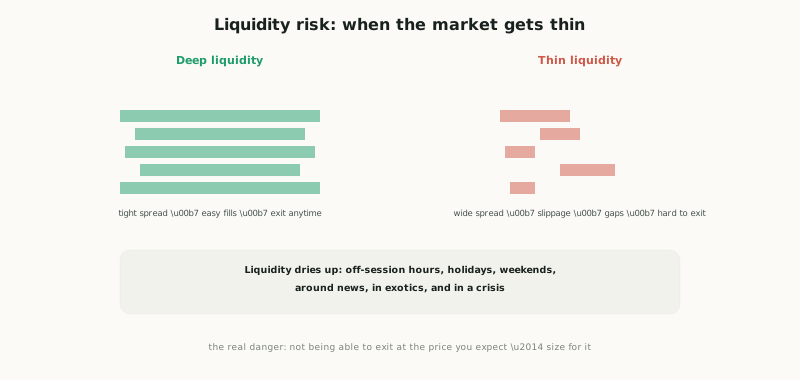
Liquidity risk is the danger that you can't execute a trade at or near the price you expect because there aren't enough buyers and sellers at that moment. "Liquidity" is the ease with which you can buy or sell without moving the price — a deep, liquid market has plenty of orders on both sides, so you get filled instantly at a tight spread; a thin, illiquid market has sparse orders, so trades fill at worse prices, spreads widen, and large orders move the price against you. Although forex is highly liquid overall (trillions traded daily), that liquidity is not uniform — it varies enormously by time, by pair, and by conditions. When it thins, you face three escalating problems: wider spreads (higher cost to trade), slippage (orders filling at worse prices than requested — see slippage), and, in the extreme, the inability to exit a position at a reasonable price at all. That last one is the true heart of liquidity risk: it's not just paying a wider spread, it's the danger of being trapped in a position, or forced out at a terrible price, because the market isn't there to take the other side.
When liquidity dries up
Knowing when liquidity thins is half of managing it. The key low-liquidity situations:
When forex liquidity is lowest
Liquidity is lowest outside the main sessions — the quiet hours between New York closing and Tokyo/London getting going, when few major centres are active. It's thin around the weekend open (the Sunday/Monday re-open, where weekend news can also cause gaps) and on public holidays, especially when a major financial centre is closed (a US holiday, for instance, drains liquidity even from pairs that don't involve the dollar's home session). It briefly evaporates around major news releases — in the seconds around a big data print or central-bank decision, liquidity providers pull back, spreads blow out, and prices can spike and gap on thin order books (the territory of news and event risk). Exotic and minor currency pairs are thin all the time (far fewer participants than the majors — hence their wider spreads), so liquidity risk is a permanent feature of trading exotics. And — most dangerously — liquidity is worst in market crises and panics, when everyone heads for the exits at once: in a crash, the buyers vanish, spreads gap enormously, and you may be unable to exit at anything close to a fair price (the dynamic behind tail-risk blowups and "flash crashes"). The bitter irony of liquidity risk is that it's worst exactly when you most need to get out — in the panic where exiting matters most, the liquidity to do so has disappeared.
Managing liquidity risk is mostly about respecting these conditions. Trade liquid pairs during active sessions whenever you can — the London–New York overlap in the majors offers the deepest liquidity and tightest spreads. Avoid or size down in thin conditions: be cautious (or flat) in the dead off-hours, around the weekend gap, on major holidays, in the seconds around big news, and in exotics. Be wary of market orders in fast or thin markets, where slippage can be severe — and understand that a stop-loss may not fill at its level when liquidity is poor (stops become market orders when triggered, so in a gapping, illiquid move they can fill far worse than expected; a guaranteed stop, where offered, is the only way to truly cap this). Account for wider spreads in your cost assumptions for less-liquid pairs and times. And the overarching defence: size positions so that an illiquid, gapping exit can't be catastrophic — because the one time it matters most (a crisis), liquidity risk and gap risk combine, and your position size is the only thing fully under your control. As always, this isn't about fear but respect: forex's deep liquidity is a genuine advantage, but it's conditional, and the disciplined trader knows when it's there and when it isn't. The honest framing: liquidity risk is the danger of not being able to trade at the price you expect because there aren't enough buyers/sellers — bringing wider spreads, slippage, and at worst the inability to exit. Forex is liquid overall but not uniformly: liquidity dries up off-session, at the weekend open, on holidays, briefly around news, in exotics always, and worst in crises (when everyone exits at once). Manage it by trading liquid pairs in active sessions, sizing down or standing aside in thin conditions, being wary of market orders and un-guaranteed stops in fast markets, accounting for wider spreads, and — above all — sizing so an illiquid, gapping exit can't be catastrophic.
Flash crashes and thin-market blow-ups
The most dramatic form of liquidity risk is the flash crash: a sudden, violent, often brief collapse (or spike) in a currency, driven by liquidity evaporating in thin conditions. These tend to strike in the low-liquidity hours — the quiet window around the Asian open, or holiday/year-end periods when major desks are closed — precisely when the order book is thinnest. The mechanics are self-reinforcing: an initial move in a thin market triggers stop-losses, which become market orders hitting an already-empty book, pushing price further and triggering more stops in a cascade, while automated systems pull their liquidity amid the chaos, deepening the vacuum. The result is an outsized move — sometimes several percent in minutes — that gaps through every stop in its path before snapping back. Several real episodes (notably in JPY crosses during thin holiday hours) have shown how brutal this can be: traders stopped out at catastrophic prices far beyond their intended risk, because there was simply no liquidity at the levels in between.
The practical lessons are sobering but simple. Be especially wary of holding sizeable positions — particularly in less-liquid pairs — through the thinnest periods (the quiet overnight hours, weekends, and major holidays), since that's when a flash crash is most likely and most savage. Understand that in such an event a normal stop offers little real protection (it fills wherever liquidity reappears, potentially miles away), so the only true defences are conservative position sizing (so even a horrific fill is survivable) and, for those who must hold through illiquid windows, possibly a guaranteed stop. Recognise too that broker liquidity differs — in stressed conditions, spreads and fills vary across providers, and thinner brokers can be worse. None of this means avoiding forex's deep liquidity, which is real and valuable in normal conditions; it means respecting that liquidity is conditional and that its disappearance — rare but devastating — is a tail risk best managed by size, since size is the one variable fully in your control when the market vanishes. The honest reminder: flash crashes happen when liquidity evaporates in thin hours and stop cascades feed on an empty book, gapping through stops in minutes — so avoid large positions (especially in less-liquid pairs) through the thinnest periods, treat normal stops as little protection in such events, lean on conservative sizing (and possibly guaranteed stops) as the real defence, and remember broker liquidity varies under stress.
Liquidity risk is the danger of not being able to trade at the price you expect because there aren't enough buyers/sellers — bringing wider spreads, slippage, and at worst the inability to exit. Forex is liquid overall but not uniformly: liquidity dries up off-session, at the weekend open, on holidays, briefly around news, in exotics always, and worst in crises (everyone exits at once — and it's gone exactly when you most need it). Manage it: trade liquid pairs in active sessions, size down or stand aside in thin conditions, be wary of market orders and un-guaranteed stops in fast markets (a stop may not fill at its level), account for wider spreads, and above all size so an illiquid, gapping exit can't be catastrophic. Deep liquidity is real — but conditional.