Win a few trades in a row and you start to feel unstoppable — like you've got the magic touch and it'll continue. That's the hot-hand fallacy, and it's one of the quietest, most dangerous traps in trading: it's how good runs set up bad blow-ups, as confidence curdles into recklessness at the worst possible moment. This guide explains the hot-hand fallacy: what it is, why it's so dangerous, and how it mirrors the opposite gambler's fallacy.
It's the streak-continuing twin of the gambler's fallacy, a product of misreading variance and luck, and exactly what thinking in probabilities cures.
Key takeaways
Q: What is the hot-hand fallacy?
A: The hot-hand fallacy is the mistaken belief that a streak of successes will continue — that being 'hot' makes the next success more likely. It comes from basketball, where players and fans believed a player who'd made several shots was 'on fire' and more likely to score again. In trading, it's the feeling after a winning streak that you've got the magic touch and your next trades will also win, encouraging you to bet bigger and take more risk.
Q: Why is the hot-hand fallacy dangerous in trading?
A: Because it leads to overconfidence right when it's most dangerous. After a winning streak, the 'hot' feeling tempts you to oversize positions, take lower-quality setups, drop your discipline and risk rules, and assume you can't lose — just as a normal losing run (which is statistically due regardless of recent wins) may be around the corner. Many traders give back weeks of gains in a few oversized, overconfident trades after feeling invincible.
Q: How does the hot-hand fallacy differ from the gambler's fallacy?
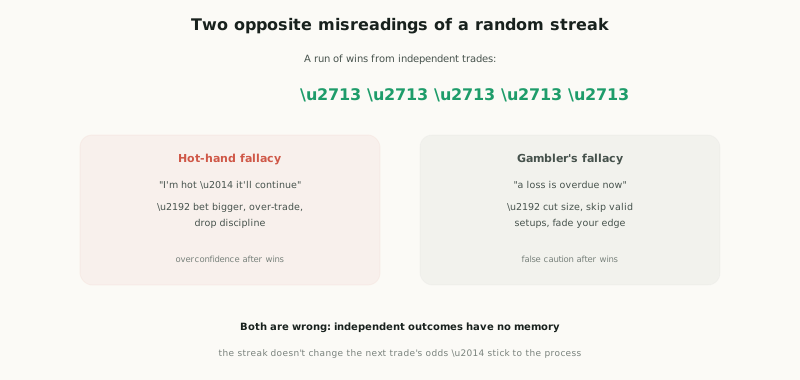
A: They're opposite misreadings of the same random streak. The hot-hand fallacy says a streak will continue ('I'm hot, I'll keep winning'); the gambler's fallacy says a streak must reverse ('I've won a lot, a loss is overdue'). Both are wrong for independent events, because each trade's odds don't depend on previous results. One causes overconfidence and oversizing; the other causes false caution and skipping valid trades.
What it is
The hot-hand fallacy is the mistaken belief that a streak of successes will continue — that being "hot" makes the next success more likely. The name comes from basketball, where players and fans long believed a player who'd sunk several shots in a row was "on fire" and more likely to score again — a belief that careful study found was largely an illusion (the makes and misses were much closer to random than the "hot hand" feeling suggested). In trading, it shows up as the powerful feeling, after a winning streak, that you've found the magic touch — that you're reading the market perfectly right now and your next trades will also win. The streak feels like evidence of a special state ("I'm in the zone, I can't lose"), and that feeling tempts you to bet bigger and take more risk, riding the supposed hot streak for all it's worth. The problem is that, for trades with an independent edge, the previous wins do not make the next trade more likely to win — a winning streak is mostly variance (even a coin will throw five heads in a row sometimes), not a sign that your odds have improved. The "hot hand" is, largely, a story your mind tells about randomness.
The danger, and the mirror fallacy
The hot-hand fallacy is dangerous precisely because it strikes when you're least on guard — feeling great after a run of wins. That "hot," invincible feeling leads directly to the behaviours that destroy accounts: oversizing positions (betting much bigger because you "can't lose right now"), taking lower-quality setups (loosening your standards because everything's working), dropping your discipline and risk rules (why bother with tight risk when you're on fire?), and a general assumption that you can't lose — all just as a perfectly normal losing run (which is statistically going to happen regardless of recent wins) may be around the corner. The classic, painful pattern: a trader has a great week, feels invincible, sizes up dramatically, abandons their rules — and gives back weeks of gains in a few oversized, overconfident trades when the inevitable losers arrive. The wins didn't change the odds; they only changed the trader's behaviour, for the worse. This is why handling winning streaks is genuinely harder than handling losses for many traders — the danger is hidden inside a good feeling.
It's illuminating to see the hot-hand fallacy alongside its mirror image, the gambler's fallacy — because they're opposite misreadings of the same random streak:
| Hot-hand fallacy | Gambler's fallacy | |
|---|---|---|
| The belief | "The streak will continue" | "The streak must reverse" |
| After wins, feel… | "I'm hot — I'll keep winning" | "A loss is overdue now" |
| The behaviour | Oversize, over-trade, drop rules | Cut size, skip valid setups |
| The error | Overconfidence | False caution |
Both fallacies make the same fundamental mistake: treating independent outcomes as if they had a memory. The hot-hand fallacy says the streak will continue (so it breeds overconfidence — bet bigger); the gambler's fallacy says the streak must reverse (so it breeds false caution — a loss is "due," so cut size or skip the trade). Neither is true when each trade's odds don't depend on previous results: the streak — win or lose — simply doesn't change the next trade's probability. The cure for both is the same: thinking in probabilities. If you genuinely accept that each trade is an independent sample from your edge — that a winning streak is variance, not a superpower, and that the next trade's odds are whatever your edge says, regardless of the last five — then a hot streak can't make you reckless and a cold streak can't make you timid. Practically: keep your position sizing constant (don't size up because you feel hot — or fixed to a rule like the 1% rule, not to your mood); follow your process and rules identically whether you're on a winning or losing run; treat the urge to "press your luck" after wins as a warning sign, not a green light; and remember that the market doesn't know or care that you've won five in a row. The disciplined trader is equally calm after five wins or five losses, because they know both are just noise around a long-run edge. The honest framing: the hot-hand fallacy is the belief that a winning streak will continue — feeling "hot" and invincible after a run of wins — which tempts oversizing, lower-quality trades and dropped discipline right before a normal losing run, so many give back weeks of gains in a few overconfident trades. It's the mirror of the gambler's fallacy (which says a streak must reverse): both wrongly treat independent outcomes as having memory. The cure is thinking in probabilities — each trade is independent, a streak is just variance, so keep sizing and process constant regardless of recent results, and stay equally calm after wins or losses.
Where it shows up beyond single streaks
The hot-hand fallacy isn't only about a run of individual winning trades — it shows up in several broader, sneakier forms. After a single big win, traders often feel a surge of "I've cracked it" invincibility and immediately take an oversized, ill-considered next trade to "keep it going." After a good week or month, the same feeling scales up: a profitable period breeds the sense that you're now in a permanently elevated state of skill, justifying bigger risk — right when mean reversion and a normal drawdown may be due. It appears in faith that a system "that's been working lately" will keep working indefinitely (ignoring that recent good performance is partly variance and conditions change). And it's amplified by social proof: the "hot" trader posting a winning streak online attracts followers who assume the streak reflects durable skill and will continue — the survivorship-flavoured spectacle of visible winners feeding everyone's hot-hand instinct. In every form, the error is the same: treating recent success as evidence that the near future is more certain and more favourable than the odds actually warrant.
The defence, in all these forms, is the constant-sizing, constant-process discipline that flows from thinking in probabilities — and a specific dose of vigilance about winning streaks, which are psychologically more dangerous than losing ones precisely because they feel good and lower your guard. Concretely: keep your risk per trade fixed by rule, not by how confident a recent run has made you feel; treat the urge to size up after wins as a red flag rather than a signal; and cultivate equanimity — the disciplined trader is equally calm after five wins or five losses, because they know both are noise around a long-run edge and that the market has no memory of either. A useful mental check after any winning run: "Has anything about my actual edge changed, or do I just feel hot?" Almost always it's the latter — and recognising that is what keeps a good run from becoming the setup for a bad blow-up. The honest reminder: the hot-hand fallacy shows up after single big wins, good weeks/months, "systems working lately," and in social-proof of streaking traders — all treating recent success as proof the near future is more certain and favourable than the odds warrant; defend with fixed, rule-based sizing, treating the urge to press after wins as a red flag, and cultivating equanimity that's equally calm after wins or losses, since the market has no memory of your streak.
The hot-hand fallacy is believing a winning streak will continue — feeling "hot" and invincible after a run of wins — which tempts oversizing, lower-quality setups and dropped discipline right before a perfectly normal losing run, so many traders give back weeks of gains in a few overconfident trades. It's the mirror of the gambler's fallacy ("a loss is overdue"): both wrongly treat independent outcomes as having memory — one breeds overconfidence, the other false caution. The cure is thinking in probabilities: each trade is independent, a streak is just variance, so keep your sizing and process constant regardless of recent results (size to a rule, not your mood), treat the urge to "press your luck" as a warning sign, and stay equally calm after five wins or five losses — the market doesn't know your streak.