The single most important mental shift in trading is to stop thinking in certainties and start thinking in probabilities. Any one trade is essentially a coin-flip with a slight edge; it's only over hundreds of trades that the edge reveals itself. Internalise this, and most of the emotion that wrecks traders — the agony over losses, the euphoria over wins, the urge to abandon a sound plan — loses its grip. This guide explains thinking in probabilities: why a single trade is random, how an edge actually works, and why this mindset is the foundation of emotional stability.
It's the bedrock beneath process-over-outcome thinking, makes sense of variance and luck, and is how a trader genuinely makes peace with uncertainty.
Key takeaways
Q: What does thinking in probabilities mean in trading?
A: It means accepting that you can't know the outcome of any individual trade — each one is uncertain — and instead focusing on having a positive edge that plays out over a large number of trades. A good strategy doesn't win every time; it wins often enough, or by enough, to be profitable across many trades. Thinking in probabilities shifts your attention from the result of one trade to the statistical performance of your process over time.
Q: Why is a single trade essentially random?
A: Because even a strong edge only tilts the odds slightly. A strategy might win 55% of the time, or win less often but with larger winners — either way, any single trade can easily lose, and short runs of losses are normal even for a profitable system. The outcome of one trade is dominated by randomness; the edge is real but only becomes visible across a large sample, much like a casino's small house edge over thousands of bets.
Q: How does thinking in probabilities help psychologically?
A: Enormously. If you accept that any single loss is just one sample from a process — not a personal failure or proof your method is broken — losses stop feeling catastrophic, wins stop breeding overconfidence, and the emotional rollercoaster flattens. It lets you follow your process calmly through inevitable losing streaks, avoid revenge trading and overconfidence, and judge yourself on execution rather than outcomes. It's the foundation of emotional stability in trading.
The core idea
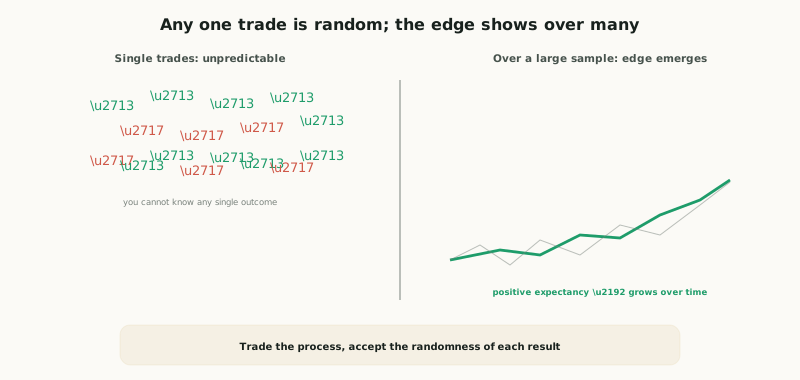
To think in probabilities is to accept that you cannot know the outcome of any individual trade — each one is genuinely uncertain — and to focus instead on having a positive edge that plays out over a large number of trades. Here's why a single trade is essentially random: even a strong edge only tilts the odds slightly. A strategy might win 55% of the time, or win less often but with larger winners — either way, any single trade can easily lose, and short runs of losses are completely normal even for a highly profitable system (a 55%-win strategy will routinely string together several losers by chance — see variance). The outcome of one trade is dominated by randomness; the edge is real but only becomes visible across a large sample. The perfect analogy is a casino: on any single spin of the roulette wheel, the casino can easily lose — the outcome is random — but over thousands of spins, its small, fixed house edge guarantees profit. The casino doesn't agonise over one losing spin or celebrate one winning one; it knows its edge plays out over volume. A trader with a positive-expectancy edge is in exactly the same position: profitable over many trades, but random on any one. So the right unit of analysis is never the single trade — it's the large sample, where the edge expresses itself and the randomness washes out.
Why it transforms your psychology
Grasping this intellectually is easy; internalising it — truly trading as if you believe it — is the hard, transformative part, and it's worth it because it dissolves most of trading's emotional difficulty. Consider what changes when you genuinely think in probabilities. A loss stops being a catastrophe or a personal failure: it's simply one sample from a process with a positive expectancy, an expected and normal cost of doing business, no more meaningful than the casino losing one spin. So the sting, the self-recrimination, and the urge to "win it back" (revenge trading) fade — there's nothing to avenge, just variance doing what variance does. A win stops breeding overconfidence: it's also just one sample, not proof of genius, so you don't get euphoric, oversize, or abandon your rules after a good run (and you sidestep both the hot-hand and gambler's fallacies, which both misread streaks of random outcomes). A losing streak stops triggering panic or a frantic overhaul of your method: you understand that even a great system has losing runs, so you can follow your process calmly through the drawdown rather than tinkering or quitting at the worst moment. In short, the emotional rollercoaster flattens — because you've stopped attaching life-or-death significance to outcomes that are, individually, mostly noise.
This is why thinking in probabilities is the foundation of emotional stability and underpins so much else on this site. It is the natural ally of process-over-outcome thinking (judge yourself on whether you executed your edge well, not on whether a given trade won — since the outcome was never fully in your control), and the antidote to the whole family of outcome-driven errors: revenge trading, overconfidence after wins, deviating from the plan, and the inability to take a valid setup after a loss. It also demands genuine acceptance of uncertainty (see dealing with uncertainty): you act decisively despite not knowing the outcome, because you trust the odds over the long run, the way a poker player bets on a strong hand knowing it can still lose. The practical disciplines that flow from it: think in terms of your next 100 trades, not the next one; expect and pre-accept losing runs as normal; size each trade small enough that no single outcome matters much (so you can stay calm and let the sample play out); and keep a journal to evaluate your process across many trades rather than reacting to individual results. None of this makes any single trade predictable — nothing can — but it lets you trade your edge with the calm, detached consistency that actually allows that edge to express itself. The honest framing: thinking in probabilities means accepting you can't know any single trade's outcome — each is essentially random — and focusing on a positive edge that only shows over a large sample, exactly like a casino's small house edge over thousands of spins. Psychologically it's transformative: losses become normal samples rather than failures (defusing revenge trading), wins stop breeding overconfidence, and losing streaks don't trigger panic, so the emotional rollercoaster flattens. It underpins process-over-outcome thinking and accepting uncertainty. In practice: think in terms of your next 100 trades, pre-accept losing runs, size so no one trade matters, and judge your process across the sample — not any single result.
Building the mindset in practice
Knowing you should think in probabilities and actually feeling it in the heat of a losing streak are different things, so the mindset has to be built through deliberate practice. The most powerful habit is shifting your unit of measurement from the trade to the sample: instead of asking "did this trade win?", ask "am I executing my edge well over my last (and next) hundred trades?" Pre-define your edge in concrete terms — your expected win rate and average win/loss, hence your expectancy — so you have a clear, statistical picture of what "working" looks like across many trades, and a benchmark that makes any single result obviously irrelevant. Pre-accept losing runs: calculate (or simply acknowledge) that a strategy with, say, a 50% win rate will routinely produce runs of five or more consecutive losers purely by chance, and decide in advance that these are normal, not a signal to panic or change — so when one arrives, you've already accepted it.
Several practical supports reinforce the mindset. Size so that no single trade matters — risking a small, fixed fraction (the 1% rule) means any one outcome is genuinely trivial to your account, which makes calm, probabilistic detachment much easier (it's hard to feel detached about a trade that could blow up your account, and easy about one that risks 1%). Adopt the casino-operator's stance: you're not the gambler hoping this spin wins, you're the house running an edge over volume — indifferent to any single result, focused on the long-run numbers. Keep a journal that evaluates your process across many trades, so your sense of "how am I doing?" comes from the sample, not from today's P&L. And lean toward a rules-based approach where you can, since mechanical execution naturally enforces the "follow the process regardless of the last result" discipline that probabilistic thinking demands. Over time, these practices retrain your gut: you start to feel a loss as one sample rather than a wound, and a win as one sample rather than a triumph — which is the calm, slightly detached state in which a real edge can finally express itself. The honest reminder: build the mindset by measuring yourself over the sample (your next 100 trades) not the trade, pre-defining your edge and pre-accepting that losing runs are normal, sizing so no single trade matters (the 1% rule), adopting the casino-operator's detachment, journaling your process across many trades, and favouring rules-based execution — until a loss genuinely feels like one sample, not a wound.
Thinking in probabilities means accepting you can't know any single trade's outcome — each is essentially random — and focusing on a positive edge that only shows over a large sample, exactly like a casino's small house edge over thousands of spins (random on one, profitable over many). Psychologically it's transformative: a loss becomes a normal sample, not a failure (defusing revenge trading); a win stops breeding overconfidence; and a losing streak doesn't trigger panic — so the emotional rollercoaster flattens. It's the foundation of process-over-outcome thinking and of accepting uncertainty. In practice: think in your next 100 trades, pre-accept losing runs as normal, size so no one trade matters much, and judge your process across the sample — never a single result.