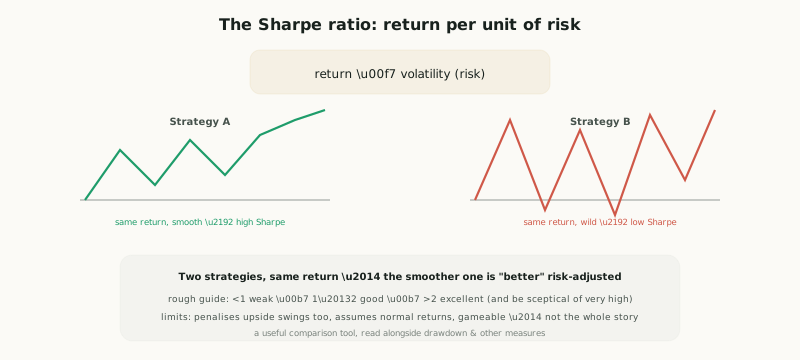
Two strategies can make the same return, yet one is far better than the other — if it got there with a smoother, less stomach-churning ride. The Sharpe ratio is the classic way to capture that: return per unit of risk. It's the most cited performance metric in finance, and a useful — if imperfect — lens on the quality of returns, not just their size. This guide explains the Sharpe ratio: what it is, how to interpret it, why smoothness scores higher, and the limitations every trader should know.
It's the most famous example of risk-adjusted returns, complements the profit factor, and is best read alongside drawdown and the equity curve.
Key takeaways
Q: What is the Sharpe ratio?
A: The Sharpe ratio measures return per unit of risk, where risk is defined as the volatility (standard deviation) of returns. In essence it asks: for the bumpiness you endured, how much return did you earn? A higher Sharpe ratio means more return for the same risk, or the same return for less risk. It's the most widely used risk-adjusted performance metric in finance, allowing strategies with different risk levels to be compared on a like-for-like basis.
Q: What is a good Sharpe ratio?
A: As a rough guide, a Sharpe ratio below 1 is considered weak, 1 to 2 is good, and above 2 is excellent (with very high figures rare and worth scrutinising). The exact interpretation depends on the timeframe and context, and Sharpe ratios are sensitive to how they're calculated. Like all single metrics, treat the number as a comparison tool rather than an absolute verdict, and be sceptical of unusually high values, which often reflect a short or cherry-picked sample.
Q: What are the limitations of the Sharpe ratio?
A: Several. It treats all volatility as 'bad,' so it penalises big upside swings as much as downside ones, even though traders welcome upside. It assumes returns are roughly normally distributed, which understates the risk of fat-tailed strategies that can blow up. It can be gamed by strategies that look smooth until they suddenly aren't. And it says nothing about maximum drawdown or the worst-case path. Use it alongside drawdown, the Sortino ratio and other measures, not alone.
What it is
The Sharpe ratio measures return per unit of risk, where risk is defined as the volatility (the standard deviation) of returns. (More precisely it's the return above a risk-free rate, divided by volatility, but the intuition is simply return-versus-bumpiness.) In essence it asks: "for the bumpiness you endured, how much return did you earn?" A higher Sharpe ratio means more return for the same risk, or the same return for less risk — either way, a more efficient use of risk. This is why it's so widely used: it lets you compare strategies with different risk levels on a like-for-like basis. A strategy returning 20% with wild swings might be worse, on a Sharpe basis, than one returning 12% smoothly — because the second earned its return with far less volatility, and could (in principle) be leveraged up to match the first's return at lower risk. The Sharpe ratio captures the crucial idea that return alone is a misleading measure: how much risk you took to get it matters just as much, and a return earned through a calm, steady equity curve is genuinely higher-quality than the same return earned through a terrifying rollercoaster.
The Sharpe ratio at a glance
How to read it, and its limits
As a rough guide, a Sharpe ratio below 1 is considered weak, 1 to 2 is good, and above 2 is excellent (with very high figures rare and worth scrutinising). The exact interpretation depends on the timeframe and context (a Sharpe ratio is usually annualised, and the same returns can give different figures depending on how they're measured), and Sharpe ratios are sensitive to how they're calculated — so a quoted Sharpe should always prompt "over what period, and computed how?". As with the profit factor, treat the number as a comparison tool rather than an absolute verdict, and be sceptical of unusually high values, which often reflect a short or cherry-picked sample (or a strategy that's about to reveal its hidden risk) — the same small-sample and overfitting cautions apply.
The Sharpe ratio's limitations are important and well-known. First, it treats all volatility as "bad", so it penalises big upside swings as much as downside ones — even though traders are delighted by upside volatility. A strategy that occasionally posts huge gains can be unfairly dinged by Sharpe for the "volatility" of those very gains, which is why the Sortino ratio (a close relative that counts only downside volatility) is often preferred for return profiles that are lopsided to the upside. Second, it assumes returns are roughly normally distributed, which understates the risk of fat-tailed strategies — approaches that look smooth and high-Sharpe for a long time and then suffer a sudden, catastrophic loss (think strategies that quietly sell tail risk). A high Sharpe can mask a lurking blow-up risk that the normal-distribution assumption simply doesn't see. Third, and relatedly, it can be gamed: certain strategies look wonderfully smooth (high Sharpe) right up until they aren't, so a great Sharpe is not proof of safety. Fourth, it says nothing about maximum drawdown or the worst-case path — two things a trader desperately cares about — since volatility and drawdown are related but distinct. For all these reasons, the Sharpe ratio should be used alongside other measures — maximum drawdown, the Sortino ratio, value at risk, the equity curve itself — not alone. Treated that way — as a valuable comparison lens that captures the return-for-risk idea but has real blind spots — the Sharpe ratio earns its place as the headline risk-adjusted metric, provided you never forget what it can't see. The honest framing: the Sharpe ratio is return per unit of risk (volatility), so two strategies with the same return score differently — the smoother one higher — capturing that how much risk you took matters as much as the return. Rough guide: below 1 weak, 1–2 good, above 2 excellent (scrutinise very high). But it penalises upside volatility too, assumes normal returns (understating fat-tail blow-up risk), can be gamed, and ignores drawdown — so use it alongside drawdown, the Sortino ratio and other measures, never alone, and be sceptical of unusually high values.
Sharpe versus other ratios, and using it sensibly
The Sharpe ratio heads a small family of risk-adjusted metrics, each fixing one of its blind spots, and knowing the alternatives helps you use Sharpe sensibly. The Sortino ratio is Sharpe's closest relative: it divides return by downside volatility only (the variability of losses), not total volatility — which fixes Sharpe's biggest flaw of penalising welcome upside swings, making Sortino better-suited to strategies with lopsided, upside-heavy returns. The Calmar ratio (and the related MAR ratio) takes a different angle, dividing return by maximum drawdown rather than volatility — which speaks directly to the trader's real fear (the worst peak-to-trough loss) and addresses Sharpe's silence on drawdown. Each captures a different facet of "return for risk," and a thorough evaluation looks at several rather than fixating on one.
For a practical retail trader, the sensible stance is: don't obsess over the Sharpe ratio, but do understand and use it as one comparison lens. Use it to compare strategies or to track whether your own performance is improving on a risk-adjusted basis — but prioritise drawdown survivability above a slightly higher Sharpe (a strategy you can actually live through beats a marginally "better" one that will shake you out), and stay alert to gamed smoothness (a suspiciously high, smooth Sharpe can hide a strategy quietly accumulating tail risk that will eventually detonate). A couple of practical notes: Sharpe ratios are usually annualised (so compare like-for-like periods), and they're noisy on short samples (the same small-sample caution as every metric — a high Sharpe over three months means little). The healthiest way to hold all of this: the Sharpe ratio elegantly encodes the genuinely important truth that risk-adjusted return matters more than raw return, so it's well worth understanding and glancing at — but it's a summary with real blind spots, best read beside drawdown, Sortino and the equity curve, and never treated as a single verdict on a strategy's worth. The honest reminder: Sharpe heads a family — the Sortino ratio uses downside volatility only (fixing Sharpe's penalty on upside), and the Calmar/MAR ratios use maximum drawdown (addressing Sharpe's silence on drawdown); for a retail trader, don't obsess over Sharpe but use it as one comparison lens, prioritise drawdown survivability over a marginally higher Sharpe, watch for gamed smoothness hiding tail risk, compare annualised like-for-like, and beware short samples — read it beside drawdown, Sortino and the equity curve, never as a single verdict.
The Sharpe ratio is return per unit of risk (volatility) — two strategies with the same return score differently, the smoother one higher — capturing that how much risk you took matters as much as the return. Rough guide: below 1 weak, 1–2 good, above 2 excellent (scrutinise very high values, which often mean a short/cherry-picked sample). But it has real blind spots: it penalises upside volatility too (the Sortino ratio fixes this), assumes normal returns (understating fat-tail blow-up risk), can be gamed (smooth until it isn't), and ignores drawdown. So use it alongside maximum drawdown, Sortino, VaR and the equity curve — a valuable comparison lens, never the whole story.