Of all the ways to summarise whether a strategy makes money, the profit factor is one of the simplest and most useful: how much you won for every pound you lost. It's a quick health-check on a system, beloved for boiling profitability down to a single intuitive number — as long as you read it with the right context and a healthy suspicion of numbers that look too good. This guide explains the profit factor: what it is, how to interpret it, and why a very high value can be a warning sign.
It complements expectancy and win rate, relates to the risk-reward ratio, and should be read alongside the equity curve.
Key takeaways
Q: What is the profit factor?
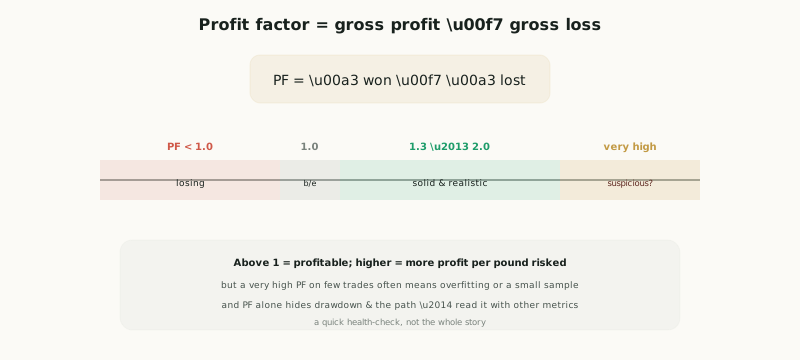
A: The profit factor is a performance metric equal to gross profit divided by gross loss — the total money made by winning trades divided by the total money lost on losing trades. A profit factor above 1 means the strategy made more than it lost (it's profitable); below 1 means it lost more than it made; exactly 1 is break-even. It's a compact way to express how efficiently a strategy turns risk into reward.
Q: What is a good profit factor?
A: Any value above 1 is profitable, and broadly, a profit factor around 1.3 to 2.0 is often considered solid and realistic for a tradeable strategy. Higher is better in principle — more profit per pound lost — but be cautious: an extremely high profit factor (say 3, 4 or more), especially over few trades, frequently signals overfitting or a too-small sample rather than a genuinely superb system. Realistic, durable strategies usually have moderate profit factors.
Q: What are the limitations of the profit factor?
A: It's a single summary number, so it hides a lot. It doesn't show drawdown or the path of returns — a strategy can have a good profit factor yet a brutal equity curve. It's very sensitive to sample size and to a few outlier trades. And it says nothing about how many trades, the win rate, or risk per trade. Use the profit factor as a quick health-check alongside other metrics like expectancy, win rate, drawdown and the equity curve, not on its own.
What it is
The profit factor is a performance metric equal to gross profit divided by gross loss — the total money made by winning trades divided by the total money lost on losing trades (both as positive figures). So if your winners made £6,000 in total and your losers lost £4,000 in total, your profit factor is 6,000 ÷ 4,000 = 1.5. The interpretation is intuitive: a profit factor above 1 means the strategy made more than it lost (it's profitable); below 1 means it lost more than it made (unprofitable); exactly 1 is break-even. It's a compact way to express how efficiently a strategy turns risk into reward — a single ratio capturing the balance between everything that went right and everything that went wrong. Its appeal is that it's easy to compute and easy to grasp: one number that tells you, at a glance, whether and how strongly a system is net profitable.
The profit factor at a glance
How to read it, and its limits
So what's a good profit factor? Any value above 1 is profitable, and broadly, a profit factor around 1.3 to 2.0 is often considered solid and realistic for a genuinely tradeable strategy. Higher is better in principle — a higher profit factor means more profit per pound lost, a more efficient edge — but here's the crucial counter-intuitive point: an extremely high profit factor (say 3, 4 or more), especially over few trades, frequently signals overfitting or a too-small sample rather than a genuinely superb system. Real, durable edges in liquid markets are modest; a backtest boasting a profit factor of 5 has usually been curve-fitted to historical noise, or is measured over so few trades that luck dominates — and it will collapse live. So a moderate profit factor on a large, robust sample is far more trustworthy than a spectacular one on a handful of trades. Counter-intuitively, when you see a too-good-to-be-true profit factor, the right reaction is suspicion, not excitement.
The profit factor's limitations are as important as its uses, because it's a single summary number that hides a lot. Most importantly, it doesn't show drawdown or the path of returns: a strategy can have a perfectly good profit factor yet a brutal equity curve — deep drawdowns, long losing streaks, a stomach-churning ride — because the ratio says nothing about when or how the wins and losses arrived (two strategies with identical profit factors can have wildly different drawdowns). It's also very sensitive to sample size and to a few outlier trades (one huge winner can flatter the figure). And it says nothing on its own about how many trades there were, the win rate, or the risk per trade. For all these reasons, the profit factor should be used as a quick health-check alongside other metrics — expectancy, win rate, maximum drawdown, the equity curve, the Sharpe ratio, number of trades — never on its own. Think of it as a useful first glance at whether a system makes money and how efficiently, which then prompts the deeper questions the single number can't answer. The honest framing: the profit factor is gross profit divided by gross loss — above 1 is profitable, below 1 is losing, and roughly 1.3–2.0 is solid and realistic. Higher is better in principle, but a very high value (especially on few trades) usually signals overfitting or a small sample, so treat too-good numbers with suspicion. It hides drawdown, the path, sample size and risk per trade, so use it as a quick health-check alongside expectancy, win rate, drawdown and the equity curve — never alone.
How it relates to win rate and reward-to-risk
The profit factor isn't a standalone number plucked from nowhere — it's determined by your win rate and your average reward-to-risk. Roughly, profit factor ≈ (win rate × average win) ÷ (loss rate × average loss). The illuminating consequence is that very different trading styles can share the same profit factor. A high-win-rate, small-reward system (wins 70% of the time but wins less than it loses per trade) and a low-win-rate, high-reward system (wins only 35% but wins far more than it loses) can both land on a profit factor of, say, 1.5 — identical aggregate efficiency, wildly different experiences (the first feels like frequent small wins with occasional larger losses; the second, frequent small losses punctuated by big wins and long losing streaks). The profit factor doesn't care how you got there, only the ratio of total winnings to total losses.
This connects the profit factor to its cousin, expectancy, and clarifies what each is for. Expectancy is the average profit per trade (in currency or R-multiples) — it tells you how much you make each time you trade, so it scales with frequency (a system with tiny expectancy but huge trade count can out-earn a high-expectancy, low-frequency one). The profit factor is an aggregate ratio — it tells you how efficiently the system converts losses into wins overall, regardless of how many trades or how big the account. They answer different questions: "how much per trade?" (expectancy) versus "how much won per pound lost?" (profit factor) — which is why you read them together. The practical value of the profit factor here is as a style-neutral comparator: because it nets everything to one ratio, you can use it to compare systems of completely different styles on a common footing (the 70%-win scalper and the 35%-win trend-follower), seeing at a glance which is more efficient — while remembering that equal profit factors can hide very unequal drawdowns and very different psychological demands, so the comparison must always be supplemented with the drawdown and equity-curve picture. The honest reminder: the profit factor is determined by win rate and reward-to-risk (PF ≈ (WR × avg win) ÷ (loss rate × avg loss)), so very different styles — high-win/small-reward vs low-win/high-reward — can share the same PF despite wildly different experiences; it differs from expectancy (profit per trade, which scales with frequency) by being a style-neutral aggregate ratio, useful for comparing different systems on a common footing — as long as you remember equal PFs can hide very unequal drawdowns.
Used wisely, the profit factor is the kind of metric you can glance at in a second and learn a lot from — a fast first filter that tells you whether a system is even worth a closer look. Just never let that convenient single number become the last word: the strategies that survive are judged on the whole picture, not one flattering ratio.
The profit factor is gross profit ÷ gross loss — above 1 is profitable, below 1 losing, 1 break-even, and roughly 1.3–2.0 is solid and realistic for a tradeable edge. Higher is better in principle, but a very high value (especially on few trades) usually signals overfitting or a small sample — so treat too-good numbers with suspicion, and trust a moderate PF on a large sample over a spectacular one on a handful of trades. It hides drawdown, the path, sample size and risk per trade (a good PF can still have a brutal equity curve), so use it as a quick health-check alongside expectancy, win rate, drawdown and the Sharpe ratio — never alone.