
Every trader hits losing streaks — even the good ones, even with a genuinely profitable system. Far from a sign something is broken, runs of consecutive losses are a statistical certainty, and the lower your win rate, the longer they get. Understanding and planning for them is what keeps a sound strategy (and a sound mind) intact through the runs that make most traders panic, deviate, or quit at exactly the wrong moment. This guide explains losing streaks: why they're inevitable, how long they run, and how to survive them.
It's a direct application of variance and luck, ties to the risk of ruin and the math of drawdowns, and demands the discipline of handling losses well.
Key takeaways
Q: Are losing streaks normal even with a good strategy?
A: Completely normal — and statistically inevitable. Any strategy that loses on some trades will, over enough trades, produce runs of consecutive losses purely from the randomness of which trades win or lose. A profitable system with a 55% win rate still loses 45% of the time, and those losses will sometimes cluster into long streaks. A losing streak is therefore usually a sign of normal variance, not a broken strategy — though it always feels like the latter.
Q: How long can a losing streak get?
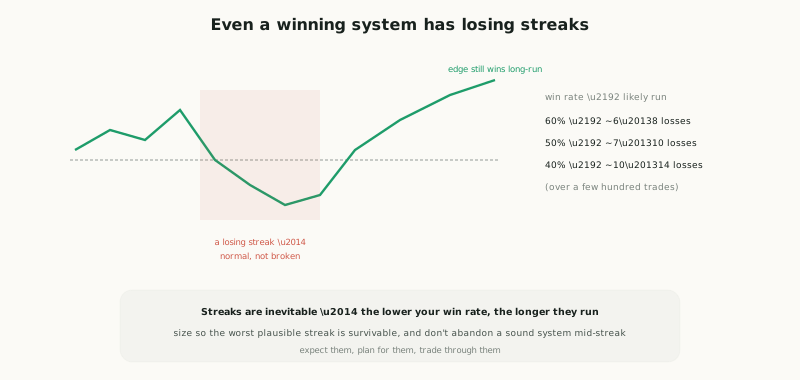
A: Longer than most traders expect, and it depends heavily on your win rate. The lower the win rate, the longer the streaks: over a few hundred trades, a 60% win-rate system can still see runs of 6–8 losses, a 50% system 7–10, and a 40% system (common for high reward-to-risk strategies) can see 10–14 or more consecutive losses. These aren't signs of failure — they're the expected behaviour of those win rates over a large sample.
Q: How do you handle a losing streak?
A: Plan for it before it happens: size your positions so that even your worst plausible streak is survivable and doesn't threaten your account or your composure (this is the heart of risk management). During a streak, the key is not to deviate — don't abandon a sound, validated system mid-streak, don't increase size to 'win it back,' and don't let frustration drive revenge trading. Expect streaks, keep risk small, trust your validated edge, and trade through them calmly.
Why they're inevitable
Losing streaks are completely normal — and statistically inevitable. Any strategy that loses on some trades will, over enough trades, produce runs of consecutive losses purely from the randomness of which trades win or lose. This is just variance at work: a profitable system with a 55% win rate still loses 45% of the time, and over hundreds of trades those losses will sometimes cluster into long streaks, exactly as a fair coin will sometimes throw several tails in a row. There's nothing mysterious about it — it's the unavoidable arithmetic of any process that isn't 100% winners (which no real strategy is). The vital reframe is that a losing streak is usually a sign of normal variance, not a broken strategy — even though, in the moment, it always feels like the latter. This gap between statistical reality ("this is expected") and emotional experience ("everything's falling apart") is where traders do the most damage to themselves, abandoning good systems and blowing up accounts over what is, in truth, routine.
How long they run, and how to handle them
Losing streaks run longer than most traders expect, and the length depends heavily on your win rate — the lower the win rate, the longer the streaks:
| Win rate | Typical longest losing run (over a few hundred trades) |
|---|---|
| 60% | around 6–8 consecutive losses |
| 50% | around 7–10 consecutive losses |
| 40% | around 10–14+ consecutive losses |
| 33% | even longer — long runs are routine |
These figures (rough, but realistic) surprise people: a perfectly good 60% win-rate system can still hand you 6–8 losses in a row, and a 40% win-rate system — common for high reward-to-risk strategies that win big but seldom (see risk-reward and expectancy) — can easily produce 10–14 or more consecutive losses while remaining highly profitable overall. Crucially, these aren't signs of failure — they're the expected behaviour of those win rates over a large sample. A trader who doesn't know this sees a 40% system hit ten straight losses and concludes it's "stopped working," when in fact it's behaving exactly as it should. (Note the link to expectancy: a low-win-rate system is profitable because its winners are large, but it pays for that with long losing runs — you can't have the high reward-to-risk without the streaks, so accepting them is the price of that style.)
So how do you handle a losing streak? The answer is mostly about what you do before it happens. Plan for it: size your positions so that even your worst plausible streak is survivable — it doesn't threaten your account or your composure. This is the heart of risk management and of the 1% rule: if you risk a small fraction per trade, even 12 losses in a row is a manageable drawdown you can recover from, whereas if you risk too much, a normal streak can ruin you (see risk of ruin). The whole point of conservative sizing is precisely to survive the inevitable streaks. Then, during a streak, the key is not to deviate: don't abandon a sound, validated system mid-streak (the worst time to quit a good strategy is during its normal, expected losing run — you'd lock in the losses and miss the recovery); don't increase size to "win it back" (turning a survivable streak into a catastrophic one — the martingale trap); and don't let frustration drive revenge trading. The disciplined mindset, hard as it is: expect streaks, keep risk small, trust your validated edge, and trade through them calmly — treating each loss as a predictable cost of doing business rather than a verdict on your worth or your system. The traders who endure are not those who avoid losing streaks (impossible) but those who've sized and prepared for them so thoroughly that a streak is an inconvenience, not an emergency. The honest framing: losing streaks are normal and statistically inevitable — any system that ever loses will, over enough trades, string losses together from pure variance, so a streak usually means normal luck, not a broken strategy (though it never feels that way). The lower the win rate, the longer the runs (a 60% system can see 6–8 losses, a 40% system 10–14+), and these are expected, not failure. Handle them by planning ahead: size so the worst plausible streak is survivable, and during one, don't deviate — don't abandon a sound system, don't increase size to win it back, don't revenge-trade. Expect them, keep risk small, trust a validated edge, and trade through calmly.
The simple math, and the gambler's fallacy
The inevitability of streaks falls straight out of basic probability. The chance of a specific run of N losses in a row is roughly the loss rate raised to the power N: for a 50% win-rate system, the chance of 5 losses in a row at any given starting point is 0.5⁵ ≈ 3% — which sounds small, but over hundreds of trades you get hundreds of chances for such a run to start, so a 5-loss streak becomes almost certain to occur, and longer ones become likely too. That's the whole mechanism: each streak is individually unlikely, but with enough trades, long streaks are practically guaranteed to appear somewhere. A trader running a 40% win-rate system over a year of frequent trading should expect, not fear, double-digit losing runs — the math says they're coming.
This leads to a crucial psychological trap to avoid: the gambler's fallacy — the false belief that after a string of losses, a win is "due." It isn't. If your trades are independent (each setup stands on its own, as it should), the market has no memory of your recent losses, and your next trade has the same probability as always — a losing streak does not make a win more likely on the next trade. This matters because the gambler's fallacy tempts traders to increase size after losses ("I'm due, so I'll bet bigger to recoup") — the martingale path to ruin — when the correct response is the opposite: keep size constant and small, because the streak could continue. The right mental model is calm acceptance: a losing streak is the edge's normal variance playing out, the edge is still there (it reasserts over the large sample, not on any particular next trade), and your job is simply to survive the run with your sizing and keep executing until the law of large numbers does its work. Prepare for streaks in advance by knowing they're coming, sizing for the worst plausible one, and rehearsing the discipline to not deviate — so that when the inevitable run arrives, it's a scenario you've already planned for, not a shock that breaks you. The honest reminder: the math is simple — the chance of N losses in a row is the loss rate to the power N, and over hundreds of trades long streaks become almost certain to appear, so expect double-digit runs from low-win-rate systems; and avoid the gambler's fallacy — with independent trades a streak does NOT make a win "due," so never increase size to recoup (the martingale trap); keep size constant and small, accept the streak as normal variance, and keep executing until the large sample reasserts the edge.
Losing streaks are normal and statistically inevitable — any system that ever loses will, over enough trades, string losses together from pure variance, so a streak usually means normal luck, not a broken strategy (even though it never feels that way). The lower the win rate, the longer the runs: a 60% system can see 6–8 losses, a 40% system 10–14+ — and these are expected, not failure (the price of a high reward-to-risk style). Handle them by planning ahead: size so the worst plausible streak is survivable (the point of the 1% rule and beating risk of ruin). During one, don't deviate — don't abandon a sound system, don't increase size to win it back, don't revenge-trade. Expect them, keep risk small, trust a validated edge, and trade through calmly.