The SuperTrend indicator draws a single line that hugs price from below in an uptrend and flips above it in a downtrend — a clean, instantly-readable picture of which way the market is leaning. Built on the Average True Range, it has become one of the most popular trend-following overlays on modern charting platforms, prized for its simplicity and clarity. It also carries one very familiar Achilles' heel. This guide explains the SuperTrend indicator: how it's built, how it signals, and where it shines and struggles.
It's an ATR-based trailing tool in the same family as the Parabolic SAR, and is often used as a dynamic trailing stop reference.
Key takeaways
Q: What is the SuperTrend indicator?
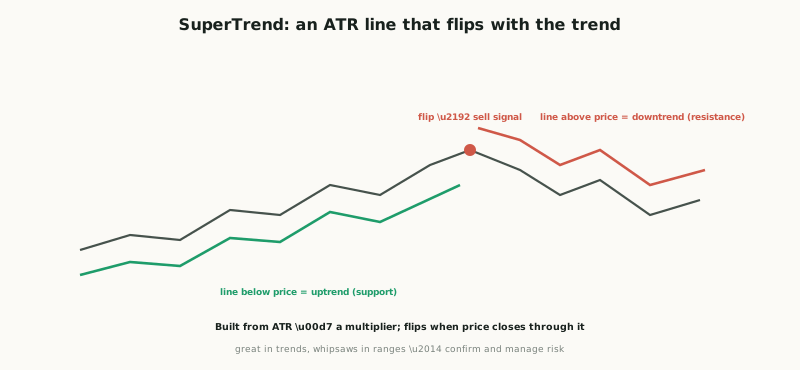
A: SuperTrend is a trend-following overlay that plots a single line on the price chart, calculated from the Average True Range (ATR) and a multiplier. The line sits below price during an uptrend (acting as support) and above price during a downtrend (acting as resistance), changing colour and 'flipping' sides when price closes through it. It gives a clear, visual read on trend direction and basic buy/sell signals.
Q: How does SuperTrend generate signals?
A: When price closes above the SuperTrend line, it flips to sit below price and turns bullish — a buy/long signal; when price closes below the line, it flips above price and turns bearish — a sell/short signal. The flip points mark trend changes. Because it's built on ATR, the line's distance from price adapts to volatility, sitting further away in volatile conditions and closer in calm ones.
Q: Is the SuperTrend indicator reliable?
A: It's effective in trending markets, where it keeps you on the right side of a sustained move and provides a sensible trailing reference. But like all trend-following tools, it whipsaws badly in ranging or choppy markets, flipping back and forth and generating false signals. It's also lagging. It works best with a trend filter, confirmation, and risk management, and is not a standalone system.
How it's built and signals
SuperTrend is calculated from the ATR and a multiplier, producing a line offset from price by a volatility-scaled distance.
SuperTrend at a glance
The mechanics are intuitive. The line is placed a distance of ATR × multiplier from price (a common default being a 10-period ATR with a multiplier of 3). During an uptrend, the SuperTrend line sits below price, turning bullish (green) and acting as a support level that trails the rising price. When price closes below that line, the indicator flips: the line jumps above price, turns bearish (red) and acts as resistance — a sell/short signal. Conversely, when price closes above the line in a downtrend, it flips to sit below price and turns bullish — a buy/long signal. So the flip points mark trend changes, and the line's colour and position give an at-a-glance read of the current trend. Because the offset is ATR-based, the line adapts to volatility — sitting further from price in volatile conditions (giving the trend more room) and closer in calm ones — which is a sensible, market-aware feature. Many traders also use the line as a dynamic trailing stop or trend filter, exiting or flipping when price closes through it.
Where it shines and struggles
SuperTrend's appeal is real: in trending markets it works well, keeping you on the right side of a sustained move, visually confirming the trend, and providing a sensible volatility-adjusted trailing reference that lets winners run while defining where the trend would be considered broken. For trend-followers, that combination of clarity and an adaptive trailing line is genuinely useful, and it's a large part of why the indicator is so widely used.
But it carries the same Achilles' heel as every trend-following tool: it whipsaws badly in ranging or choppy markets. When price moves sideways without a clear trend, it repeatedly crosses the line, causing the SuperTrend to flip back and forth — generating a string of false signals that buy near the top of the range and sell near the bottom, exactly wrong, racking up small losses (the universal trend-follower's curse, shared with the Parabolic SAR and moving-average systems). It's also lagging — the flip confirms a trend change after price has already moved through the line — and, like all indicators, it's a derived tool that knows nothing about why price is moving. So the sensible use mirrors the advice for all trend tools: deploy SuperTrend where it excels (clear trends) and protect against where it fails (ranges), ideally with a trend filter — only taking SuperTrend signals when a separate measure (a higher-timeframe trend, or ADX confirming trend strength) says the market is actually trending, and standing aside when it's ranging. Combine it with market structure and confirmation rather than trading every flip blindly, treat the whipsaws in ranges as an inherent cost managed by sizing and a trend filter (not eliminable), avoid over-tuning the ATR period and multiplier to past data, and always pair it with disciplined risk management. Used as a clean trend-following aid and trailing reference — not a standalone system — SuperTrend is a deservedly popular tool. The honest framing: SuperTrend is an ATR-based trend overlay (commonly ATR 10 × multiplier 3) plotting one line that sits below price in uptrends (support, green) and above in downtrends (resistance, red), flipping — and signalling — when price closes through it; the ATR basis makes it adapt to volatility, and it doubles as a trailing stop. It shines in trends, keeping you on the right side and trailing winners, but whipsaws badly in ranges (false flips buying tops and selling bottoms) and lags. Use a trend filter (e.g. ADX or higher-timeframe trend), confirm with structure, don't over-optimise the settings, and manage risk — it's an aid, not a system.
Settings, combinations and pitfalls
SuperTrend has two key parameters — the ATR period and the multiplier — and they directly control its behaviour. A common default is a 10-period ATR with a multiplier of 3. A smaller multiplier (e.g. 1.5–2) places the line closer to price, producing more frequent flips/signals — more responsive, catching trend changes earlier, but generating more whipsaws. A larger multiplier (e.g. 3–4) places the line further away, giving fewer but more reliable flips — smoother, fewer false signals, but slower to react. This is the universal trend-tool trade-off between responsiveness and reliability, and there's no perfect setting; the worst mistake is over-optimising the parameters to fit past data (curve-fitting), since settings tuned to history characteristically fail going forward. Pick robust values suited to your timeframe and accept the inherent trade-off rather than chasing a "perfect" backtest.
SuperTrend works far better combined with other tools than alone. The most important pairing is a trend filter to address its core weakness: use a separate measure — ADX for trend strength, a higher-timeframe trend for direction, or a long moving average — and only take SuperTrend signals when that filter confirms a genuine trend, standing aside in flat, ranging conditions where the indicator whipsaws. Multi-timeframe use is powerful: align with a higher-timeframe SuperTrend for direction and use a lower-timeframe one for entries. SuperTrend also makes an excellent trailing stop: in a long trade, trail your stop to the SuperTrend line (below price), exiting when price closes through it — a volatility-adjusted trail that lets winners run while defining the break. A couple of pitfalls to note: signals are based on the close through the line, so don't act on intrabar flirtations that may not hold by the close (a form of repaint risk on the live bar), and never treat a flip as a high-probability signal in isolation — in a range it's likely a false flip. The disciplined approach: robust (un-over-fitted) settings, a trend filter to avoid range chop, confirmation from structure, optional multi-timeframe alignment, use as a trailing stop, and always strict risk management. The honest reminder: the ATR period and multiplier trade responsiveness against reliability (smaller multiplier = more signals and whipsaws, larger = fewer and steadier) — don't over-optimise them; pair SuperTrend with a trend filter (ADX/higher timeframe) to dodge range whipsaws, act only on closes through the line, use it as a volatility-adjusted trailing stop, and combine with structure and risk management.
It's worth being clear-eyed about why SuperTrend feels so satisfying yet disappoints traders who lean on it alone: its clarity is seductive. A single colour-coded line that confidently says "uptrend" or "downtrend" gives an impression of certainty the market simply doesn't offer, and in a clean trend it looks almost magical — which tempts beginners to trade every flip as gospel. Then a few weeks of ranging chop hand them a dozen whipsaw losses, and the magic evaporates. The tool didn't fail; it was used outside its element. Internalise that SuperTrend is a trend tool that is only as good as your ability to tell when a market is actually trending — supply that judgement (via a filter and context) and it's excellent; omit it and the indicator's confident line will lead you straight into the range chop it can't handle.
The SuperTrend is an ATR-based trend overlay (common settings: ATR 10, multiplier 3) plotting one line that sits below price in uptrends (support, green) and above price in downtrends (resistance, red), flipping — and giving a buy/sell signal — when price closes through it. The ATR basis makes the line adapt to volatility, and it doubles as a dynamic trailing stop. It shines in trends (keeps you on the right side, trails winners) but whipsaws badly in ranges (false flips that buy tops and sell bottoms) and lags. Use a trend filter (ADX or higher-timeframe trend) to avoid range chop, confirm with structure, don't over-optimise the period/multiplier, and manage risk — it's a trend-following aid, not a standalone system.