Forex closes for the weekend, but the world doesn't. News breaking while the market is shut can mean it reopens on Sunday at a different price than where it closed on Friday — a "gap." For anyone holding positions over the weekend, that gap is a real and specific risk, because it's the one time your stop-loss can't help you. This guide explains the weekend gap: what it is, why it's risky, the gap-fill tendency, and how to manage it.
It's the weekend-specific form of gap risk, a feature of the forex trading week's structure, and it's why guaranteed stops exist.
Key takeaways
Q: What is a weekend gap in forex?
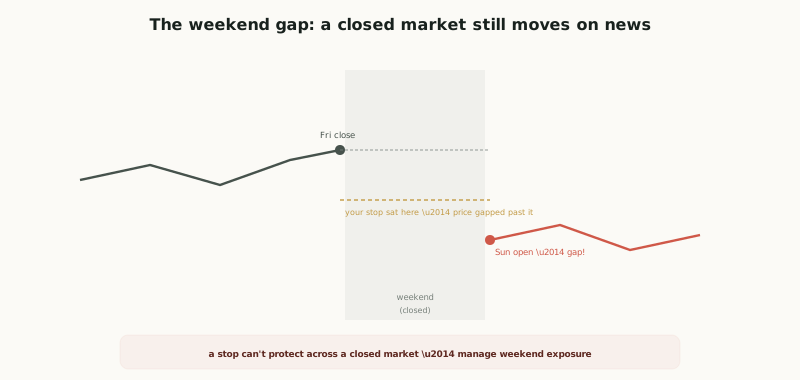
A: A weekend gap is when the forex market opens on Sunday (around 5pm New York time) at a noticeably different price from where it closed on Friday. Because the market is shut over the weekend but global events keep happening, news — geopolitics, elections, surprise announcements — can shift the 'fair' price while no trading is possible, so when the market reopens it jumps straight to a new level, leaving a visible gap on the chart.
Q: Why are weekend gaps risky?
A: Because your stop-loss can't protect you across a closed market. If you hold a position over the weekend and the market gaps against you, price can jump straight past your stop and fill at a much worse level than intended — a loss larger than you'd planned for. Leverage magnifies this, so a large weekend gap on a sizeable position can be very damaging. The risk applies only to positions held through the weekend closure.
Q: How do you manage weekend gap risk?
A: The simplest approach is to reduce or close positions before the weekend, so you have no exposure to a gap. If you do hold over the weekend, size positions so that even a sizeable gap can't be catastrophic, and be aware that ordinary stops won't cap the gap. Some brokers offer guaranteed stop-loss orders (for a fee) that do hold across gaps. Many traders simply avoid carrying significant risk into a weekend when major news is expected.
What it is
A weekend gap is when the forex market opens on Sunday (around 5pm New York time, as the new trading week begins) at a noticeably different price from where it closed on Friday (around 5pm NY). The cause is simple: the market is shut over the weekend, but global events keep happening — geopolitical developments, elections, referendums, surprise announcements, central-bank news — and these can shift the market's view of a currency's "fair" price while no trading is possible. With no way for prices to adjust gradually (the market is closed), when it reopens it simply jumps straight to the new level that reflects the weekend's news, leaving a visible gap on the chart between Friday's close and Sunday's open. Most weekends produce small gaps (or none), since quiet weekends give little new information; but a weekend with major news can produce a large gap — occasionally a very large one (a surprise election result or geopolitical shock can move a currency substantially before anyone can trade). The gap is, in essence, the market "catching up" all at once to everything that happened while it was closed.
Why it's risky, and how to manage it
The weekend gap is risky for one decisive reason: your stop-loss can't protect you across a closed market. A stop-loss works by triggering when price trades through your level — but over the weekend, no trading happens, so if the market gaps against you, price jumps straight past your stop without ever trading at it, and your position is closed at the first available price on Sunday — which can be far worse than your intended stop level. You planned to lose, say, 30 pips if wrong; a weekend gap can hand you a 100-pip loss because price leapt past your stop while the market was shut. This is fundamentally different from normal trading, where a stop (barring fast-market slippage) caps your loss — over the weekend, that protection is simply gone. And leverage magnifies it: a large weekend gap on a sizeable, leveraged position can be very damaging, occasionally enough to threaten an account. The crucial scoping point: this risk applies only to positions held through the weekend closure — if you're flat over the weekend (no open positions), a weekend gap is just an interesting chart feature that costs you nothing. So the entire risk is a function of whether you carry exposure into the weekend, which means it's largely within your control.
Two further points complete the picture. First, the gap-fill tendency: many — though by no means all — weekend gaps tend to "fill" (price drifts back toward Friday's closing level) in the hours or days after the open, as the initial reaction settles; some traders even trade this tendency (fading the gap, betting it fills). But this is only a tendency, not a rule — gaps driven by genuine, lasting news (a real shift in fundamentals) may not fill at all and instead mark the start of a new move, so betting on a gap fill is itself a risky fade that needs caution. Don't rely on a gap filling to rescue a bad weekend position. Second, how to manage the risk: the simplest, most reliable approach is to reduce or close positions before the weekend, so you carry no exposure to a gap (many traders flatten or trim risk into the Friday close as a matter of routine — see the trading week). If you do hold over the weekend, size positions so that even a sizeable gap can't be catastrophic (assume a gap can blow past your stop, and keep the position small enough that this is survivable), and be aware that ordinary stops won't cap the gap. Some brokers offer guaranteed stop-loss orders (for a fee) that do hold across gaps — the one tool that genuinely caps weekend gap risk — worth considering if you must hold over a risky weekend. And many traders simply avoid carrying significant risk into a weekend when major news is expected (an election, a referendum, a critical summit), stepping aside rather than gambling on the gap. The overarching principle: respect that the weekend is the one period your normal protections lapse, and manage your weekend exposure deliberately rather than drifting into it. The honest framing: a weekend gap is the market opening Sunday at a different price from Friday's close, because it's shut over the weekend while global news keeps happening, so it jumps to a new level on reopening. It's risky because a stop-loss can't protect you across the closed market — price can gap straight past your stop for a loss bigger than planned, magnified by leverage — but only for positions held through the weekend. Manage it by reducing or closing positions before the weekend, sizing so a gap can't be catastrophic, considering guaranteed stops, and avoiding big weekend risk around major news; gaps often (but not always) fill, so don't rely on it.
Beyond the weekend: other gap moments
The weekend gap is the most common, but it's worth seeing it as one instance of a broader truth: even a "24-hour" market has discontinuities. Forex gaps far less than the stock market — stocks close every night and gap at each morning's open, whereas forex trades continuously five days a week, so mid-week overnight gaps are rare (price moves smoothly through the session handovers). But forex is not gap-free. Beyond the weekend, gaps or gap-like jumps can occur around major scheduled events released when liquidity is thin, during public holidays (when key centres are closed and liquidity drops), and in genuinely illiquid moments where price can leap rather than glide. The Sunday open itself is the prime example, but the principle generalises: wherever the market is thin or closed, price can jump.
The practical takeaway extends the weekend lesson to those moments. Recognise that holidays and thin sessions carry elevated gap-and-spike risk (a major US holiday, for instance, drains liquidity even on a weekday), and that scheduled high-impact events can produce near-instant jumps that behave like mini-gaps (see news and event risk). The defence is the same as for the weekend: manage your exposure around these discontinuities — reduce size or stand aside when you know liquidity will be thin or a shock is possible, and don't assume a stop will protect you in a fast, thin market. The broader principle worth internalising is that "continuous" markets still have holes in them — moments when the smooth tape breaks — and a thoughtful trader maps those moments (weekends, holidays, major events) and trades around them deliberately. The honest reminder: the weekend gap is one case of a broader truth — even a 24/5 market has discontinuities; forex gaps far less than stocks (no nightly close mid-week) but isn't gap-free, with elevated jump risk around holidays, thin sessions and major scheduled events, so manage exposure around those moments just as you do the weekend, never assuming a stop protects you in a thin, fast market.
A weekend gap is the market opening Sunday at a different price from Friday's close — it's shut over the weekend while global news keeps happening, so it jumps to a new level on reopening (small most weekends, large around major news). It's risky because a stop-loss can't protect you across a closed market: price can gap straight past your stop for a loss bigger than planned, magnified by leverage — but only for positions held through the weekend (flat = no risk). Manage it: reduce or close positions before the weekend, size so a gap can't be catastrophic, consider guaranteed stops (the one tool that holds across gaps), and avoid big weekend risk around major news. Gaps often but not always fill, so never rely on a fill to rescue a bad position.