
Fading is the contrarian's craft: betting against a move just as everyone else is piling in. Done at genuine extremes with tight risk, it can be lucrative; done blindly against a strong trend, it's one of the fastest ways to get run over in all of trading. It's the mirror image of momentum trading — where momentum buys strength, fading sells it — and it demands far more caution. This guide explains fading strategies: what they are, why they're so risky, and the rules that keep the approach survivable.
It's a form of counter-trend trading and mean reversion, and at its best takes the shape of fading a failed breakout (the swing failure / trap play).
Key takeaways
Q: What is a fading strategy?
A: Fading means trading against the prevailing move — selling into a sharp rally or buying into a sharp sell-off, betting that the move is overdone and will reverse. Fading strategies target extremes: fading a failed breakout, a news spike, an over-extended move, or a gap, in the expectation of a snap-back. It's a counter-trend, mean-reversion-style approach, the opposite of momentum's 'buy strength.'
Q: Why is fading so risky?
A: Because you're trading against momentum, and a strong move can keep going far longer than you expect — 'the trend is your friend' cuts directly against the fader. Fade a move that's actually the start of a powerful trend and you're caught on the wrong side of accelerating losses, the classic 'picking up pennies in front of a steamroller' danger. Fading needs real extremes, confirmation, and tight stops; without them, it's a fast route to large losses.
Q: How do you fade more safely?
A: Only fade at genuine extremes (not just any move up), wait for confirmation that the move is actually failing or reversing (rather than fading into ongoing strength), use tight, well-defined stops just beyond the extreme so a continued move costs little, favour range-bound or clearly over-extended conditions over strong trends, and keep position sizes small given the counter-trend risk. Never fade a strong trend blindly — the failed-breakout fade is the higher-quality version.
What it is
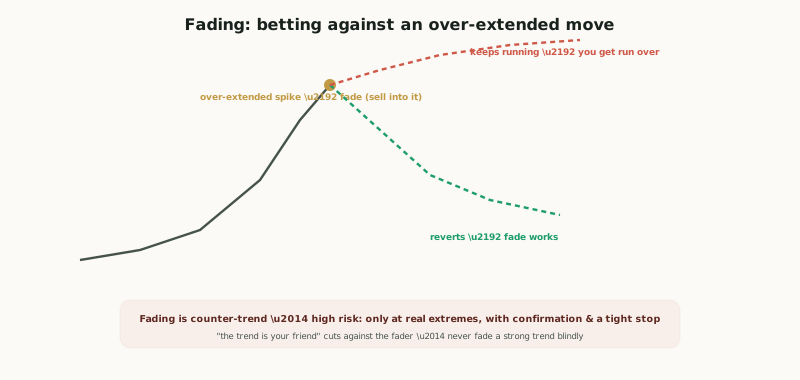
Fading means trading against the prevailing move — selling into a sharp rally or buying into a sharp sell-off, betting that the move is overdone and will reverse. Rather than joining strength (as momentum does), the fader bets on exhaustion and snap-back. Fading strategies target extremes: fading a failed breakout (trading the reversal once a breakout fails — see bull and bear traps), fading a news spike (betting an emotional over-reaction to a headline reverts), fading an over-extended move (a market that has run too far, too fast), or fading a gap (betting a gap fills). In every case the logic is the same contrarian, mean-reversion bet: the crowd has pushed price to an unsustainable extreme, and you profit from the reversion. It is, quite explicitly, the opposite of momentum's "buy strength" — fading is "sell strength" (or buy weakness) on the premise that the strength is spent.
Why it's risky, and the rules
Fading is high-risk for one fundamental reason: you're trading against momentum, and a strong move can keep going far longer than you expect. "The trend is your friend" cuts directly against the fader — every principle that says "trade with the trend" is, by definition, a warning to the person fading it. The catastrophic case: you fade a move that turns out to be the start of a powerful new trend, so instead of reverting it accelerates, and you're caught on the wrong side of compounding losses with no reversion coming. This is the classic "picking up pennies in front of a steamroller" danger — fading often produces a high win rate of small gains (markets do revert most of the time), lulling the fader into confidence, until the one move that doesn't revert (a real trend or a violent continuation) delivers a loss that wipes out many winners at once. Worse, fading appeals to the ego (the thrill of "calling the top") and to stubbornness (refusing to accept a move is real), so undisciplined faders tend to add to losing fades and average down into a trend that keeps running — the exact behaviour that blows up accounts. Without genuine extremes, confirmation and tight stops, fading is one of the surest ways to turn a string of small wins into a single catastrophic loss. Never fade a strong trend blindly.
So how do you fade survivably? The rules all aim at containing the counter-trend risk. Only fade at genuine extremes — not just any move up, but a move that is demonstrably over-extended (statistically stretched, at a major level, wildly overbought/oversold) where reversion is genuinely likely; fading ordinary strength is just betting against the trend. Wait for confirmation that the move is actually failing or reversing — rather than fading into ongoing strength (catching a falling knife / shorting a rocket), wait for evidence the move is done (a failed breakout that's snapped back, a reversal candle, momentum divergence, a clear rejection); the failed-breakout fade is the higher-quality version precisely because the failure is the confirmation. Use tight, well-defined stops just beyond the extreme, so that if the move continues (the steamroller keeps rolling) you're stopped out cheaply — this single rule is what separates survivable fading from ruin, since it caps the "didn't revert" case before it compounds. Favour the right conditions: fading suits range-bound markets (where reversion at the range edges is the norm — see range trading) and clearly over-extended spikes, and is dangerous in strong trending markets. Keep size small given the counter-trend risk, and never average down into a losing fade. Above all, internalise the asymmetry: because the rare non-reversion can be huge, fading only works if your stops genuinely cap that tail — a fader who respects stops and extremes can have an edge; one who fades strong trends, skips stops, and adds to losers is simply waiting to be run over. The honest framing: fading is betting against a move — selling sharp rallies or buying sharp sell-offs at an extreme, expecting reversion (the mirror of momentum, a counter-trend/mean-reversion play). It's high-risk because strong moves persist and "the trend is your friend" works against you — fade the start of a real trend and small wins turn into one catastrophic loss ("pennies in front of a steamroller"). Fade survivably by only fading genuine extremes, waiting for confirmation the move is failing (the failed-breakout fade is best), using tight stops just beyond the extreme, favouring ranges over trends, keeping size small, and never averaging down or fading a strong trend blindly.
Where fading actually has an edge
Fading isn't uniformly reckless — there are specific situations where it carries a genuine, explicable edge, and confining your fading to these is what separates a contrarian with a method from a stubborn trend-fighter. The highest-quality fade setups: range-edge reversion — in an established range, fading the touches of the range boundaries (sell the top, buy the bottom) is one of the soundest fades, because the whole premise of a range is that the edges hold; failed breakouts / swing failures — fading a breakout that has demonstrably failed and snapped back (the swing failure / trap play), where the failure itself is your confirmation and the trapped traders fuel your reversal; news over-reactions — fading an emotional, exaggerated spike to a headline once it shows signs of reverting (though this is treacherous given news volatility); gap fills — fading a gap on the well-documented tendency of many gaps to fill; and statistical extremes/exhaustion — fading a move that is genuinely, measurably over-extended (far from a mean, climactic volume/velocity, exhaustion signals) at a major level.
The reason these work, when they do, is that markets over-react: the crowd's fear and greed push price past fair value at extremes, and the snap-back is the correction of that over-shoot (the behavioural basis of mean reversion), while at range edges and failed breakouts the liquidity and trapped positioning mechanically favour reversal. But notice the common thread in every safe fade: a genuine extreme or a confirmed failure, at a meaningful level, with confirmation, and — critically — never against a strong, healthy trend with no sign of exhaustion. That last point is the line between edge and ruin: fading a range or a failed breakout is trading with the local structure; fading a strong trend just because it "feels too far" is fighting the dominant force and waiting for the steamroller. So the disciplined fader is really a specialist in exhaustion and failure, not a generic trend-contrarian — they wait for the market to show that a move is spent (a failed break, a rejection at a level, a clear reversal signal) before betting against it, and they let the tight stop handle the times they're wrong. Combined with small size and ironclad risk management, that focused, evidence-led approach is what gives fading a real place in a trader's toolkit. The honest reminder: fading has a genuine edge in specific spots — range-edge reversion, failed breakouts/swing failures, news over-reactions, gap fills, and confirmed statistical exhaustion at major levels — because markets over-react and trapped positioning favours reversal; the common thread is a real extreme or confirmed failure at a meaningful level with confirmation, never fading a strong healthy trend, so be a specialist in exhaustion and failure (not a generic trend-fighter), backed by tight stops and small size.
Fading is betting against a move — selling sharp rallies or buying sharp sell-offs at an extreme, expecting reversion (the mirror of momentum; a counter-trend/mean-reversion play). It's high-risk because strong moves persist and "the trend is your friend" works against you — fade the start of a real trend and a string of small wins becomes one catastrophic loss ("pennies in front of a steamroller"). Fade survivably: only fade genuine extremes, wait for confirmation the move is failing (the failed-breakout fade is the best version), use tight stops just beyond the extreme (so a continuation costs little), favour ranges over trends, keep size small, and never average down into a losing fade or fade a strong trend blindly. The stops are everything — they cap the rare move that doesn't revert.