
A bull trap looks like a breakout to the upside — until it snaps back and traps the buyers. A bear trap does the mirror to sellers. These false breakouts are among the most common ways traders get caught on the wrong side, and learning to spot them protects you — and can even create opportunity. This guide explains bull and bear traps: what they are, why they happen, how to avoid being trapped, and how some traders fade the failed move.
They're specific, named forms of the false breakout, close kin to the swing failure pattern, and best handled with the patience of trading the retest.
Key takeaways
Q: What is a bull trap?
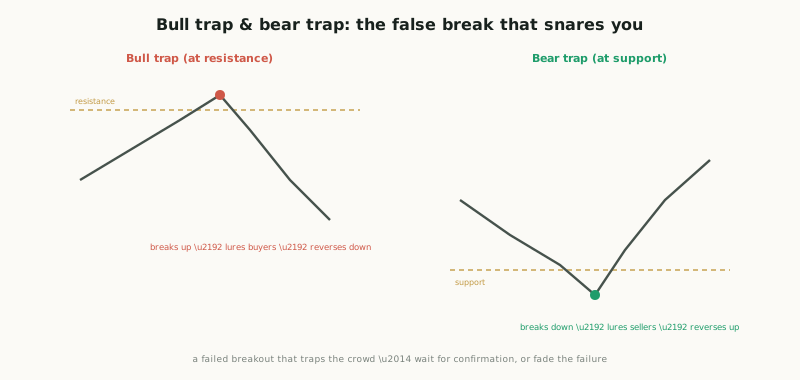
A: A bull trap is a false upside breakout: price breaks above a resistance level (or recent high), luring in buyers who expect a continued rally, but then reverses sharply back below the level, trapping those buyers in losing long positions. The 'breakout' was a trap — it failed and reversed. A bear trap is the mirror image: a false downside breakout below support that lures in sellers, then reverses back up.
Q: Why do bull and bear traps happen?
A: Partly because obvious levels attract predictable behaviour: many traders place breakout orders and stop-losses just beyond key support/resistance, so a brief push past the level triggers a cluster of orders (and liquidity) before the move fails. Whether driven by larger players hunting that liquidity or simply by insufficient genuine follow-through, the result is the same — a breakout that traps the traders who chased it before snapping back.
Q: How do you avoid bull and bear traps?
A: Wait for confirmation rather than entering on the first break: look for a candle to close beyond the level (not just a wick), for follow-through, or for a successful retest of the broken level before committing. Be cautious chasing breakouts of very obvious levels, especially without volume or momentum behind them. Some traders go further and deliberately fade failed breakouts — trading the reversal once the trap is sprung.
What they are
A bull trap is a false upside breakout: price breaks above a resistance level (or recent high), luring in buyers who expect a continued rally, but then reverses sharply back below the level — trapping those buyers in losing long positions. The "breakout" was a trap: it failed and reversed, leaving everyone who bought the break offside and forced to sell (which fuels the reversal further). A bear trap is the exact mirror image: a false downside breakout below a support level, luring in sellers who expect a continued decline, that then reverses back up — trapping the sellers. The defining feature of both is the lure-then-reverse structure: the move looks like a legitimate breakout (the very thing breakout traders are waiting for), draws people in, and then betrays them. This is why traps are so painful and so common — they exploit the correct-looking action (a breakout) that traders are trained to trade, turning a textbook setup into a loss. The trapped traders aren't foolish; they took a reasonable-looking breakout that simply failed, which is exactly what makes traps such an effective — and recurring — hazard.
Why they happen, and how to handle them
Why do traps occur so reliably? A big part is that obvious levels attract predictable behaviour. Around an obvious support or resistance level, traders cluster breakout orders (to buy the break) and stop-losses (from those positioned the other way) just beyond the level — a concentrated pool of orders and liquidity. A brief push past the level triggers that cluster (breakout buys and stops firing), creating a spike that looks like a breakout — but if there's no genuine follow-through behind it (insufficient real buying to sustain the move, or larger players deliberately hunting that liquidity — see stop-loss hunting and the swing failure pattern), the move fails and reverses, springing the trap. Whether it's driven by deliberate liquidity-hunting or simply by a breakout that lacked real conviction, the mechanics produce the same outcome: the traders who chased the obvious break get caught.
Handling traps comes down to patience and confirmation, and — for the more advanced — turning the tables. To avoid being trapped: don't enter on the first break of a level. Wait for confirmation — a candle closing decisively beyond the level (not just a wick poking through), genuine follow-through after the break, or a successful retest (price breaking out, pulling back to the broken level, and holding it as new support/resistance before continuing). These filters dramatically reduce how often you're caught by a trap, at the cost of slightly later entries — a worthwhile trade. Be especially cautious chasing breakouts of very obvious levels, particularly without volume or momentum behind them, since the most-watched levels are exactly where traps tend to spring. To turn traps into opportunity: once a trap is clearly sprung (the breakout has failed and price has reversed back through the level), some traders deliberately fade the failed breakout — trading in the reversal direction (short after a sprung bull trap, long after a sprung bear trap), since the trapped traders being forced to exit add fuel to the reversal (this is essentially the swing-failure / fading play, and it can be a high-quality, well-defined setup with a stop just beyond the failed-breakout extreme). As always, neither avoidance nor fading is foolproof — sometimes an apparent trap is a real breakout that briefly pulled back — so confirmation, sensible stops and risk management remain essential. The honest framing: a bull trap is a false upside breakout that lures buyers then reverses down; a bear trap is a false downside breakout that lures sellers then reverses up — both exploit the textbook-looking breakout traders are trained to take. They happen because obvious levels hold clustered breakout orders and stops that a brief push triggers without real follow-through (sometimes liquidity-hunted). Avoid being trapped by waiting for confirmation — a decisive close beyond the level, follow-through, or a successful retest — and being wary of chasing obvious breakouts; advanced traders fade the failed breakout once the trap springs, with a stop beyond the extreme. Not foolproof — confirm and manage risk.
Reading the warning signs in real time
While no one can label a trap with certainty before it springs, several warning signs make a breakout far more likely to be a trap — and learning to read them is what turns "I keep getting caught" into "I see why that was risky." A breakout is suspicious when: it happens on weak conviction (a feeble push with little momentum or, where you can gauge it, low participation, rather than a strong, decisive thrust); it breaks against the higher-timeframe trend (a bullish break in a larger downtrend is prime trap territory, since the dominant force is still down); it pushes into an obvious pool of liquidity (just beyond a heavily-watched level where stops cluster — exactly what a liquidity grab targets); it leaves a sharp rejection wick (price spikes past the level then closes back inside, a classic failed-break tell); it fails to hold a retest (breaks out, pulls back to the level, and then loses it rather than holding it as support); or it shows momentum divergence (the break makes a new extreme but momentum doesn't confirm). The more of these align, the more you should suspect a trap — and at minimum wait for confirmation rather than chasing.
Underpinning all of this is the psychology that makes traps work. Breakouts are exciting — price is moving, and the fear of missing out drives traders to chase the break impulsively, buying at the worst possible spot (the extreme) without confirmation. Traps prey precisely on this herd impulse: the crowd piles into the obvious break, their orders provide the liquidity for the reversal, and when it snaps back their forced exits (stops hit, panic selling) accelerate the move against them. Understanding this reframes the whole phenomenon — a trap isn't bad luck, it's the predictable punishment of undisciplined, herd-following chasing, and the defence is simply to not be the herd: stay patient, demand confirmation, respect the higher-timeframe trend, and treat the most "obvious," most-chased breakouts with the most suspicion. The trader who waits for the close, the follow-through or the held retest sacrifices a little speed but sidesteps the great majority of traps — and, with experience, can flip them into high-quality fade setups. The honest reminder: a breakout is more likely a trap when it shows weak conviction, breaks against the higher-timeframe trend, pushes into obvious liquidity beyond watched levels, leaves a sharp rejection wick, fails a retest, or diverges on momentum; traps prey on FOMO-driven chasing of the herd, whose forced exits fuel the reversal — so don't be the herd: wait for confirmation, respect the bigger trend, and be most suspicious of the most obvious breakouts.
Ultimately, bull and bear traps are a lesson in patience over impulse. The market rewards the trader who waits a beat for proof over the one who lunges at every break, because the lunge is exactly what traps are built to punish. Internalise that a breakout is a hypothesis to be confirmed, not a signal to be chased, and the trap that catches the crowd becomes, for you, either an avoided loss or a high-quality opportunity to fade. Few habits protect a trading account as cheaply as simply refusing to chase the obvious break.
A bull trap is a false upside breakout that lures buyers then reverses down; a bear trap is a false downside breakout that lures sellers then reverses up — both exploit the textbook-looking breakout traders are trained to take. They happen because obvious levels hold clustered breakout orders and stops that a brief push triggers without real follow-through (sometimes liquidity-hunted). Avoid being trapped: wait for confirmation — a decisive close beyond the level (not a wick), follow-through, or a successful retest — and be wary of chasing obvious breakouts. Advanced: fade the failed breakout once the trap springs (short a sprung bull trap / long a sprung bear trap), stop beyond the extreme — the swing-failure play. Not foolproof (a real breakout can pull back) — confirm and manage risk.