Momentum trading is built on a simple, powerful idea: things in motion tend to stay in motion. Rather than buying weakness and hoping for a turn, momentum traders buy strength and ride it — joining moves that are already underway and aiming to profit as they continue. It's a genuinely effective approach with strong empirical support, and one obvious danger. This guide explains momentum trading strategies: the core idea, the tools, how to enter and exit, the best conditions, and the risk of chasing.
It's the active "how-to" companion to the mean-reversion-vs-momentum comparison, a close cousin of trend following, and often executed via pullbacks.
Key takeaways
Q: What is momentum trading?
A: Momentum trading is an approach based on the tendency of price moves to persist — 'buy strength, sell weakness.' Instead of trying to pick tops and bottoms, momentum traders identify currencies or pairs already moving strongly and trade in the direction of that move, aiming to ride the existing momentum. It rests on the empirical observation that strong trends often continue for a while rather than immediately reversing.
Q: How do momentum traders measure momentum?
A: With tools that gauge the speed and strength of price movement: momentum and rate-of-change indicators, the RSI (especially its position and slope rather than just overbought/oversold), the MACD, moving averages and their slope, and simple price action (the size and persistence of moves, new highs/lows). The aim is to confirm that a move has genuine strength behind it before joining, rather than fading early strength.
Q: What is the main risk of momentum trading?
A: Reversals and chasing. Because you enter when a move is already underway, you risk buying near the end of it — momentum eventually fades and reverses, and entering a stretched, exhausted move can mean buying the top. 'Chasing' a move that's already run far is the classic mistake. Momentum works best with discipline: confirmation of genuine strength, sensible entries (often on pullbacks within the move), and strict stops for when momentum dies.
The approach
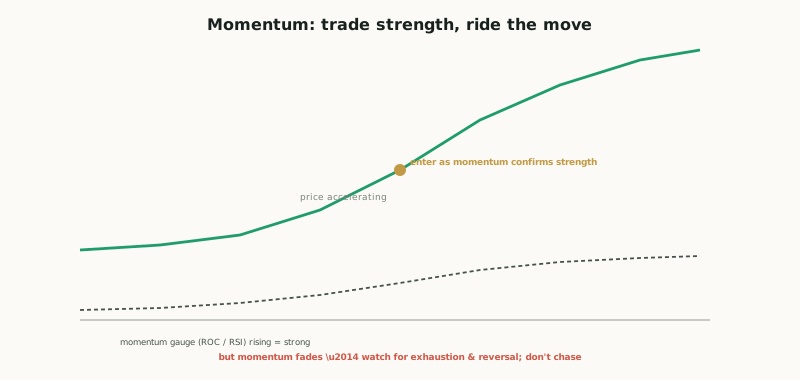
Momentum trading rests on the empirical observation that strong moves often persist for a while rather than reversing immediately — a real, well-documented tendency in markets. So instead of trying to pick tops and bottoms (buying low, selling high — the mean-reversion instinct), the momentum trader does the opposite: identifies a pair already moving strongly and trades in the direction of that move, betting the strength continues.
Momentum trading at a glance
It overlaps heavily with trend following — both ride existing direction — but "momentum" puts the emphasis specifically on the speed and strength of the move (how forcefully price is travelling), trading the energy of a move rather than just its existence. The mindset is counter-intuitive to beginners (it feels safer to "buy the dip" than to "buy something that's already gone up"), but it aligns with how trends actually behave: strength tends to beget more strength, at least for a time.
Tools, entries and the chasing risk
Momentum traders measure momentum with tools that gauge the speed and strength of price movement: the momentum and rate-of-change indicators, the RSI (using its position and slope — e.g. RSI pushing and holding above 50/60 in an uptrend — rather than naively fading "overbought"), the MACD, the slope of moving averages, and simple price action (the size and persistence of candles, the making of new highs/lows). The goal is to confirm genuine strength before joining — the whole point is to trade real momentum, not to fade early strength or jump on a feeble move. For entries, there are two broad styles: breakout-style momentum entries (entering as price breaks to new highs/lows on strong momentum) and — often lower-risk — pullback entries (waiting for a shallow pullback within the strong move and entering as it resumes, getting a better price and a tighter stop — see pullback trading). For exits, momentum traders typically ride the move until momentum fades — trailing a stop, or exiting when the momentum tools roll over (e.g. RSI/MACD turning down, the move's energy visibly dying) — since the edge lasts only while the momentum does.
The key risk, and the one that defines the discipline, is reversals and chasing. Because you enter when a move is already underway, you inherently risk buying near the end of it: momentum eventually fades and reverses, and entering a stretched, exhausted move can mean buying the exact top (or selling the bottom). "Chasing" — jumping into a move that has already run far, late and emotionally, often driven by FOMO — is the classic, costly mistake, and it's the dark twin of momentum's logic (the same "it's going up, get in!" instinct that powers the strategy also powers its worst error). Managing this is what separates disciplined momentum trading from reckless chasing: confirm genuine, fresh strength rather than piling into a tired move; prefer pullback entries that get you in at better prices with defined risk (rather than chasing the spike); set strict stops for when momentum dies (so a reversal costs little); be wary of entering when a move is already massively extended (the risk/reward is poor and exhaustion is near); and watch for momentum divergence (price making new highs while the momentum tools weaken — a warning the move is running out of fuel, see divergence). As with every approach here, momentum trading is no holy grail: it works well in trending, strongly-moving markets and poorly in choppy, range-bound ones (where strength quickly reverses), so it must be matched to conditions, combined with confirmation, and governed by risk management. Used with discipline — trading real strength, entering sensibly, exiting as momentum fades, and refusing to chase — it's a powerful, time-tested edge; used as an excuse to chase every move, it's a fast way to buy tops. The honest framing: momentum trading is "buy strength, ride it" — joining moves already underway on the tendency of strength to persist, measured with momentum/ROC, RSI slope, MACD, MA slope and price action, and best in trending markets. Enter on breakouts or (lower-risk) pullbacks within the move, and exit as momentum fades. The defining risk is reversals and chasing — entering a stretched, exhausted move late — so confirm genuine strength, prefer pullback entries, set strict stops, avoid massively extended moves, watch for momentum divergence, match it to trending conditions, and never chase.
Momentum across timeframes and markets
It's worth appreciating that momentum is not just a forex tactic but one of the most robust, widely-documented phenomena in all of markets — academics have found momentum effects across asset classes and decades, making it one of the few "anomalies" that has persisted long after being discovered. This matters practically because it gives momentum trading a genuine, durable rationale (behavioural: investors under-react then over-react to information, and trends self-reinforce as more participants pile in) rather than being a mere chart pattern. There are two broad flavours worth knowing: time-series momentum (trading an instrument based on its own recent trend — the everyday sense used above) and relative-strength momentum (ranking instruments and favouring the strongest against the weakest — in forex, buying the strongest currency against the weakest, a natural fit given currencies trade in pairs).
Momentum also operates on every timeframe, and aligning them sharpens the edge. A scalper trades intraday momentum bursts; a swing trader rides multi-day momentum; and combining timeframes — trading with momentum on the higher timeframe while timing entries on a lower one — keeps you on the side of the dominant force (a recurring multi-timeframe principle). Pairing momentum with a simple trend filter (only taking long-momentum signals when the higher-timeframe trend is up) is one of the most effective refinements, since it stops you buying strength against a larger downtrend. The crucial regime-awareness, though, is that momentum "crashes" at turning points: the same persistence that pays in trends turns vicious when a strong trend reverses, and the most over-extended momentum trades can suffer the sharpest reversals (which is exactly what fading tries to exploit from the other side). So momentum and mean-reversion are two regimes of the same market — momentum dominates in trends, reversion at exhaustion — and the skilled trader reads which regime is in force rather than marrying one. The honest reminder: momentum is one of markets' most robust, well-documented effects (with a real behavioural rationale), comes in time-series and relative-strength forms, works across timeframes (align them, and add a trend filter), but "crashes" at trend reversals — so read whether the market is in a trending (momentum) or exhausted (reversion) regime rather than applying it blindly.
The deeper appeal of momentum, once you accept its discipline, is that it lets the market do the heavy lifting: you don't have to predict tops and bottoms or out-analyse anyone — you simply identify where strength already exists and align yourself with it until it fades. That humility (following the move rather than forecasting it) is part of why momentum has endured. The whole skill reduces to two questions asked honestly: is there genuine strength here, and am I joining it early enough that the risk–reward still makes sense? Answer those well, refuse to chase when the answer is no, and momentum becomes one of the most reliable edges available.
Momentum trading is "buy strength, ride it" — joining moves already underway on the tendency of strength to persist — measured with momentum/ROC, RSI slope, MACD, MA slope and price action, and best in trending, strongly-moving markets (poor in chop). Enter on breakouts or — lower-risk — pullbacks within the move, and exit as momentum fades (trail, or when the tools roll over). The defining risk is reversals and chasing: entering a stretched, exhausted move late (often on FOMO) can buy the top. So confirm genuine fresh strength, prefer pullback entries, set strict stops, avoid massively extended moves, watch for momentum divergence, match it to trending conditions — and never chase. A powerful, time-tested edge with discipline; a way to buy tops without it.