
The Aussie and the Kiwi are economic cousins — neighbouring, commodity-exporting, risk-sensitive economies that tend to move together against the rest of the world. That kinship makes AUD/NZD a different animal from most crosses: because its two currencies are so alike and so correlated, the pair largely cancels out the common global forces and isolates the relative difference between two very similar economies — producing a comparatively range-bound, lower-volatility cross with its own distinctive logic. This guide explains trading AUD/NZD: why correlation shapes it, what drives it, its character and best sessions.
It's the purest expression of currency correlation at work, built from the AUD/USD and NZD/USD legs.
Key takeaways
Q: What is the AUD/NZD pair?
A: AUD/NZD is a cross pair (no US dollar) pitting the Australian dollar against the New Zealand dollar — two neighbouring 'antipodean' currencies whose commodity-exporting, risk-sensitive economies are closely linked. Because the two are highly correlated and move together, the cross tends to be range-bound with lower volatility than most pairs, isolating the relative difference between the two economies.
Q: What drives AUD/NZD?
A: Mainly the relative monetary policy of the two central banks — the Reserve Bank of Australia (RBA) versus the Reserve Bank of New Zealand (RBNZ) — and the rate differential between them. Relative commodity exposure also matters (Australia's metals and China links versus New Zealand's dairy and agriculture), as does relative economic performance. Broad global risk-on/off largely cancels out, since both are risk currencies.
Q: Why is AUD/NZD less volatile?
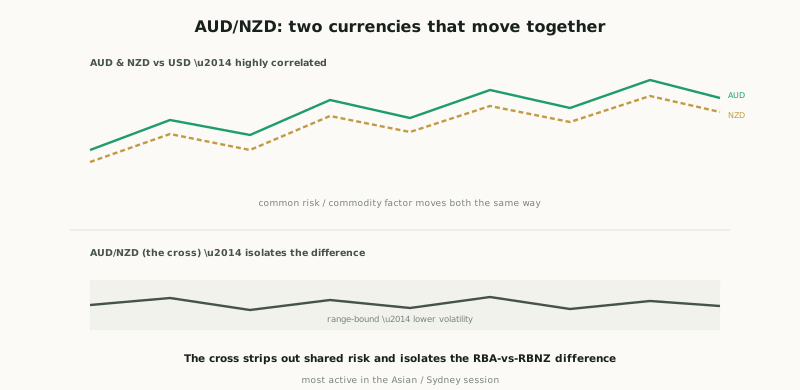
A: Because the Australian and New Zealand dollars are highly correlated — they share commodity exposure, risk sensitivity and regional ties, so they tend to rise and fall together against other currencies. When you pair them against each other, much of that common movement cancels out, leaving only the smaller relative difference. That makes AUD/NZD comparatively range-bound and lower-volatility, appealing to range traders.
Why correlation shapes the pair
The key to understanding AUD/NZD is the tight correlation between its two currencies. The Australian and New Zealand dollars are both commodity currencies, both risk-sensitive, and both tied to neighbouring, closely linked economies — so they tend to rise and fall together against other currencies (when risk appetite lifts the Aussie, it usually lifts the Kiwi too). When you pair them against each other, much of that shared movement cancels out, leaving only the smaller relative difference between the two. The practical consequences are distinctive: AUD/NZD is comparatively range-bound and lower-volatility than most pairs, with a tendency toward mean reversion, since the legs rarely diverge dramatically for long. This makes it a favourite of range traders, and means broad global risk-on/off swings — which move both currencies similarly — matter less here than in almost any other AUD or NZD pair.
What sets the two apart
If the common factors cancel out, what's left to drive the pair is whatever makes the two economies differ. The table highlights the key distinctions.
| Factor | Australia (AUD) | New Zealand (NZD) |
|---|---|---|
| Central bank | RBA | RBNZ |
| Key commodities | Iron ore, metals, coal | Dairy, agriculture |
| Big external link | China (largest market) | China & Australia |
| Relative size | Larger economy | Smaller economy |
The single most important driver is the relative monetary policy of the two central banks — the Reserve Bank of Australia (RBA) versus the Reserve Bank of New Zealand (RBNZ) — and the rate differential between them: when one central bank is more hawkish than the other, the cross moves toward the higher-yielding currency. Relative commodity exposure matters too, because the two countries export different baskets — Australia leans on iron ore, metals and coal (with heavy China exposure), New Zealand on dairy and agriculture — so divergent commodity fortunes nudge the pair. Relative economic performance (growth, inflation, employment in one versus the other) rounds out the drivers. In short, AUD/NZD is a relative-value play between two close cousins, driven by what separates them rather than what they share.
On timing, both currencies sit in or near the same time zone, so AUD/NZD is most active during the Sydney and broader Asian session, when Australian and New Zealand data and flows dominate. On correlations, the defining feature is the high positive correlation between the AUD and NZD legs (which is precisely why the cross moves relatively little), and AUD/NZD tends to be fairly independent of the broad risk swings that dominate other Aussie and Kiwi pairs. As with every pair, this is the pair's typical character, not a forecast — ranges can break (a sharp divergence in the two central banks' paths can trend the pair), volatility and spreads vary with conditions and broker, and the relationships are tendencies. The honest framing: AUD/NZD pits two highly similar antipodean commodity/risk currencies against each other — and because the AUD and NZD are so correlated (both commodity-linked, risk-sensitive, neighbouring economies), the cross strips out the common risk factor and isolates the relative difference, driven mainly by the RBA-vs-RBNZ rate differential, relative commodity exposure (Australian metals/China vs New Zealand dairy) and relative data. It tends to be range-bound with lower volatility (the legs move together), suiting range traders, and is most active in the Asian/Sydney session, with broad risk-on/off largely cancelling out. Character varies and ranges can break, so manage risk.
Trading the range
AUD/NZD's range-bound, mean-reverting character makes it a natural home for range-trading approaches. Because the two highly correlated currencies rarely diverge dramatically for long, the pair tends to oscillate within identifiable boundaries, so tactics that buy near established support and sell near established resistance — fading extremes back toward the middle — suit it better than aggressive breakout or trend-chasing strategies most of the time. Mean-reversion logic, oscillators that flag overbought/oversold conditions, and patience for the pair to reach the edges of its range all fit its temperament. The lower volatility also means different expectations: targets and stops are typically tighter in pip terms than on a wild cross like GBP/AUD, and position sizing can reflect the calmer ranges — though "calmer" never means "risk-free," and stops remain essential.
The catalysts to watch are whatever drives the two economies apart. The RBA and RBNZ meetings and their relative policy paths are the headline events — a surprise from either central bank, or a clear divergence in their rate trajectories, is the single most likely thing to move AUD/NZD meaningfully and, importantly, to break its range into a trend. Relative data (growth, inflation, employment in one country versus the other) and divergent commodity fortunes (Australian iron ore and metals versus New Zealand dairy, and any China-specific impact that hits the two unevenly) supply the rest. A trader on this pair watches the two central banks against each other rather than global risk headlines, since the broad risk-on/off swings that dominate other Aussie and Kiwi pairs largely cancel out here.
That last point cuts both ways and is the key honest caveat: AUD/NZD's range-bound calm depends on the two currencies staying in step, and when they don't — when the RBA and RBNZ embark on clearly different paths, or a shock hits one economy far harder than the other — the range can break and the pair can trend persistently, catching out traders who assumed it would keep reverting. Range-trading the pair therefore requires alertness to the central-bank divergence that signals a regime change, and stops that protect against the range failing. The usual practicalities also apply: as a cross it carries wider spreads than the majors (a larger consideration given the smaller ranges, since spread is a bigger fraction of a modest move), and swap costs reflect the rate differential. Combine the relative-value read (which central bank is more hawkish, which economy stronger) with technical range and trend analysis to time entries, and AUD/NZD offers a distinctive, lower-volatility opportunity for range-oriented traders — provided you respect that even the steadiest range is a tendency, not a guarantee, and manage risk on every trade. The honest framing is the one running through this pair: it's a relative-value play between two close cousins, calm because they move together, tradeable through its range — but liable to trend when they part ways, so never mistake its quiet for safety.
The purest rate-differential pair
One reason traders value AUD/NZD is that it's often the cleanest expression of a relative interest-rate view available in forex. On most pairs, the rate-differential signal is muddied by all the other forces at work — risk sentiment, commodity swings, USD moves, geopolitical noise. On AUD/NZD, because so many of those common forces affect the two currencies alike and cancel out, what remains is dominated by the relative stance of the RBA and RBNZ. That makes the pair a relatively pure play for a trader who has formed a view that, say, one central bank will out-hawk the other: the trade isn't drowned out by global risk headlines the way the same view expressed through AUD/USD or NZD/USD would be. This clarity is precisely why AUD/NZD rewards close attention to the two central banks relative to each other — their meeting outcomes, their guidance, the gap in their expected paths — more than to any broad market theme. It's a relative-value instrument in the truest sense, and traders who enjoy expressing nuanced central-bank views often gravitate to it for exactly that reason. The same property is the source of its risk, of course: when the differential shifts decisively, the pair can leave its range and trend, so the very clarity that makes it attractive also demands respect for what happens when the central banks part ways.
AUD/NZD is a cross (no USD) pitting two highly similar "antipodean" commodity/risk currencies against each other. Because the AUD and NZD are highly correlated (both commodity-linked, risk-sensitive, neighbouring economies that move together), the cross cancels out the common global factor and isolates the relative difference — making it comparatively range-bound and lower-volatility, a favourite of range traders. Its main driver is the RBA-vs-RBNZ rate differential, plus relative commodity exposure (Australian metals/China vs New Zealand dairy) and relative data; broad risk-on/off largely cancels out. Most active in the Asian/Sydney session. But ranges can break if the two central banks' paths sharply diverge — character and spreads vary with conditions, so manage risk.