EUR/CAD pits the rate-driven euro against a classic petro-currency, the Canadian dollar — and that contrast is the key to the pair. Watch the ECB-versus-BoC gap on one side and the price of crude oil on the other, and the cross's logic comes into focus: a blend of eurozone monetary policy and Canadian commodity dynamics that behaves differently from either currency's dollar pair. This guide explains trading EUR/CAD: what drives it, its character, and its best sessions.
It marries the euro's rate story with the oil-linked Canadian dollar of USD/CAD, a textbook commodity currency relationship.
Key takeaways
Q: What is the EUR/CAD pair?
A: EUR/CAD is a cross pair (no US dollar) pitting the euro against the Canadian dollar. It blends two quite different currencies: the euro, a large, liquid, rate-driven currency shaped by the European Central Bank and eurozone economy, and the Canadian dollar, a commodity (petro-) currency heavily influenced by crude oil prices and the Bank of Canada.
Q: What drives EUR/CAD?
A: Two main forces. On the euro side, eurozone growth and ECB monetary policy; on the Canadian side, the price of crude oil (Canada is a major oil exporter) and Bank of Canada policy. The interest-rate differential between the ECB and BoC matters, as does the oil price: rising oil tends to strengthen the Canadian dollar and push EUR/CAD lower, all else equal.
Q: Is EUR/CAD volatile?
A: It's a cross with moderate to higher volatility and wider spreads than the major pairs, because it combines two independent driver sets (eurozone policy and Canadian oil) with less of the deep liquidity the majors enjoy. Movements in crude oil can add sharp swings on the CAD side. It's quite tradeable but should be sized to its wider ranges and spreads, with proper risk management.
Pair snapshot
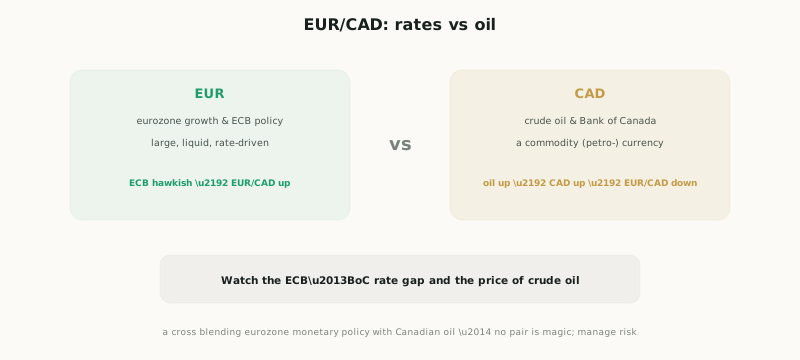
EUR/CAD is a cross (no US dollar) combining a large, rate-driven currency with a commodity one. The snapshot captures its essentials.
EUR/CAD at a glance
The euro side behaves as it does across all EUR pairs: driven by eurozone growth, inflation and — above all — European Central Bank policy and rate expectations, with the euro being the world's second most-traded currency and deeply liquid. The Canadian side is where the distinctiveness lies: the Canadian dollar is a commodity (petro-) currency, because Canada is a major oil exporter, so the price of crude oil is a powerful driver — higher oil tends to strengthen the CAD (improving Canada's terms of trade and export revenues), and Bank of Canada policy responds partly to that commodity-linked economy.
What moves the pair, and its sessions
Putting the two together, EUR/CAD is driven by the interplay of eurozone monetary policy and Canadian oil-and-rates dynamics. The ECB–BoC rate differential is a central anchor: when the ECB is expected to tighten relative to the BoC, the euro tends to gain on the CAD (EUR/CAD up), and vice versa. Overlaid on that is the oil price: a sustained rise in crude tends to lift the CAD and push EUR/CAD lower, while falling oil weakens the CAD and lifts EUR/CAD — so a EUR/CAD trader effectively keeps one eye on the oil market in a way a pure EUR/USD trader need not. Relative economic data (eurozone PMIs, inflation, growth versus Canadian jobs, CPI and GDP) feeds the rate-expectation story on both sides. Because the two driver sets are largely independent — eurozone news and Canadian oil rarely move in lockstep — the pair can produce its own trends rather than simply echoing the majors.
On sessions, EUR/CAD is most active when the relevant markets are open and overlapping. The London session brings heavy euro liquidity and is the most active period for the EUR side, while the New York session brings both North American flows and — importantly — the bulk of oil-market activity and Canadian data releases, making the London–New York overlap the prime window of liquidity and movement. As a cross rather than a major, EUR/CAD carries wider spreads and somewhat thinner liquidity than EUR/USD or USD/CAD, and oil-driven moves can add sharp volatility on the CAD side — so positions should be sized to its wider ranges and spreads, and a trader should be aware that an oil-price shock or a surprise from either the ECB or BoC can move it quickly. As with every pair on this site, no cross is magic: EUR/CAD offers a distinctive blend of drivers to analyse, not a guaranteed edge, and it must be traded with confirmation and disciplined risk management. The honest framing: EUR/CAD is a cross pitting the rate-driven euro (eurozone growth and ECB policy) against Canada's oil-linked dollar (crude oil and the Bank of Canada). It's driven by the ECB–BoC rate differential and the oil price — rising oil tends to strengthen the CAD and push EUR/CAD lower — with relative data feeding both sides; the two driver sets are largely independent, so it can trend on its own. Most active in the London–New York overlap (euro liquidity plus oil and Canadian data). As a cross it has wider spreads and thinner liquidity than the majors, and oil shocks can add volatility, so size to its ranges and manage risk — a distinctive pair to analyse, never a guarantee.
How to approach EUR/CAD
For a trader, EUR/CAD is most useful as a way to express a specific blended view rather than a generic punt. The cleanest setups arise when the two driver sets align: if you expect the ECB to tighten relative to the BoC and oil to fall (weakening the CAD), both forces push EUR/CAD higher together, a higher-conviction setup than betting on one alone; conversely, a dovish ECB plus an oil rally lines up for a move lower. The pair is therefore a natural vehicle for traders who have a strong view on crude oil but want to express it against something other than the US dollar, or who have a view on the eurozone-versus-Canada policy gap. A practical habit is to keep the oil chart open alongside EUR/CAD: because the CAD leg is so oil-sensitive, a sharp move in crude often telegraphs or explains a EUR/CAD move, and divergences (EUR/CAD not following oil) can themselves be informative about euro-side strength or weakness.
A few mechanics matter. Correlations: EUR/CAD tends to move loosely opposite to oil (via the CAD) and is related to both EUR/USD and USD/CAD, so a trader should be careful not to unknowingly double up on the same risk across positions — being long EUR/CAD and short USD/CAD, for instance, both lean the same way on the CAD. Carry: the ECB–BoC rate gap means the pair has a carry characteristic (you earn or pay the differential via swap), worth factoring into longer holds. Sizing for the spread and ranges: as a cross, EUR/CAD has wider spreads than EUR/USD, so it's less suited to very short-term scalping where the spread eats the edge, and oil-driven volatility means stops need room — size positions accordingly. It tends to reward a swing or position approach, holding for moves driven by the slower rate-and-oil narrative, more than frantic intraday churn. As always, the pair offers a distinctive analytical angle, not a guarantee: confirm setups with your usual tools, respect the oil-shock and central-bank event risk, and keep risk per trade controlled. The honest reminder: EUR/CAD shines when you have a clear oil or ECB-vs-BoC view, is best traded on the swing timeframe with spread-aware sizing, and demands awareness of its oil and cross-pair correlations — a focused way to express a blended macro view, never a free edge.
A worked scenario
To see the drivers interact, picture two scenarios. Scenario one — an oil rally: a supply shock sends crude sharply higher. Canada, a major oil exporter, benefits; the Canadian dollar strengthens on improving terms of trade and export revenue; with the EUR side quiet, EUR/CAD drifts lower as the CAD gains. A EUR/CAD trader who saw the oil move coming, or who reads the falling pair as confirmation of CAD strength, has a coherent story. Scenario two — a hawkish ECB surprise: the European Central Bank signals faster tightening than expected; the euro strengthens on the widening rate advantage; with oil and the BoC steady, EUR/CAD pushes higher on euro strength. Now picture them combining: a hawkish ECB and falling oil both lift the euro relative to the CAD, reinforcing a move higher — the kind of aligned setup that offers higher conviction than either driver alone. Conversely, a dovish ECB colliding with an oil rally would drive EUR/CAD sharply lower as both forces favour the CAD. The lesson is to read the pair as the net of its two engines, and to prize the moments when they point the same way — while staying alert that they can also offset (a hawkish ECB and rising oil partly cancel), producing a muddier, range-ier pair. Mapping the scenarios in advance keeps you oriented when the news hits.
EUR/CAD is a cross blending the rate-driven euro (eurozone growth, ECB policy) with Canada's oil-linked dollar (crude oil, Bank of Canada). Watch the ECB–BoC rate gap and the oil price: rising oil tends to strengthen the CAD and push EUR/CAD lower, while a wider ECB-over-BoC rate gap lifts it. The two driver sets are largely independent, so the pair can trend on its own rather than echo the majors. Most active in the London–New York overlap (euro liquidity plus oil markets and Canadian data). As a cross it carries wider spreads and thinner liquidity than EUR/USD or USD/CAD, and oil shocks can add sharp moves — so size to its ranges, keep an eye on crude, and manage risk. A distinctive blend of drivers to analyse, not a guaranteed edge.