
When a ratings agency downgrades a country, currencies can lurch — sometimes violently for fragile economies, barely at all for the giants. Sovereign credit ratings are a window into how risky a government's debt is judged to be, and understanding their effect — and, just as importantly, their limits — rounds out the external side of fundamental analysis. This guide covers credit ratings and forex: what the ratings are, how they move currencies, and why their impact varies so much.
It connects directly to sovereign debt, works through bond yields and capital flows, and matters most for emerging-market currencies and in currency crises.
Key takeaways
Q: What are sovereign credit ratings?
A: Sovereign credit ratings are assessments by agencies like Moody's, S&P and Fitch of how likely a government is to repay its debt — essentially the default risk on its bonds. Ratings run from the highest quality (AAA) down through investment grade to speculative or 'junk' levels. Each agency also assigns an 'outlook' (positive, stable or negative) signalling the likely direction of future rating changes. They influence how cheaply a government can borrow.
Q: How do credit ratings affect a currency?
A: A downgrade signals higher perceived default risk, so investors demand higher yields to hold the government's bonds, and may pull capital out of the country — which can pressure the currency lower. Upgrades and positive outlook changes can do the reverse. The effect runs through bond yields and capital flows, and outlook changes can move markets even before an actual rating change, since they flag what's likely coming.
Q: Do credit ratings always move currencies a lot?
A: No — the impact varies enormously. Ratings often lag the market, which has usually priced in the risk before the agencies act, so a downgrade can be a non-event if it was expected. And big reserve-currency issuers like the US are far less affected, because demand for their debt and currency rests on much more than a rating. The largest effects are on emerging-market and fragile economies, where a downgrade can trigger serious capital flight and currency weakness.
What they are
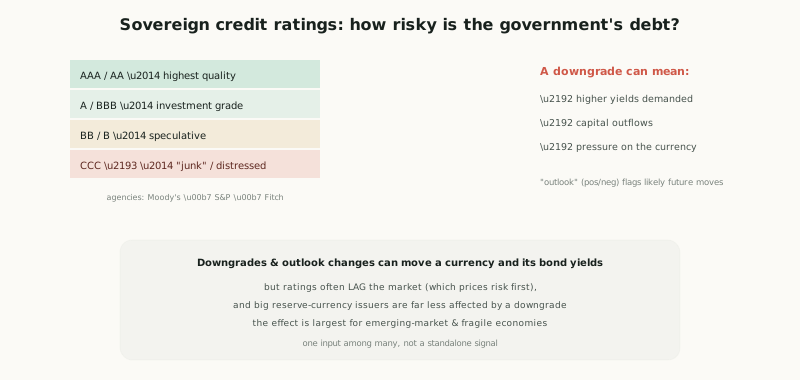
Sovereign credit ratings are assessments by agencies — chiefly Moody's, S&P and Fitch (the "big three") — of how likely a government is to repay its debt, essentially the default risk on its bonds. Ratings run on a scale from the highest quality (AAA) down through investment grade (still considered safe) to speculative or "junk" levels (where default risk is material), and on down to distressed and default. Each agency also assigns an "outlook" — positive, stable or negative — signalling the likely direction of future rating changes (a "negative outlook" warns a downgrade may be coming). These ratings matter in the real world because they influence how cheaply a government can borrow: a higher rating means investors accept lower yields (the government's debt is seen as safe), while a lower rating forces the government to pay higher yields to compensate lenders for the risk. For a forex trader, ratings are relevant because the creditworthiness of a government feeds into the attractiveness of its bonds and its currency — they're part of the external, sovereign-risk side of the macro picture, alongside debt levels and the current account.
How they move a currency — and the big caveats
A downgrade signals higher perceived default risk, so investors demand higher yields to hold the government's bonds, and may pull capital out of the country — which can pressure the currency lower (capital outflow means selling the currency; see capital flows). Upgrades and positive outlook changes can do the reverse. The effect runs through bond yields and capital flows, and — importantly — outlook changes can move markets even before an actual rating change, since they flag what's likely coming (markets are forward-looking, so a shift to "negative outlook" can hit a currency immediately). But here are the crucial caveats that stop you over-trading rating headlines. First, ratings often LAG the market: by the time an agency acts, the market has usually already priced in the risk (yields rose and the currency weakened as the problems became obvious), so a downgrade can be a non-event — or even spark a "sell the rumour, buy the fact" bounce — if it was widely expected. The agencies are frequently behind, not ahead of, the story. Second, big reserve-currency issuers are far less affected: when the US (or other major reserve issuers) has been downgraded, the impact on the dollar has been muted, because demand for its debt and currency rests on far more than a rating (its reserve status, deep markets, and safe-haven role — ironically, US debt is often bought in a crisis even when the crisis involves the US). Third, the largest effects are on emerging-market and fragile economies, where a downgrade — especially one that pushes debt from investment grade into "junk" (forcing some funds to sell) — can trigger serious capital flight and currency weakness, sometimes feeding a currency crisis. So a rating action's market impact depends enormously on who's being rated, whether it was expected, and the threshold being crossed — it is not a uniform, mechanical mover of currencies.
The balanced takeaway is to treat credit ratings as one input among many, not a standalone signal. They do matter — a surprise downgrade of a vulnerable economy, or a shift to negative outlook, can genuinely move a currency and is worth being aware of (especially around scheduled review dates, which agencies publish) — but they're best read in context: was it expected (already priced)? Who is it (a fragile EM or a reserve giant)? What threshold (a move within investment grade, or the dramatic crossing into junk)? Because ratings often confirm what the market already knew, the savvier approach is usually to watch the underlying fundamentals (debt, deficits, inflation, political stability) that drive ratings, rather than waiting for the agencies to catch up — the market, and you, can often see the trouble coming before the downgrade arrives. Used this way — as a meaningful but lagging, context-dependent input — credit ratings add a useful piece to the sovereign-risk picture without becoming a crude headline-trading trap. The honest framing: sovereign credit ratings (from Moody's, S&P, Fitch) assess a government's default risk from AAA down to junk, with an outlook flagging the likely direction; a downgrade can mean higher yields demanded, capital outflows and currency pressure (and outlook changes move markets in advance). But the impact varies enormously — ratings often lag the market (so an expected downgrade can be a non-event), big reserve issuers like the US are barely affected, and the largest effects hit emerging and fragile economies, where a downgrade to junk can trigger capital flight. Treat ratings as one lagging, context-dependent input, watching the underlying fundamentals that drive them.
The agencies, their limits, and reviews
It pays to understand the agencies themselves and their well-documented limits. The "big three" — Moody's, S&P and Fitch — dominate, and their ratings can differ (a "split rating," where one rates a country a notch higher than another, is common and itself informative). Their track record invites healthy scepticism: agencies have been widely criticised for lagging events (downgrading only after trouble is obvious), for conflicts of interest in how they're paid, and notably for their poor record before the 2008 financial crisis (when highly-rated products proved anything but safe). So treat their pronouncements as informed opinions that often confirm what markets already know, not as infallible early warnings — the market frequently front-runs the agencies.
That said, ratings do have specific moments of real market impact worth tracking. The most important is the investment-grade-to-junk threshold: when a country is downgraded from the lowest investment-grade rung into "junk" (sub-investment-grade), it can trigger forced selling, because many institutional funds are mandated to hold only investment-grade debt and must dump the bonds — a mechanical wave of selling that can hit the bonds and currency hard regardless of whether the downgrade was "expected." Agencies also publish scheduled review dates for sovereigns, which act as known events a trader can mark (a review with a "negative outlook" looming is a flagged risk). The practical synthesis reinforces the article's theme: watch the underlying fundamentals (debt, deficits, inflation, politics) that drive ratings rather than waiting on the agencies, treat downgrades through the lens of "expected? who? what threshold?", pay special attention to the junk threshold and scheduled reviews as genuine event risks, and otherwise regard ratings as a lagging confirmation rather than a leading signal. That keeps you ahead of the headlines instead of reacting to them. The honest reminder: understand the agencies and their limits — the big three (Moody's, S&P, Fitch) can disagree (split ratings), and they're criticised for lagging events, conflicts of interest, and their pre-2008 record, so the market often front-runs them; but watch genuine event risks like the investment-grade-to-junk threshold (which can force institutional selling) and scheduled review dates, while otherwise tracking the underlying fundamentals that drive ratings rather than waiting on the agencies' lagging confirmation.
Sovereign credit ratings (from Moody's, S&P, Fitch) assess a government's default risk — AAA down to "junk" — with an outlook flagging the likely direction. A downgrade can mean higher yields demanded, capital outflows and currency pressure (and outlook changes move markets in advance). But impact varies enormously: ratings often lag the market (an expected downgrade can be a non-event), big reserve issuers like the US are barely affected (their reserve status outweighs a rating), and the largest effects hit emerging and fragile economies, where a drop to junk can spark capital flight. Treat ratings as one lagging, context-dependent input — ask "was it expected? who? what threshold?" — and watch the underlying fundamentals that drive them, since the market often sees trouble before the agencies act.