
Sometimes a currency doesn't just drift — it collapses, losing much of its value in days as confidence evaporates. Currency crises are dramatic, frequently contagious, and a genuine tail risk in the FX market. Understanding how they unfold — the ingredients, the trigger, the self-reinforcing spiral — is part of respecting what currencies are truly capable of, and of managing the rare-but-severe risks they pose. This guide explains currency crises: their causes, how they spread, and why they matter to traders.
They're intimately tied to exchange-rate regimes (especially pegs), sovereign debt, failed intervention, and the instability dynamics of a Minsky moment.
Key takeaways
Q: What is a currency crisis?
A: A currency crisis is a sudden, severe loss of value in a country's currency — often a sharp devaluation or collapse over a short period — typically triggered when confidence in the currency breaks down. It frequently involves the failure of a fixed exchange-rate peg, rapid capital flight, and a central bank running down its reserves trying (and often failing) to defend the currency before it falls sharply.
Q: What causes currency crises?
A: Common ingredients include an overvalued currency or an unsustainable fixed peg, large debts (especially foreign-currency debt), persistent deficits, drained foreign-exchange reserves, weak fundamentals, and — the trigger — a loss of market confidence. When investors lose faith and rush to sell or pull capital out, the pressure can overwhelm the central bank's defences, and the resulting fall can become self-reinforcing as the collapse itself deepens the panic.
Q: Why do currency crises matter to traders?
A: Because they're a genuine tail risk: violent, fast, and sometimes contagious (spreading to other vulnerable currencies). They can cause huge gaps and slippage, blow through stops, and inflict outsized losses — especially on leveraged or exotic-currency positions. Even if you don't trade the crisis currency, contagion and risk-off shockwaves can ripple across markets. Respecting this tail risk through sizing, caution on vulnerable currencies, and gap awareness is essential.
What causes them
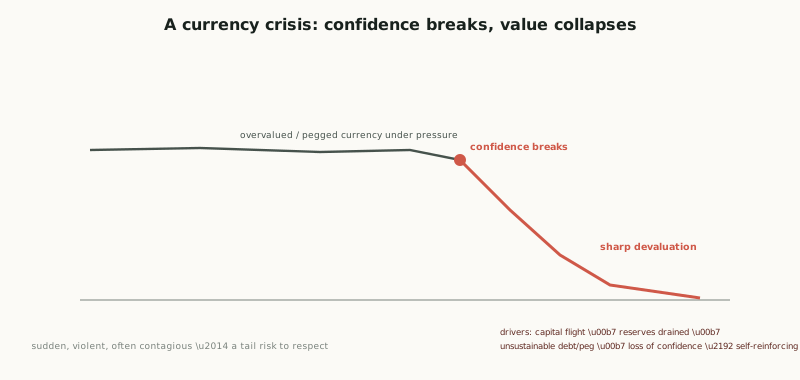
A currency crisis is a sudden, severe loss of value in a country's currency — often a sharp devaluation or collapse over a short period — typically triggered when confidence in the currency breaks down. They rarely come from nowhere; usually a set of vulnerabilities builds up, and then a trigger tips the balance. The common ingredients: an overvalued currency or an unsustainable fixed peg (a rate the fundamentals no longer justify); large debts, especially foreign-currency debt (which becomes crushingly heavier as the currency falls); persistent deficits (current-account or fiscal); weak fundamentals (high inflation, low growth, political instability); and drained foreign-exchange reserves (the war-chest a central bank uses to defend the currency). With these vulnerabilities in place, the trigger is a loss of market confidence — investors come to believe the currency cannot hold its value (or its peg), and rush to sell it and pull capital out.
The mechanics of the collapse are often a doomed defence followed by a break. Faced with selling pressure, a central bank typically tries to defend the currency — spending its reserves to buy it, and/or hiking interest rates sharply to make holding it more attractive. But if the pressure is great enough, this defence fails: reserves get drained, the rate hikes choke the economy, and eventually the central bank capitulates — abandoning the peg or stopping the defence — and the currency falls sharply. This is especially common with fixed exchange-rate pegs (see exchange-rate regimes): a peg that markets decide is unsustainable invites a speculative attack, and once it breaks, the currency can plummet to wherever the market thinks it belongs. Famous historical episodes followed this pattern — the breaking of pegs, the failed defences, the sudden devaluations — and emerging-market currencies with heavy foreign-debt loads have been particularly crisis-prone.
The self-reinforcing spiral, contagion, and the trader's view
What makes currency crises so dangerous is that they tend to become self-reinforcing and can spread. The spiral: as the currency falls, the consequences deepen the panic — a falling currency makes foreign-currency debt heavier (harder to repay, raising default fears), stokes inflation (imports cost more), and confirms the fears of those already fleeing — so the fall itself triggers more selling, in a vicious feedback loop that can turn an orderly decline into a rout (closely related to the instability dynamics of a Minsky moment). This is why crises are so fast and violent rather than gradual. And they can be contagious: once one vulnerable currency collapses, investors reassess other similar economies, pull capital from them too, and the crisis spreads to other currencies sharing the same vulnerabilities (regional or emerging-market contagion has been a repeated feature of history). For traders, this combination — sudden, violent, self-reinforcing, contagious — is a serious tail risk: crises cause huge gaps and slippage that blow through stops, inflicting outsized losses, especially on leveraged or exotic-currency positions (exotics are exactly the crisis-prone currencies). Even if you don't trade the crisis currency itself, contagion and the broad risk-off shockwave can ripple across all markets (safe havens bid, risk currencies sold). The lesson is one of respect and caution: be wary of vulnerable currencies (heavy foreign debt, shaky pegs, weak fundamentals), recognise that even a stop may not protect you in a gapping collapse, size positions conservatively in exotics, and treat a defended peg as a coiled spring that can snap.
None of this is to say currency crises are common — they're rare — but their severity is what demands attention, in exactly the way all tail risks do. You can't predict precisely when a crisis will hit (the trigger and timing are notoriously hard to call, and many "unsustainable" situations persist far longer than expected), so the right posture isn't prediction but preparedness: understanding which currencies carry crisis vulnerabilities, keeping exposure to them modest, being acutely aware of gap and weekend risk on fragile currencies, and never being so leveraged that a violent, stop-jumping move could do catastrophic damage. Respecting that a currency can collapse — fast, far, and contagiously — is simply part of mature risk management in a market where, occasionally, it does. The honest framing: a currency crisis is a sudden, severe collapse in a currency's value, triggered when confidence breaks — typically on a backdrop of overvaluation or an unsustainable peg, heavy (especially foreign-currency) debt, deficits, weak fundamentals and drained reserves. A central bank often defends with reserves and rate hikes, fails, and the currency plummets — a self-reinforcing spiral as the fall worsens debt and inflation, and often contagious to similar economies. For traders it's a serious tail risk: violent gaps and slippage blow through stops, hitting leveraged and exotic positions hardest, with risk-off ripples everywhere. You can't time crises, so respect the tail risk — caution on vulnerable currencies, modest exposure, gap awareness, and conservative sizing.
Types and warning signs
Economists broadly distinguish a few types of currency crisis, which helps in recognising vulnerabilities. So-called first-generation crises stem from fundamental inconsistency — a government running unsustainable deficits or printing money while trying to hold a fixed peg, until reserves run out and the peg inevitably breaks (a crisis the fundamentals made unavoidable). Second-generation crises are more self-fulfilling — a currency's peg might be defensible, but if enough speculators believe it will break and attack it, the cost of defending (sky-high rates, drained reserves) becomes so painful that the government chooses to abandon it, making the feared collapse happen because it was feared (confidence and expectations doing the work). Third-generation crises involve balance-sheet and banking fragilities — where heavy foreign-currency debt in banks and companies means a falling currency triggers a banking/debt crisis, which deepens the currency collapse in a doom loop (the pattern in several emerging-market crises). You don't need the academic labels, but the underlying lesson is useful: crises can come from bad fundamentals, from self-fulfilling panic, or from fragile balance sheets — and often a mix.
The practical value is in the warning signs they point to. Vulnerabilities worth watching on any currency: a fixed or heavily-managed peg that looks increasingly out of line with fundamentals (especially if the central bank is spending reserves to defend it); falling foreign-exchange reserves (the defence running low); large and rising foreign-currency debt (the balance-sheet fragility); persistent large deficits (current-account and fiscal); high inflation and weak growth; political instability or loss of policy credibility; and an overvalued real exchange rate. The more of these stack up, the more crisis-prone a currency is — though, critically, timing remains unpredictable: a vulnerable currency can limp along for years before a trigger (a shock, a contagion, a tipping point in confidence) sets off the collapse, so these are vulnerability signals, not timing signals. For the trader, the takeaway is straightforward and defensive: identify which currencies carry these vulnerabilities (typically certain emerging-market and pegged currencies, the exotics beginners are warned off), keep exposure to them modest and conservatively sized, be acutely aware that a gap can leap past your stop in a collapse, and never carry leverage on a fragile currency that a violent move could turn catastrophic. Respect the vulnerabilities, watch the warning signs, but don't pretend you can time the break. The honest reminder: crises come in types — fundamental inconsistency, self-fulfilling speculative attacks, and balance-sheet/banking doom loops (often a mix) — with watchable warning signs (shaky peg, falling reserves, rising foreign debt, big deficits, high inflation, political stress, overvaluation); the more that stack up, the more crisis-prone, but timing is unpredictable, so identify vulnerable currencies, size modestly, mind gap risk, and avoid catastrophic leverage on fragile currencies.
A currency crisis is a sudden, severe collapse in a currency's value, triggered when confidence breaks — on a backdrop of overvaluation or an unsustainable peg, heavy (especially foreign-currency) debt, deficits, weak fundamentals, and drained reserves. A central bank often defends (spending reserves, hiking rates), fails, and the currency plummets — a self-reinforcing spiral as the fall worsens foreign debt and inflation, frequently contagious to similar economies. For traders it's a serious tail risk: violent gaps and slippage blow through stops, hitting leveraged and exotic positions hardest, with risk-off ripples across all markets. You can't time crises — so respect the tail risk: caution on vulnerable currencies, modest exposure, gap/weekend awareness, and conservative sizing. Rare, but severe enough to demand respect.