
With dozens of currency pairs to choose from, beginners often make one of two mistakes: scattering their attention across too many, or chasing the wild swings of volatile exotics. The better path is deliberately narrow: a major pair or two, learned well. This guide explains why the majors are the ideal starting point, what makes a pair beginner-friendly, and which pairs to avoid until you have more experience.
It builds on the major pairs and points toward the most-recommended starter, EUR/USD, while flagging the exotics to avoid early.
Key takeaways
Q: What are the best currency pairs for beginners?
A: The major pairs — those involving the US dollar against another major currency, such as EUR/USD, GBP/USD and USD/JPY — are the best starting point. They have the tightest spreads (lowest cost), the deepest liquidity (clean, reliable fills), the most stable and predictable behaviour, and the most freely available analysis and education. EUR/USD in particular is often recommended as the single best pair for a beginner to learn on.
Q: Which currency pairs should beginners avoid?
A: Exotic pairs — a major currency against an emerging-market currency, like USD/TRY or USD/ZAR — are best avoided early on. They have wide spreads (high cost), thinner liquidity, and can be extremely volatile and prone to sudden, sharp moves, which makes them unforgiving for newcomers. Minor pairs (crosses without the dollar) sit in between and can come later; beginners should focus on the liquid majors first.
Q: Should beginners trade many pairs or just a few?
A: Just a few — ideally one or two majors to start. Focusing on a small number of pairs lets you learn their typical behaviour, the news that moves them and how they trade, building real familiarity. Spreading attention across many pairs scatters your focus and stretches you thin without deepening your skill on any one. Mastering a single pair like EUR/USD is far more valuable early on than dabbling in a dozen.
Why the majors are the place to start
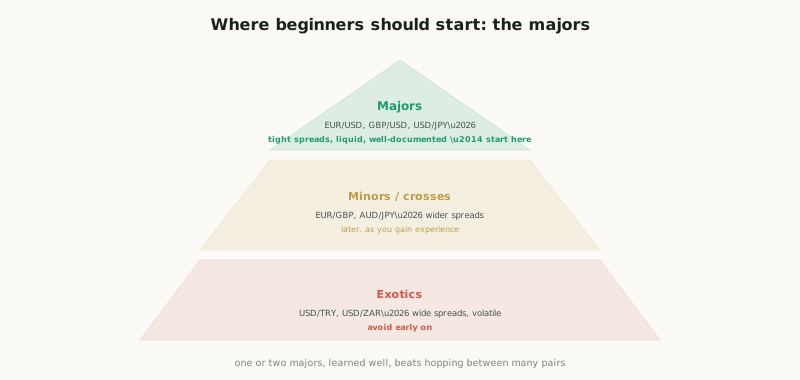
For a beginner, the major pairs — the US dollar against another major currency, such as EUR/USD, GBP/USD and USD/JPY — are clearly the best place to start, for four concrete reasons. First, tight spreads: the majors have the lowest trading costs of any pairs, so you're not handing away an edge on every trade (a real advantage when you're learning and your results are marginal). Second, deep liquidity: enormous trading volume means clean, reliable fills with minimal slippage, and far less risk of erratic, gappy moves than thinner pairs. Third, more stable, predictable behaviour: the majors tend to move in a relatively orderly way driven by well-understood economic factors, rather than the violent, headline-driven lurches of less liquid pairs — they're more forgiving to learn on. Fourth, abundant information: because the majors are the most-traded pairs in the world, there is vastly more analysis, news coverage, education and commentary available on them, so a beginner can find ample material to learn from. EUR/USD in particular — the most-traded pair, with the tightest spreads and the most coverage — is often singled out as the single best pair for a beginner to learn on, and starting there is sound advice.
What to avoid, and focusing your attention
Just as important is knowing what to avoid early on. Exotic pairs — a major currency against an emerging-market currency, like USD/TRY (Turkish lira) or USD/ZAR (South African rand) — are the opposite of beginner-friendly: they have wide spreads (high cost on every trade), thinner liquidity, and can be extremely volatile, prone to sudden, sharp, sometimes brutal moves driven by local politics, intervention or capital flight. That combination is unforgiving for newcomers — the high costs erode results, and the volatility can inflict large losses fast (see exotic currency pairs). The volatility can look exciting, which is precisely the trap: the potential for big moves draws beginners in before they have the risk management to handle it. Minor pairs (crosses that don't include the US dollar, like EUR/GBP or AUD/JPY) sit in between — wider spreads than majors but generally more manageable than exotics — and can reasonably come later, once you've found your feet on the majors.
Beyond which pairs, there's the question of how many — and here the advice is firmly: just a few, ideally one or two to start. It's tempting to watch a dozen pairs hoping to catch more opportunities, but that scatters your attention and stretches you thin without deepening your skill on any one. Focusing on a small number of pairs lets you learn their typical behaviour — how they tend to move, which news and sessions affect them, their usual volatility and rhythm — building the genuine familiarity that's worth far more than superficial exposure to many. Mastering how EUR/USD behaves, what moves it, and how it trades through the London and New York sessions is a real, transferable skill; flicking between twelve pairs you barely know is not. So the beginner's pair strategy is simple and powerful: start with one or two liquid majors (EUR/USD is the classic choice), avoid the exotics until you're experienced, and focus deeply rather than dabbling widely — you can always broaden your horizons later, once the fundamentals are solid. The honest framing: the best pairs for beginners are the major pairs (USD against another major, like EUR/USD, GBP/USD, USD/JPY), because they have tight spreads (low cost), deep liquidity (clean fills), more stable, predictable behaviour, and abundant information — with EUR/USD often the single best starter. Avoid exotic pairs (major vs emerging-market currency) early on: wide spreads, thin liquidity, and extreme volatility make them unforgiving; minors (non-dollar crosses) sit in between and can come later. And trade just one or two pairs to start, focusing deeply to learn their behaviour rather than scattering across many. Start narrow, on the majors, and broaden later.
Getting to know your pair
Choosing a major like EUR/USD is only the start; the real value comes from getting to know it deeply. A pair has a "personality" — a typical rhythm and set of drivers — and learning it is what turns a beginner into someone with genuine feel. A few things to study on your chosen pair. Its sessions and rhythm: when is it most active and liquid (for EUR/USD, the London and New York hours and especially their overlap), and when is it quiet and rangey? Trading it during its active window means tighter spreads and cleaner moves. Its typical volatility and range: roughly how far does it tend to move in a day, so you can size positions and place stops sensibly relative to its normal behaviour (the ATR helps quantify this). And the news that moves it: for EUR/USD, that's US and eurozone data, the Fed and the ECB, and the broad dollar story — knowing which releases on the economic calendar matter for your pair lets you anticipate volatility and avoid being blindsided.
The practical way to build this familiarity is simply focused screen time: watch your one or two pairs regularly, ideally on a demo at first, observing how they behave across sessions and around news, and journalling what you notice. Over weeks, patterns that were invisible become familiar — you start to recognise the pair's typical behaviour, its quiet and active periods, how it reacts to the news that matters — and that hard-won familiarity is a real, transferable edge that no amount of pair-hopping provides. As for when to add a second pair: only once you genuinely know your first — you understand its drivers, you've traded it through different conditions, and you're consistent — should you consider broadening, and even then, add one at a time (a sensible next step might be another major, or a related cross). Beware the temptation to expand too fast chasing more "opportunities"; depth on a few pairs reliably beats shallow exposure to many, especially early on. The progression — master one major, then perhaps a second, broadening only as your skill and consistency justify it — mirrors good development in any skill: build a solid foundation before adding complexity. The honest reminder: don't just pick a major — get to know it deeply by studying its sessions, typical volatility and the news that moves it, through focused demo screen time and journalling; add a second pair only once you genuinely know your first, one at a time, because depth on a few beats shallow exposure to many.
It's worth noting that "best for beginners" doesn't mean "best forever" — it means best for learning. The qualities that make the majors ideal starting ground (tightness, liquidity, stability, information) are simply the qualities that let you learn with the fewest unnecessary obstacles. As you develop genuine skill and risk discipline, you may well branch into crosses or other pairs that suit particular strategies — and that's fine. The point is the order: build competence and consistency on a liquid major first, where the conditions are forgiving and the learning is cleanest, before complicating things. Almost every experienced trader's journey started with mastering one or two majors; following that well-trodden path is simply the most efficient way to learn.
The best pairs for beginners are the major pairs (the US dollar against another major — EUR/USD, GBP/USD, USD/JPY), for four reasons: tight spreads (low cost), deep liquidity (clean fills, little slippage), more stable, predictable behaviour, and abundant information to learn from. EUR/USD is often the single best pair to start on. Avoid exotic pairs (a major vs an emerging-market currency, like USD/TRY) early — wide spreads, thin liquidity and extreme volatility make them unforgiving; minors (non-dollar crosses) sit in between and can come later. And trade just one or two pairs to start — focus deeply to learn how they behave rather than scattering attention across many. Start narrow on the majors; broaden later once the fundamentals are solid.