
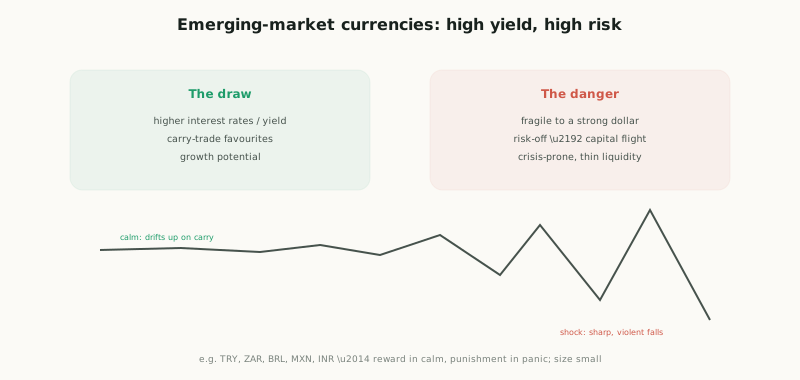
Emerging market currencies — the Turkish lira, South African rand, Brazilian real, Mexican peso and others — tempt traders with high yields and growth stories. But the flip side is fragility: they're acutely sensitive to a strong dollar, risk-off shocks and capital flight, and their history is studded with crises. The defining feature is an asymmetry — a slow climb in calm times, a violent fall in a panic. This guide explains emerging market currencies: what they are, why they're risky, their crisis-prone nature, and how to approach them sensibly.
They're the high-yield engines of the carry trade, frequent protagonists in currency crises, and many trade as exotic pairs.
Key takeaways
Q: What are emerging market currencies?
A: They're the currencies of developing or 'emerging' economies — examples include the Turkish lira (TRY), South African rand (ZAR), Brazilian real (BRL), Mexican peso (MXN), Indian rupee (INR) and many others. Compared with the major currencies of advanced economies, they tend to offer higher interest rates (higher yield) but come with higher risk: thinner liquidity, greater volatility, political and economic instability, and vulnerability to global financial conditions.
Q: Why are emerging market currencies considered risky?
A: Because they're fragile to forces largely outside their control. A strong US dollar and rising US rates pull capital out of emerging markets toward safer, higher US returns; risk-off shocks trigger capital flight as investors flee to safe havens; and many emerging economies carry dollar-denominated debt that becomes harder to service when their currency falls. Add thinner liquidity, political instability and inflation, and EM currencies can fall sharply and suddenly — they've been at the centre of many currency crises.
Q: How should traders approach emerging market currencies?
A: With respect for the asymmetry: they can drift higher on carry in calm conditions but fall violently in a panic, so position sizes should be smaller and risk management tighter than for the majors. Watch the US dollar and US rates, global risk sentiment, and each country's specific situation (politics, inflation, debt). They suit experienced traders who understand the crisis risk; they're not a place for oversized positions or the assumption that the high yield comes for free.
What they are
Emerging market currencies are the currencies of developing or "emerging" economies — examples include the Turkish lira (TRY), South African rand (ZAR), Brazilian real (BRL), Mexican peso (MXN), Indian rupee (INR) and many others across Latin America, Eastern Europe, Africa and Asia. Compared with the major currencies of advanced economies, they tend to offer higher interest rates (higher yield) — the draw — but come bundled with higher risk: thinner liquidity, greater volatility, political and economic instability, higher and more erratic inflation, and acute vulnerability to global financial conditions. They embody the classic risk–reward trade-off in the currency world: the higher yield is compensation for the higher risk, not a free lunch.
Emerging market currencies at a glance
Why they're risky and crisis-prone
Emerging market currencies are considered risky because they're fragile to forces largely outside their control — above all, the US dollar and US interest rates, and global risk sentiment. When the US dollar is strong and US rates are rising, capital is pulled out of emerging markets toward safer, higher US returns — so EM currencies often weaken simply because the dollar is attractive, regardless of their own fundamentals. When a risk-off shock hits, investors flee to safety, triggering capital flight out of EM (which is seen as risky) and into safe havens — EM currencies can drop sharply on a global panic that has nothing to do with the country itself. Compounding this, many emerging economies carry dollar-denominated debt: when their currency falls, that debt becomes more expensive to service (it's owed in dollars but earned in the local currency), which can spiral — a falling currency worsens the debt burden, which worsens confidence, which drives the currency lower still. Add thinner liquidity (moves are more violent), political instability (coups, elections, policy shocks), and bouts of high inflation, and you have currencies that can fall sharply and suddenly. This fragility is why EM currencies have been at the centre of many currency crises — the Asian crisis, various Latin American and Turkish episodes, and others — where a loss of confidence triggered rapid, self-reinforcing collapses. The asymmetry is the key mental model: in calm, risk-on conditions they tend to drift higher (rewarded by their carry — see the carry trade, for which they're favourite targets), but in a shock they can plunge, often giving back months of carry gains in days. "Picking up yield in front of a crisis" is the danger.
Approaching EM currencies sensibly means respecting that asymmetry. Because they drift up slowly on carry but fall violently in panic, position sizes should be smaller and risk management tighter than for the majors — the same nominal position carries far more tail risk in an EM currency, and a stop can be gapped through in a fast collapse, so prudent sizing matters more than usual (see pair volatility and gap risk). Watch the right drivers: the US dollar and US rates (the global tide for EM), global risk sentiment (the risk-on/risk-off backdrop), and each country's specific situation (politics, inflation, debt, central-bank credibility). Understand that the high yield is the compensation for the crisis risk, not a gift — a carry trade in a high-yield EM currency is, in effect, selling insurance against a currency crash, which pays steadily until it doesn't. EM currencies suit experienced traders who understand and respect this; they're emphatically not a place for oversized positions or for assuming the yield comes for free. Treated with that respect — small size, tight risk, eyes on the dollar and risk sentiment, and humility about the crisis tail — they can be traded; treated as easy yield, they eventually deliver a brutal lesson. The honest framing: emerging market currencies (TRY, ZAR, BRL, MXN, INR and more) offer higher yield and growth appeal but higher risk — thin liquidity, volatility, instability, and acute fragility to a strong dollar, rising US rates, risk-off shocks and capital flight (often worsened by dollar debt). They drift up on carry in calm conditions but fall violently in panics, which is why they're crisis-prone. Approach them with smaller size, tighter risk management, and attention to the dollar, global risk sentiment and each country's specifics — the high yield is compensation for crisis risk, not a free lunch.
The carry cycle and the role of the Fed
To trade EM currencies you have to understand the cycle they move through, which is driven as much by global liquidity as by local fundamentals. In calm, risk-on conditions — especially when US rates are low and the dollar is soft — investors "reach for yield," pouring capital into high-yielding EM currencies via the carry trade; these inflows lift EM currencies and reward the carry, often for an extended, seductive stretch. Then a shock — a spike in US rates, a strong dollar, or a global risk-off event — triggers a violent unwind: capital floods back out to safety, EM currencies plunge, and the crowded carry trade reverses all at once (everyone heads for the same narrow exit). This boom-then-bust cycle is the EM signature, and it's why the asymmetry (slow up, fast down) is so pronounced.
The US Federal Reserve sits at the centre of this. Because so much global capital and dollar funding keys off US policy, EM currencies are tightly bound to the US liquidity cycle: when the Fed eases, liquidity flows to EM; when it tightens (or even just signals it), capital rushes home — the "taper tantrum" of 2013, when a hint of Fed tightening sent EM currencies tumbling, is the canonical example. So watching the dollar and the Fed is often more important for EM than watching the EM country itself. That said, differentiation matters: not all EM currencies are equally fragile — those with large current-account deficits, heavy dollar-denominated debt, high inflation or weak institutions are the most vulnerable in a shock, while better-managed economies with surpluses and credible central banks hold up better. The practical synthesis: an EM carry position is effectively selling insurance against a currency crash — it pays a steady premium (the high yield) until the crash comes and wipes out months of gains — so "high carry = high crash risk," and the yield should be sized as the dangerous compensation it is. The honest reminder: EM currencies move in a carry cycle — yield-chasing inflows lift them in calm, risk-on conditions, then a dollar/rate/risk shock triggers a violent unwind as capital flees; the Fed and the US liquidity cycle are central (the 2013 taper tantrum is the classic case), not all EM are equally fragile (current-account deficits and dollar debt mark the weakest), and a high-carry EM position is really selling crash insurance — high carry means high crash risk, so size it accordingly.
Emerging market currencies (TRY, ZAR, BRL, MXN, INR and more) offer higher yield and growth appeal but higher risk — thin liquidity, volatility, instability, and acute fragility to a strong dollar, rising US rates, risk-off shocks and capital flight (often worsened by dollar-denominated debt). The defining asymmetry: they drift up on carry in calm conditions but fall violently in panics — which is why they're crisis-prone and favourite carry targets. Approach: smaller size, tighter risk management (stops can gap in a collapse), and watch the dollar, global risk sentiment and each country's politics/inflation/debt. The high yield is compensation for crisis risk, not a free lunch — for experienced traders, never oversized.