Not all currency pairs move the same amount. Some drift quietly; others swing violently. This difference in volatility — how far a pair typically travels — should shape which pairs you trade, how big your positions are, and how wide your stops sit. Treating a wild pair like a calm one is a classic, costly mistake. This guide explains currency pair volatility: why pairs differ, how to measure it, and why it must drive your position sizing and stops.
It feeds directly into volatility-based position sizing, relates to the wildness of exotic pairs, and is measured with tools like the ATR.
Key takeaways
Q: Why do some currency pairs move more than others?
A: A pair's typical volatility reflects the characteristics of its two currencies and their relationship. Pairs of closely linked, stable economies (like EUR/CHF or EUR/GBP) tend to move in smaller ranges, while pairs combining currencies that diverge — especially yen crosses like GBP/JPY, or anything involving a higher-yielding or commodity currency — tend to swing more. Exotic pairs are the most volatile and erratic. Liquidity, interest-rate gaps and risk sensitivity all feed in.
Q: How do you measure currency pair volatility?
A: The most common tool is the Average True Range (ATR), which gives the average size of a pair's price movement over a period — a practical gauge of how far it typically travels in a day or session. Traders also look at average daily ranges (in pips) and historical volatility. The aim is a realistic sense of a pair's normal movement, so you can size positions and place stops appropriately for that pair rather than using one-size-fits-all numbers.
Q: Why does pair volatility matter for position sizing?
A: Because risk scales with how far price moves. A more volatile pair needs a wider stop (to avoid being shaken out by normal swings), and a wider stop means a smaller position to keep the same money risk — so volatile pairs should generally be traded in smaller size. Treating a wild pair like a calm one (same stop distance, same size) means either getting stopped out constantly or risking far more than intended. Match size and stops to the pair's volatility.
Why pairs differ
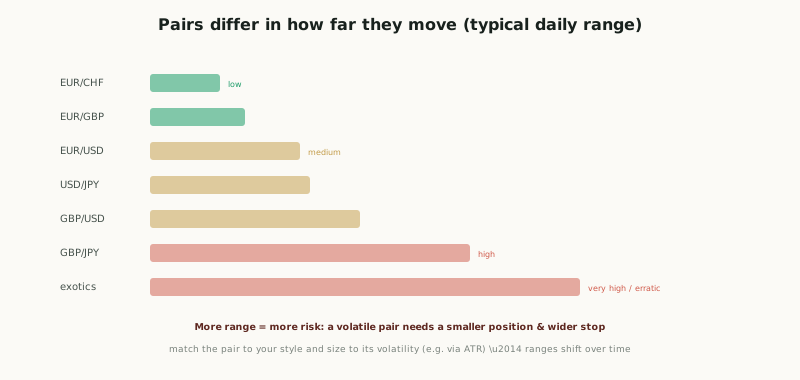
A pair's typical volatility reflects the characteristics of its two currencies and their relationship. At the calm end, pairs of closely linked, stable economies tend to move in smaller ranges — EUR/CHF (two tightly-linked European economies) and EUR/GBP (neighbouring, intertwined economies) are classic low-volatility pairs that often drift rather than lurch. In the middle sit most of the liquid majors — EUR/USD, USD/JPY — with moderate, "normal" ranges. At the wild end are pairs combining currencies that diverge — especially yen crosses like GBP/JPY (long nicknamed "the dragon" or "the beast" for its big swings), and anything pairing a higher-yielding or commodity currency with a contrasting one — which tend to swing far more. And the most volatile and erratic of all are the exotic pairs (involving emerging-market or thinly-traded currencies), which can move dramatically and unpredictably. Underlying these differences are factors like liquidity (thinner pairs move more violently per unit of flow), interest-rate gaps and policy divergence between the two currencies, and risk sensitivity (risk-on/risk-off pairs whip around with sentiment). The point isn't to memorise a ranking — volatility shifts over time — but to recognise that each pair has its own characteristic "personality" of movement.
Measuring it, and why it drives your sizing
To trade a pair sensibly you need a realistic sense of its normal movement, and the most common tool is the Average True Range (ATR), which gives the average size of a pair's price movement over a period — a practical gauge of how far it typically travels in a day or session. Traders also look at average daily ranges (in pips) and historical volatility. The aim is simply to know what's normal for this pair, so you can set stops and sizes that fit it rather than applying one-size-fits-all numbers across very different pairs. This connects directly to the most important practical consequence:
Volatility matters for position sizing because risk scales with how far price moves. A more volatile pair needs a wider stop — placed far enough away that normal swings don't shake you out (a tight stop on GBP/JPY that would suit EUR/CHF will be hit by ordinary noise) — and a wider stop means a smaller position to keep the same money risk (since risk = stop distance × position size × pip value). So volatile pairs should generally be traded in smaller size, and calm pairs can carry larger size for the same risk. The classic, costly mistake is treating a wild pair like a calm one — using the same stop distance and the same position size regardless of the pair — which leads to one of two bad outcomes: either your stop is too tight for the volatile pair and you get stopped out constantly by normal movement, or your position is too large for the volatility and a normal swing costs you far more than you intended (sometimes catastrophically, on an exotic). The fix is volatility-based position sizing: let the pair's ATR / typical range set your stop distance, then size the position so your fixed money risk (e.g. the 1%) is constant across pairs. Done this way, you can trade a calm pair and a wild one with the same account risk — just with very different stop distances and position sizes. Never carry the same lot size from EUR/CHF onto GBP/JPY or an exotic and assume the risk is the same; it isn't, by a wide margin.
Beyond sizing, a pair's volatility should influence which pairs you choose. Match the pair to your style and temperament: a beginner or a risk-conscious trader is usually better served by the calmer, liquid majors (more forgiving, tighter spreads), while the wild swings of GBP/JPY or exotics demand more experience, wider stops, smaller size, and a stronger stomach — the larger ranges offer bigger opportunities and bigger risks. Consider too that volatility changes with conditions: even a "calm" pair can become volatile around major news or in a crisis, and ranges expand and contract over time, so a pair's volatility isn't fixed — re-checking the current ATR matters more than relying on a pair's reputation. The overarching principle is simple and important: volatility is a core dimension of a pair's character, and your risk management must adapt to it pair by pair. Know how far a pair typically moves, size and place stops for that reality, choose pairs that suit your experience and risk appetite, and never assume one set of numbers fits them all. The honest framing: currency pairs differ in volatility — calm crosses (EUR/CHF, EUR/GBP), medium majors (EUR/USD, USD/JPY), wild pairs (GBP/JPY) and erratic exotics — driven by liquidity, rate gaps and risk sensitivity. Measure a pair's normal movement (commonly via ATR / average daily range), because risk scales with how far price moves: a volatile pair needs a wider stop and therefore a smaller position to keep the same money risk. The classic mistake is trading a wild pair like a calm one (same stop and size) — so use volatility-based sizing, match pairs to your style, and remember volatility shifts over time.
Volatility changes — read the regime
A crucial refinement: a pair's volatility is not fixed — it expands and contracts over time in cycles, so today's calm pair can be next month's wild one. Volatility tends to cluster (quiet periods beget quiet periods, then a shock kicks off a stretch of high volatility), and it spikes around major news, central-bank decisions and crises — even a normally placid pair like EUR/CHF can erupt violently on a policy shock (as its own history dramatically shows). It also differs by session: a pair is typically far more active during its currencies' main sessions and the overlap than in its quiet off-hours, so "how volatile is this pair?" partly depends on when you're trading it.
The practical consequences are simple but important. Re-measure rather than assume: check the current ATR/range rather than relying on a pair's reputation or a number you learned months ago, and adapt your stops and sizing as volatility shifts — widening stops and shrinking size when volatility expands, and vice versa (this is the heart of volatility-based sizing, and why it uses a live ATR). Beware the low-volatility trap: a pair that's been unusually quiet can lull you into oversized positions and tight stops right before a volatility explosion, so calm should prompt caution about complacency, not bigger bets. Reading the volatility regime — quiet or active, expanding or contracting, calm session or news window — and adjusting to it is what keeps your risk constant even as the market's character changes beneath you. The honest reminder: volatility isn't fixed — it cycles and clusters, spikes around news and crises (even calm pairs), and varies by session — so re-measure the current ATR rather than assuming, adapt stops and size as it shifts, and beware the low-volatility trap where a quiet pair lulls you into oversized risk just before it erupts.
Currency pairs differ in volatility — calm crosses (EUR/CHF, EUR/GBP), medium majors (EUR/USD, USD/JPY), wild pairs (GBP/JPY) and erratic exotics — driven by liquidity, rate gaps and risk sensitivity. Measure a pair's normal movement (commonly via ATR / average daily range), because risk scales with how far price moves: a volatile pair needs a wider stop, and a wider stop needs a smaller position to keep the same money risk. The classic costly mistake is trading a wild pair like a calm one (same stop and size) — so use volatility-based sizing (let ATR set the stop, then size for a fixed 1% risk), match pairs to your style and experience, and remember volatility shifts over time and spikes around news. Never assume one set of numbers fits every pair.