
The Australian, Canadian and New Zealand dollars are known as the "commodity currencies" — their economies lean heavily on exporting raw materials, so their currencies tend to rise and fall with commodity prices and the global growth cycle. Knowing what drives each one adds a useful lens when you trade them, helping explain moves that pure chart-watching can't. This guide explains commodity currencies: what they are, what drives the AUD, CAD and NZD specifically, and why the link is loose rather than mechanical.
It's a natural companion to currency correlations and to the individual guides for AUD/USD, USD/CAD and NZD/USD.
Key takeaways
Q: What are commodity currencies?
A: Commodity currencies are the currencies of countries whose economies depend heavily on exporting raw materials — most notably the Australian dollar (AUD), Canadian dollar (CAD) and New Zealand dollar (NZD). Because commodity exports are central to these economies, their currencies tend to strengthen when the relevant commodity prices and global demand rise, and weaken when they fall. They are also typically 'risk-on,' growth-sensitive currencies.
Q: What drives the AUD, CAD and NZD?
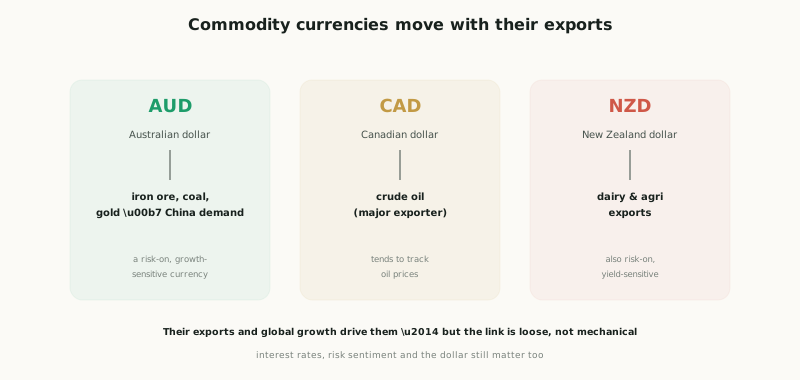
A: Broadly, each tracks its key exports and global growth: the Australian dollar is linked to iron ore, coal and gold and is sensitive to Chinese demand; the Canadian dollar is closely tied to crude oil, as Canada is a major exporter; and the New Zealand dollar is influenced by dairy and agricultural exports. All three are also affected by their central banks' interest rates, broader risk sentiment, and the US dollar — commodities are just one major driver among several.
Q: Is the link between commodity prices and these currencies reliable?
A: It's a real and useful relationship, but loose rather than mechanical. CAD often tracks oil and AUD often tracks its key commodities and Chinese growth, but the correlations vary over time and can break down — interest-rate differentials, risk sentiment, central-bank policy and dollar strength can all dominate in any given period. Treat the commodity link as one important influence to watch, not a precise predictor.
What they are
Commodity currencies are the currencies of countries whose economies depend heavily on exporting raw materials — most notably the Australian dollar (AUD), Canadian dollar (CAD) and New Zealand dollar (NZD) (the "comdolls"). The logic is straightforward economics: when commodity exports are central to a country's income, higher commodity prices and stronger global demand mean more export revenue, a healthier economy, and — all else equal — a stronger currency; falling prices and weak demand do the reverse. On top of this, all three share a "risk-on," growth-sensitive character: they tend to strengthen when global risk appetite is high and growth optimism prevails (capital flows toward growth and yield), and weaken in risk-off, fearful conditions (when capital flees to safe havens instead). So they're often a useful barometer of global growth and risk sentiment — effectively the opposite end of the spectrum from the defensive safe-haven currencies.
What drives each one
While they share the commodity-and-growth theme, each has its own dominant drivers worth knowing:
| Currency | Key commodity / driver | Watch |
|---|---|---|
| AUD (Australia) | Iron ore, coal, gold | Chinese demand & growth |
| CAD (Canada) | Crude oil (major exporter) | Oil prices |
| NZD (New Zealand) | Dairy & agricultural exports | Commodity/dairy prices, risk sentiment |
The Australian dollar is linked to iron ore, coal and gold (Australia's big export earners) and is especially sensitive to Chinese demand — China being the dominant buyer of Australian raw materials, so Chinese growth data and policy can move the AUD sharply (it's often traded as a liquid proxy for the China/Asia growth story). The Canadian dollar is closely tied to crude oil, since Canada is a major oil exporter — so CAD often strengthens when oil rises and weakens when oil falls, making USD/CAD a pair many traders watch alongside the oil price (with the wrinkle that the US is both Canada's neighbour and an oil player, so the relationship has nuances). The New Zealand dollar is influenced by dairy and agricultural exports (New Zealand being a leading dairy exporter), so dairy-auction results and soft-commodity prices feed into it, and — like its close cousin the AUD — it's a risk-on, yield-sensitive currency (the two often move together, which is why AUD/NZD isolates their differences). Knowing these links lets you connect currency moves to the wider world: a slump in oil hints at CAD weakness, a surge in Chinese stimulus hints at AUD strength, and a global growth scare tends to pressure all three.
The essential caveat is that this is a real and useful relationship but a loose one, not mechanical. CAD often tracks oil and AUD often tracks its commodities and Chinese growth — but the correlations vary over time and can break down entirely for stretches. In any given period, other forces can dominate: interest-rate differentials and central-bank policy (a hawkish RBA or BoC can lift its currency regardless of commodities — see central-bank divergence), broad risk sentiment, and the strength of the US dollar itself (since these are usually quoted against USD, dollar moves alone shift them). So the commodity link is one important influence to watch, not a precise predictor — don't assume "oil up, therefore CAD up" will hold on any given day, because rates, sentiment or the dollar may be pulling harder. Used as one lens among several — a reason to watch oil for CAD, China and metals for AUD, dairy for NZD, and global risk appetite for all three — the commodity-currency framework genuinely enriches your understanding of why these currencies move, while respecting that no single relationship rules them. The honest framing: commodity currencies (AUD, CAD, NZD) are the currencies of big raw-material exporters, tending to rise with commodity prices and global growth and falling in risk-off conditions — risk-on, growth-sensitive currencies. Each has its own driver: AUD with iron ore/coal/gold and Chinese demand, CAD with crude oil, NZD with dairy/agriculture. The commodity link is real and useful but loose, not mechanical — interest rates, risk sentiment, central-bank policy and the US dollar can all dominate — so treat it as one important influence to watch, not a precise predictor.
Trading the commodity currencies
Putting the concept to practical use starts with knowing which pairs express each currency most cleanly. The purest expressions are usually the dollar pairs: AUD/USD, USD/CAD and NZD/USD isolate each commodity currency against the dollar, so they respond most directly to the commodity-and-growth story (watch oil for USD/CAD, metals and Chinese data for AUD/USD, dairy and risk sentiment for NZD/USD). The yen crosses — especially AUD/JPY — are widely used as a risk barometer, because they pair a risk-on commodity currency against a risk-off safe haven, so AUD/JPY tends to rise when the world is optimistic and fall when it's fearful (a clean read on global risk appetite). And because the AUD and NZD are such close cousins (both risk-on, both commodity-linked, both Australasian), they move together most of the time — which is exactly why AUD/NZD strips out the shared story and isolates the differences between the two economies (relative dairy vs metals, RBA vs RBNZ policy).
Two further angles sharpen how you trade them. First, the carry/yield dimension: the AUD and NZD have often been higher-yielding currencies, making them favourites for the carry trade (borrow a low-yielder, hold a higher-yielder for the interest), which adds a flow that can support them in calm, risk-on conditions and savage them when carry trades unwind in a panic — another reason they're so risk-sensitive. Second, treat the trio as a global-growth gauge: when all three are strong together, it usually signals broad risk-on optimism and healthy growth expectations; when all three sag, it often flags a growth scare or risk-off mood — useful context even when you're trading other pairs. The practical discipline is to watch the right inputs for each (oil, metals/China, dairy), use the relevant crosses for what you actually want to express (a risk view via AUD/JPY, a relative-economy view via AUD/NZD, a clean commodity-dollar view via the USD pairs), and always remember the commodity link is one input among rates, sentiment and the dollar. Trade them as the risk-on, growth-and-commodity-sensitive currencies they are — with the bigger swings that character brings, sized accordingly. The honest reminder: trade the commodity currencies through their cleanest pairs (AUD/USD, USD/CAD, NZD/USD for the commodity-dollar story; AUD/JPY as a risk barometer; AUD/NZD to isolate the two Australasian economies), watch each one's key inputs (oil, metals/China, dairy), respect the carry/yield and risk-sentiment dimensions, and read the trio together as a global-growth gauge — always treating the commodity link as one input among rates, sentiment and the dollar.
The deeper value of the commodity-currency lens is that it connects the chart to the real world. When AUD/USD moves, it's rarely arbitrary — there's usually a story in iron ore, Chinese data or risk sentiment behind it, and learning to see that story turns price action from noise into something you can reason about. That said, the discipline is to hold the framework lightly: it explains a great deal of the time and almost nothing some of the time, so use it to understand and anticipate, never to override what price and your risk rules are actually telling you.
Commodity currencies — the AUD, CAD and NZD — are the currencies of big raw-material exporters, tending to rise with commodity prices and global growth and fall in risk-off conditions (they're risk-on, growth-sensitive, the opposite of safe havens). Each has its own key driver: AUD → iron ore, coal, gold & Chinese demand; CAD → crude oil; NZD → dairy & agriculture. The commodity link is real and useful but loose, not mechanical — in any period, interest-rate differentials, risk sentiment, central-bank policy and the US dollar can all dominate (and the correlations shift). So treat it as one important lens — watch oil for CAD, China/metals for AUD, dairy for NZD, risk appetite for all three — not a precise predictor.