
Your broker may offer 30:1 leverage (or far more), but that number tells you almost nothing about your risk. What matters is your effective leverage — how big your actual positions are relative to your account. Two traders with the same broker can run wildly different risk, and most blow-ups come from quietly using far more leverage than the trader realises. This guide explains effective leverage: what it is, why it matters more than the broker's maximum, and how to keep it modest.
It's the practical reality behind the dangers of overleverage, flows directly from your position sizing, and connects to margin.
Key takeaways
Q: What is effective leverage?
A: Effective leverage is the actual leverage you're using on your account, calculated as your total open position size divided by your account equity. If you have £5,000 and open a £50,000 position, your effective leverage is 10:1, regardless of whether your broker allows 30:1 or 500:1. It measures how exposed you really are — which is what determines your risk, not the maximum the broker makes available.
Q: Why does effective leverage matter more than the broker's maximum?
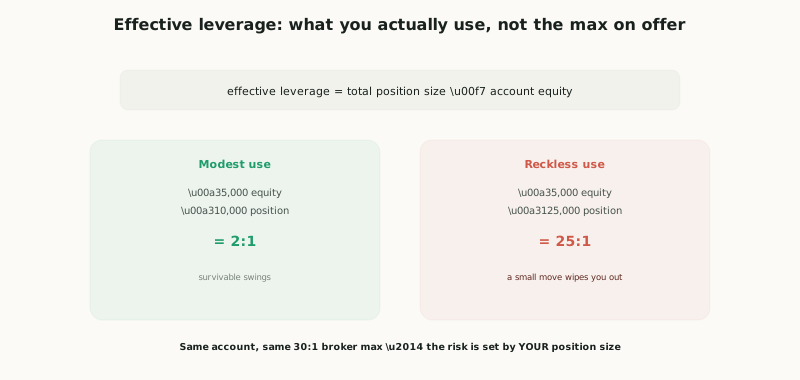
A: Because the broker's maximum is just a ceiling on what's possible — your effective leverage is what you actually do, and that's what your account experiences. Two traders with the same 30:1 broker can run completely different risk: one using 2:1 effective leverage is safe, while one using 25:1 can be wiped out by a small move. High available leverage is only dangerous if you use a lot of it; the risk lives in your position sizing, not the broker's offer.
Q: What's a safe level of effective leverage?
A: There's no single number, but lower is safer, and many disciplined traders keep effective leverage modest — often in low single digits — so that normal market swings can't threaten the account. The more reliable approach is to size positions from your risk per trade (e.g. risking 1% with a sensible stop), which naturally keeps effective leverage in check. If you find your positions imply double-digit effective leverage, that's usually a warning sign of over-exposure.
What it is
Effective leverage is the actual leverage you're using on your account, calculated simply as your total open position size divided by your account equity. If you have £5,000 and open a £50,000 position, your effective leverage is 10:1 — regardless of whether your broker allows 30:1, 100:1 or 500:1. It measures how exposed you really are, which is what determines your risk — not the maximum the broker makes available.
Effective leverage at a glance
The crucial mental shift is that the broker's maximum is a ceiling on what's possible, not a measure of what you're doing. A 500:1 broker isn't 500:1 risky — it's only as risky as you make it by your position sizing. Effective leverage is the number that actually describes your account's exposure, and it's entirely within your control.
Why it matters more than the broker's max
This distinction is one of the most misunderstood and dangerous in trading. The broker's maximum is just a ceiling on what's possible; your effective leverage is what you actually do, and that's what your account experiences in profit and loss. Two traders with the same 30:1 broker can run completely different risk: one using 2:1 effective leverage is safe (a normal market swing barely dents the account), while one using 25:1 can be wiped out by a small move (because every price tick is amplified 25-fold against a thin equity buffer). Same broker, same "available" leverage — utterly different fates, decided entirely by position size. This is why blaming "high leverage" for blow-ups misses the point: high available leverage is only dangerous if you use a lot of it. Leverage is a tool; the broker handing you a 500:1 ceiling is like a shop selling you a vehicle that can do 200mph — the danger isn't the capability, it's how fast you choose to drive. The mistake the marketing around high leverage encourages — and the one that quietly destroys accounts — is treating the available leverage as an invitation to use it, opening positions sized to the broker's max rather than to sensible risk. A trader using high effective leverage feels fine in calm markets (the amplified gains are pleasant) right up until a normal adverse move, magnified by the leverage, triggers a cascade of losses or a margin call — the leverage that flattered the wins now devastates. The risk lives in your effective leverage, not the broker's offer — internalise that and you stop fearing (or worshipping) the broker's number and start managing the only figure that matters.
So what's a safe level, and how do you keep it there? There's no single magic number, but the principle is clear: lower is safer, and many disciplined traders keep effective leverage modest — often in low single digits — so that normal market swings can't threaten the account. The far more reliable approach, though, is not to target a leverage number directly but to size positions from your risk per trade: decide the money you'll risk (e.g. the 1% rule), set a sensible stop, and let the position size fall out of that calculation — this automatically keeps effective leverage in check, because a position sized to risk only 1% with a reasonable stop simply can't be enormous relative to your equity. In effect, proper position sizing controls effective leverage as a by-product, which is the right way round (you manage risk, and modest leverage follows), rather than chasing a leverage figure. As a diagnostic, effective leverage is a great sanity check: if you ever find your open positions imply double-digit effective leverage, that's usually a warning sign of over-exposure — a prompt to cut size before a normal move does it for you. Combine this with awareness of correlation (several correlated positions stack effective leverage even if each looks modest — see portfolio heat) and the principles of risk management generally. The honest framing: effective leverage is the leverage you actually use — total position size divided by account equity — and it, not the broker's maximum, determines your real risk; two traders on the same broker can run 2:1 (safe) or 25:1 (one bad move from ruin) purely through position sizing. High available leverage is only dangerous if you use a lot of it. Keep effective leverage modest by sizing positions from your risk per trade (e.g. 1% with a sensible stop), which controls leverage automatically; treat double-digit effective leverage as a warning sign of over-exposure.
Notional exposure, margin, and the leverage illusion
A big reason traders under-estimate their effective leverage is the confusion between notional exposure and margin used. Your notional exposure is the full size of the position you control (the £50,000 in the earlier example) — this is what effective leverage measures, and what your profit and loss actually swing on. Your margin is merely the deposit the broker requires to open that position (a small fraction of the notional). The trap is that low margin requirements create an illusion of safety: a trader opens a huge position, sees that it "only" tied up a little margin, and feels barely exposed — while in reality their notional exposure (and therefore their effective leverage and risk) is enormous. The margin number is small and reassuring; the notional number is large and dangerous, and it's the one that matters.
The danger becomes concrete in the percentage-move-to-wipeout math. Effective leverage tells you directly how big an adverse move it takes to destroy your account: at 2:1, it would take a ~50% adverse move to wipe you out (effectively impossible in normal forex); at 10:1, a ~10% move; at 25:1, just a ~4% move; at 50:1, a mere ~2%. Since major pairs can move 1–2% in a single session — and far more around news — high effective leverage means a perfectly ordinary move can be fatal, while modest leverage gives you the buffer to survive normal volatility. This is the whole game: the lower your effective leverage, the larger the adverse move you can absorb before ruin. So anchor your thinking to notional exposure, not the comforting margin figure: ask "how big is my total position relative to my equity, and what percentage move would hurt me badly?" rather than "how much margin did this use?" Keep that percentage-to-pain comfortably large, and the overleverage trap can't catch you. The honest reminder: don't confuse notional exposure (the full position size, which drives your P&L and effective leverage) with the small margin needed to open it — low margin creates a false sense of safety while notional exposure is the real risk; the percentage-move-to-wipeout follows directly from effective leverage (2:1 needs ~50%, 25:1 only ~4%, 50:1 ~2%), so since ordinary moves are 1–2%, anchor on notional exposure and keep your move-to-pain comfortably large.
Effective leverage is the leverage you actually use — total position size ÷ account equity — and it, not the broker's maximum, determines your real risk. Two traders on the same broker can run 2:1 (safe) or 25:1 (one bad move from ruin) purely through position sizing — so high available leverage is only dangerous if you use a lot of it (the broker's max is a ceiling, not an instruction). Keep it modest by sizing positions from your risk per trade (e.g. the 1% rule with a sensible stop) — proper position sizing controls effective leverage as a by-product. Treat double-digit effective leverage as a warning sign of over-exposure (and remember correlated positions stack it — see portfolio heat). Manage this one number and most overleverage danger disappears.