Athletes call it "the zone" — that state of calm, absorbed, almost effortless performance where everything clicks and the right action seems obvious. Traders can find it too: a focused clarity in which you execute your process fluidly, read the market without strain, and act decisively, free of anxiety, hesitation and overthinking. This is flow state, and while it's a genuinely valuable state to cultivate, it comes with an important honest caveat — it must be earned through preparation, not chased, and it can never replace a sound system. This guide explains flow in trading: what it is, the conditions that create it, how to cultivate it, and why to keep it in perspective.
It's supported by a strong trading routine, part of the trader's mindset, and built on the foundation of process-focused trading.
Key takeaways
Q: What is flow state in trading?
A: Flow, or 'the zone', is a psychological state of optimal performance and full immersion described by psychologist Mihaly Csikszentmihalyi — marked by complete focus, effortless action, and a loss of self-consciousness. In trading it means executing your process calmly, fluidly and decisively, reading the market clearly without anxiety, hesitation or overthinking.
Q: How do you get into a flow state when trading?
A: Flow arises when challenge is balanced with skill, with clear goals, immediate feedback and deep concentration. For trading, that means mastering your system, having a clear plan and rules, minimising distractions, managing risk and emotions so you're calm, staying present, and being well-rested. A consistent routine or ritual can help you enter the state.
Q: Can you rely on a flow state to trade well?
A: No — and you shouldn't try. Your system and discipline must carry you even on days when flow doesn't come. Chasing 'the zone' or only trading when you feel it is unreliable, and a euphoric, reckless 'hot hand' feeling can be mistaken for genuine flow, breeding overconfidence. True flow is calm and disciplined; it enhances good process, it doesn't replace it.
What flow is
Flow, popularised by psychologist Mihaly Csikszentmihalyi, is the state of optimal performance and full immersion in an activity — characterised by complete focus, effortless action, a loss of self-consciousness, a distorted sense of time, and intrinsic enjoyment of the activity itself. It's the state athletes, musicians and performers describe as being "in the zone," where skill and situation align so well that performance feels fluid and almost automatic. In trading, flow looks like a state of calm, focused, present execution: you follow your process smoothly, read the market with clarity, and act on your setups decisively — without the anxiety, hesitation, second-guessing or overthinking that plague trading done in a poor state. Crucially, trading flow is not euphoria or a gambling high; it's calm, absorbed competence — a quiet, clear-headed engagement, not an adrenaline rush. That distinction matters, as we'll see.
The conditions for flow, and how to cultivate it
Csikszentmihalyi identified specific conditions that produce flow, and they translate well to trading. The table maps them.
Conditions for flow — and the trading equivalent
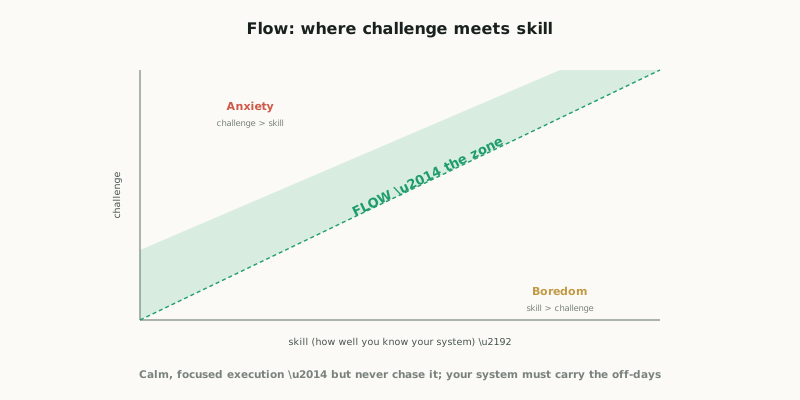
The central condition is a balance between challenge and skill: the task must stretch you without overwhelming you. Too much challenge for your skill level produces anxiety (the overwhelmed, fearful state); too little produces boredom; flow lives in the channel between, where your skill is equal to the challenge. For trading, this means knowing your system well — competence breeds the calm that flow requires, while trading a method you haven't mastered breeds the anxiety that blocks it. The other conditions follow: clear goals map to having a clear plan and rules (which remove ambiguity and the anxiety it brings); immediate feedback comes naturally from the market responding to your decisions; deep concentration requires a distraction-free environment; and a sense of control comes from managed risk (more below).
To cultivate flow, then, work on these conditions. Master your system so skill meets challenge. Have a clear plan and process so you're following well-defined rules rather than improvising anxiously. Minimise distractions and create a focused environment, and use a consistent routine or pre-trading ritual to settle into the right state (the routine link). Manage your risk and emotions so you're calm — this is key: trading a position size small enough that you're not anxious, with risk properly controlled, removes the fear that destroys flow (the fear-and-greed and position-sizing links). Stay present and mindful, and let go of attachment to outcomes — focusing on executing well (the process link) rather than on the money, which paradoxically frees you to perform. And ensure you're rested and healthy, since flow needs a clear, fresh mind — a tired or stressed trader rarely finds the zone.
Keeping it in perspective
Here the honest caveats are essential, because flow can be misunderstood in ways that hurt traders. First, don't chase flow or rely on "feeling it." Your trading must work even when you're not in the zone — most days you won't be, and the whole point of a tested system and solid discipline is that they carry you on the off-days, when you feel flat, distracted or out of sync. A trader who only performs when "feeling it" has no reliable edge; flow is a welcome enhancement, not a prerequisite, and treating it as required leads to skipping trades or forcing a state. Second, and more dangerously, beware mistaking a euphoric "hot hand" feeling for genuine flow. A run of wins can produce a giddy, invincible sensation that feels like being in the zone but is actually overconfidence — and it tempts reckless over-risking just as variance is about to turn (the winning-streaks link). True flow is calm and disciplined, not euphoric or reckless; if you feel invincible and find yourself wanting to abandon your rules and bet big, that's not flow, it's a warning sign. Third, even when genuinely in flow, follow your rules — flow should enhance the execution of your process, not license deviation from it. The honest framing: flow state ("the zone") is the calm, focused, fully-immersed state of optimal performance — in trading, executing your process fluidly and clearly without anxiety or overthinking. It arises when skill meets challenge, with clear goals, feedback and concentration, and is cultivated by mastering your system, having a clear plan, minimising distractions, managing risk and emotions (so you're calm), staying present, and resting well. But don't chase it or rely on feeling it — your system and discipline must carry the off-days — and don't mistake a euphoric gambling-high or lucky-streak feeling for genuine, calm flow, which breeds overconfidence. Flow enhances the execution of a sound process; it never replaces one. Cultivate it as a valuable state, kept firmly in honest perspective.
Building the conditions deliberately
Because flow arises from specific conditions rather than appearing on command, the practical path to it is to engineer those conditions deliberately — chiefly through a consistent routine. A pre-session routine primes the state: reviewing the market and your plan, checking the day's key levels and scheduled news, confirming your risk parameters, and settling your mind before you trade. This preparation does double duty — it sharpens your readiness (skill meeting challenge) and it quiets the anxiety of uncertainty (clear goals), both of which are flow conditions. Many traders add a small ritual — a few minutes of quiet, a breathing exercise, tidying the desk, a fixed sequence of pre-trade checks — that signals to the mind "it's time to focus," helping them drop into a concentrated state more reliably. The environment matters too: a quiet, distraction-free space (notifications off, phone away, no chaotic feeds) protects the deep concentration flow requires, whereas a cluttered, interrupted environment makes it nearly impossible.
Equally important is knowing how to recover the state when it's disrupted, because it will be — a sharp loss, a surprise news spike, an interruption, or a creeping emotional reaction can knock you out of flow mid-session. The skilled response is not to keep trading agitated (where mistakes multiply) but to pause and reset: step away briefly, breathe, return to your plan, and only re-engage once you've regained composure. This is where flow and emotional control meet — recognising you've lost the calm, focused state, and deliberately restoring it (or stopping for the day if you can't), rather than trading through agitation. It's also why risk management underpins flow: when your position size is small enough that no single trade frightens you, and your risk is genuinely controlled, the fear that destroys flow simply has less to grip; you can stay calm because nothing on the table is threatening. The deeper point is that flow isn't a mystical gift to wait for but largely a product of preparation, environment, risk control and routine — build those well, and you create the conditions in which flow can arise far more often. Yet hold to the earlier caveat throughout: engineer the conditions, welcome the state when it comes, but never depend on it — your routine, your rules and your discipline are what carry you through the many sessions when the zone simply doesn't show up.
Flow ("the zone," per Csikszentmihalyi) is the calm, focused, fully-immersed state of optimal performance — in trading, executing your process fluidly and clearly, free of anxiety, hesitation and overthinking (calm competence, not a euphoric high). It arises when challenge meets skill, with clear goals, immediate feedback, deep concentration and a sense of control. Cultivate it by mastering your system, having a clear plan/rules, minimising distractions (and using a routine), managing risk and emotions so you're calm, staying present and process-focused, and being well-rested. But keep it in perspective: don't chase it or rely on feeling it — your system and discipline must carry the off-days; and don't mistake a euphoric "hot hand" or lucky-streak feeling for flow — that's overconfidence, and a warning sign. Flow enhances execution of a sound process; it never replaces one.