Markets seem to breathe: building quietly, rising, topping out, falling, then starting the whole rhythm again. Market cycle theory formalises that rhythm into four phases, linking price to the shifting balance of sentiment and participation over time. It's a genuinely useful lens for understanding where a market might be in its broader arc and why — as long as you remember, honestly, that the cycles are far from clockwork. This guide explains market cycle theory: the four phases, the sentiment behind them, and the important caveats.
It overlaps with Dow theory's phases and the Wyckoff method, and runs alongside the economic business cycle.
Key takeaways
Q: What is market cycle theory?
A: Market cycle theory is the idea that markets move through repeating cycles, classically described in four phases: accumulation (smart money quietly building positions after a decline), markup (a rising trend as more participants join), distribution (smart money selling to latecomers near the top), and markdown (a falling trend as the cycle unwinds). The cycle then repeats. It links price action to the shifting balance of sentiment and participation over time.
Q: What are the four phases of the market cycle?
A: Accumulation (a sideways base after a downtrend, where informed buyers accumulate amid lingering pessimism), markup (the established uptrend, as optimism and participation grow), distribution (a sideways top, where informed money sells into the euphoria of latecomers), and markdown (the downtrend, as the cycle unwinds toward the next accumulation). Sentiment runs from despair and disbelief through hope, optimism and euphoria, then back to fear.
Q: Is market cycle theory reliable for timing?
A: Not for precise timing. The four-phase pattern captures a real, recurring rhythm in market sentiment and is a useful framework for understanding where a market may be in its broader arc. But real cycles are highly irregular in length and shape, phases are far clearer in hindsight than in real time, and forcing the pattern onto charts invites hindsight bias and over-fitting. Use it as a conceptual lens, not a mechanical timing tool.
The four phases
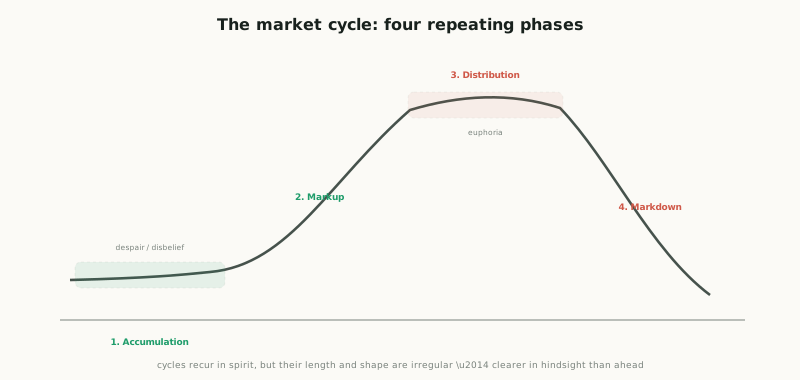
Market cycle theory holds that markets move through repeating cycles, classically described in four phases, each reflecting a different stage in the balance of buyers, sellers and sentiment. Accumulation comes first: after a decline has exhausted itself, the market moves sideways in a base, and informed ("smart") money quietly accumulates positions while the general mood is still pessimistic or indifferent — the lows are in, but few believe it. Markup follows: a genuine uptrend develops as more participants notice and join, optimism builds, and price rises — the phase where trends are clearest and most tradeable. Distribution is the top: price moves sideways at elevated levels as informed money sells into the euphoria of latecomers piling in at the highs (the mirror of accumulation). Markdown completes the cycle: a downtrend sets in as the buying exhausts and the cycle unwinds, falling toward the next accumulation base — and then the whole thing repeats. Mapped to sentiment, the cycle runs from despair and disbelief (accumulation), through hope and optimism (markup), to euphoria (distribution top), then anxiety and fear (markdown) — the emotional arc of a market, which is much of why the pattern recurs: human psychology in aggregate tends to repeat.
This framework connects to several others on this site. It echoes Dow theory's accumulation–participation–distribution phases and the Wyckoff method's operator-driven accumulation/distribution — indeed market cycle theory can be seen as the general, sentiment-level version of those more specific frameworks. It also runs alongside (but is distinct from) the economic business cycle: the business cycle is about the economy (growth, recession), while the market cycle is about price and sentiment, which often leads the economy. Understanding the phases helps a trader read context: trends are most reliable in markup and markdown, while accumulation and distribution are choppy, range-bound transitions where trend strategies struggle and reversals brew.
The honest caveats
Here's the essential honesty about market cycle theory: the four-phase pattern captures a real, recurring rhythm, but real cycles are highly irregular, and treating them as precise is a trap. The length and shape vary enormously — one cycle's markup may last months, another's years; some phases are drawn-out, others fleeting or even skipped; cycles nest within larger cycles — so there is no fixed period you can set your watch by. Worse, the phases are far clearer in hindsight than in real time: looking back at a chart, the accumulation base and distribution top are "obvious," but living through them, you genuinely cannot be sure whether a sideways range is accumulation (about to rise) or distribution (about to fall) until after price resolves — they look identical while forming. This makes the theory dangerously prone to hindsight bias (the past always fits the model neatly) and to over-fitting (forcing the four-phase template onto any chart, seeing cycles that aren't really there). Anyone selling a "market cycle" that precisely times tops and bottoms is overstating wildly. So use market cycle theory as a conceptual lens — a way to think about sentiment, participation and roughly where a market might be in its arc — not as a mechanical timing tool. It's valuable for context and humility (reminding you that euphoric tops and despairing bottoms recur), not for pinpoint prediction.
Held with that honesty, market cycle theory earns its place: it explains why trends and ranges alternate, why sentiment swings between despair and euphoria, and why the crowd is so often most bullish near tops and most bearish near bottoms — all genuinely useful for perspective and for tempering your own emotions (recognising you may be feeling the crowd's euphoria at the distribution top). But always pair it with concrete evidence — actual price structure, confirmation, and other analysis — rather than trading a phase you've merely assumed, and with strict risk management, since "the cycle says it should turn here" is a thesis, not a certainty. The honest framing: market cycle theory says markets move in repeating cycles of four phases — accumulation (a quiet base, smart money buying amid pessimism), markup (the uptrend as optimism grows), distribution (a top, smart money selling into euphoria), and markdown (the downtrend) — mirroring a sentiment arc from despair to euphoria and back. It's the general, sentiment-level cousin of Dow and Wyckoff phases, distinct from the economic business cycle. But real cycles are irregular in length and shape, phases look identical while forming and are clear only in hindsight, and the pattern invites hindsight bias and over-fitting — so use it as a conceptual lens for context and humility, not a precise timing tool, paired with concrete evidence and risk management.
Using cycle thinking well
Granted the heavy caveats, how do you use market cycle theory constructively rather than as a curve-fitting trap? The key is to use it for context and adaptation, not prediction. The most practical application is matching your tools to the likely phase: in markup and markdown (the trending phases), trend-following approaches — trading pullbacks, riding momentum — tend to work, while in accumulation and distribution (the sideways, transitional phases) range and mean-reversion approaches fit better and trend strategies get chopped up. Rather than predicting the next phase, you read the current conditions (is price trending or ranging?) and adapt your strategy accordingly — which is robust precisely because it responds to what price is actually doing rather than to an assumed position in a cycle. This sidesteps the timing problem: you don't need to call the top or bottom in advance, only to recognise and trade the conditions in front of you.
A second valuable use is sentiment-checking your own emotions. The cycle's emotional arc — despair at bottoms, euphoria at tops — is a mirror: if you notice yourself feeling euphoric, certain the market "only goes up," and tempted to pile in with leverage, the cycle framework prompts the sobering question, "am I feeling the distribution-top euphoria?" — and likewise, paralysing despair near lows may be the disbelief of accumulation. Using the cycle as a contrarian sentiment gauge on your own state (and the crowd's) is genuinely useful for tempering emotional extremes, echoing the theory of contrary opinion. The disciplines that keep cycle thinking honest: never trade a phase you've merely assumed — require concrete confirmation from actual price structure before acting; hold the cycle loosely, ready to be wrong about where you are; and combine it with other analysis rather than treating "the cycle says so" as sufficient reason. Approached as a flexible lens for adapting strategy and checking sentiment — rather than a rigid clock for timing tops and bottoms — market cycle theory adds real value without the over-fitting danger. The honest reminder: use cycle thinking for context and adaptation, not prediction — match tools to the conditions (trend strategies in markup/markdown, range strategies in accumulation/distribution), use the emotional arc to sentiment-check your own euphoria or despair, and always require concrete confirmation and other analysis rather than trading an assumed phase.
The enduring value of cycle theory is the perspective it grants: it reminds you that no trend rises forever and no decline falls forever, that today's euphoria and despair have both come before and will pass, and that markets move in rhythms driven by the unchanging swings of human sentiment. That long view is itself steadying — it discourages buying tops in a frenzy and panic-selling bottoms — even though the precise timing of each turn remains, and will always remain, beyond reliable prediction.
Market cycle theory: markets move in repeating cycles of four phases — accumulation (a quiet base, smart money buying amid pessimism), markup (the uptrend as optimism and participation grow), distribution (a top, smart money selling into euphoria), and markdown (the downtrend) — mirroring a sentiment arc from despair to euphoria and back. It's the general, sentiment-level cousin of Dow and Wyckoff phases, and distinct from the economic business cycle. But real cycles are irregular in length and shape; accumulation and distribution look identical while forming and are clear only in hindsight; and the template invites hindsight bias and over-fitting. Use it as a conceptual lens for context and humility — not a precise timing tool — paired with concrete price evidence and risk management.