Take the often-volatile pound, pair it with an oil-driven Canadian dollar, and you get a cross with two largely independent engines — and the wide, sometimes choppy ranges that come from two currencies moving on entirely separate news. GBP/CAD is one of the more energetic crosses for exactly this reason, rewarding traders who respect its volatility and punishing those who size it like a placid major. This guide explains trading GBP/CAD: why it ranges so widely, what drives it, and its best sessions.
It combines the spirited pound with the oil-linked Canadian dollar of USD/CAD — a relative of the calmer EUR/CAD.
Key takeaways
Q: What is the GBP/CAD pair?
A: GBP/CAD is a cross pair (no US dollar) pairing the British pound against the Canadian dollar. It combines the pound — a major but often volatile currency driven by the Bank of England, UK data and politics — with the Canadian dollar, a commodity (petro-) currency shaped by crude oil prices and the Bank of Canada. The two move on largely separate drivers.
Q: Why is GBP/CAD so volatile?
A: Because it stacks two independent sources of movement with little common factor. The pound brings its own often-sharp swings (UK data, BoE policy, political headlines), while the Canadian dollar moves on crude oil and BoC policy. Since UK news and Canadian oil rarely move together, the pair lacks a stabilising shared driver, producing wide, sometimes choppy ranges — amplified by a cross's thinner liquidity and wider spreads.
Q: When is the best time to trade GBP/CAD?
A: The London–New York overlap is generally the most active and liquid window. The London session drives the pound side with heavy GBP liquidity and UK data, while the New York session brings North American flows, the bulk of oil-market activity and Canadian data releases. Outside that overlap, liquidity thins and the already-wide spreads on this cross can widen further.
Why it ranges so widely
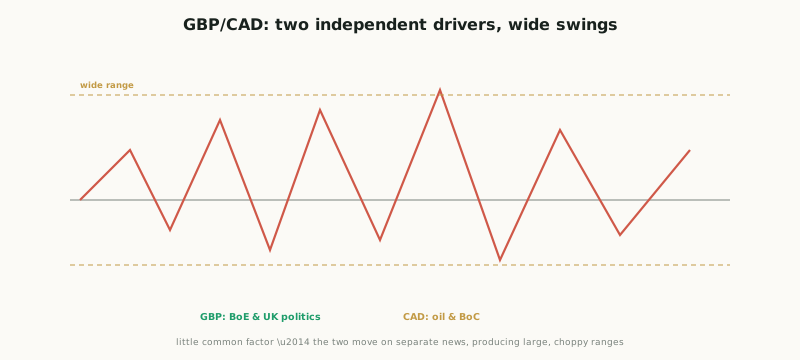
The defining feature of GBP/CAD is its wide-ranging, often choppy behaviour, and the reason is structural: it stacks two largely independent sources of volatility with little common factor to stabilise it. The pound is itself an often-volatile major — prone to sharp moves on Bank of England decisions, UK inflation and growth data, and political headlines (the pound has a long history of event-driven swings). The Canadian dollar, meanwhile, marches to a completely different drum — the price of crude oil and Bank of Canada policy. Because UK news and Canadian oil dynamics rarely move in lockstep, the pair lacks the kind of shared driver that keeps a correlated cross like AUD/NZD range-bound; instead, GBP/CAD often has both sides moving independently, and sometimes in reinforcing directions, producing large ranges. Add the thinner liquidity and wider spreads of a cross (versus a major), and you have a pair that can travel a long way in a session — a feature for traders who want movement, but a hazard for anyone who under-estimates it. The practical implication is clear: GBP/CAD must be sized for its volatility, with wider stops appropriate to its ranges and smaller position sizes to keep risk controlled.
Drivers and sessions
Breaking down the two sides: on the pound side, watch UK drivers — Bank of England rate decisions and expectations, UK inflation, employment and growth data, and political developments, any of which can spark a sharp GBP move. On the Canadian side, watch crude oil (Canada being a major oil exporter, so rising oil tends to strengthen the CAD and push GBP/CAD lower, all else equal) and Bank of Canada policy and Canadian data. The BoE–BoC rate differential provides a slower-moving anchor for the pair's broad direction, while oil swings and UK event risk drive the shorter-term volatility. As with EUR/CAD, a GBP/CAD trader effectively needs to track the oil market alongside two central banks — a broader watch-list than a single major pair demands.
On sessions, the London–New York overlap is the prime window: the London session supplies heavy pound liquidity and UK data, while the New York session brings North American flows, the bulk of oil-market activity, and Canadian releases — so the overlap concentrates the liquidity and the catalysts for both sides. Outside that window, liquidity thins and the already-wide spreads on this cross can widen further, making off-peak trading more costly and erratic. Given all this, GBP/CAD suits traders who actively want volatility and will respect it with appropriate sizing and stops; it's poorly suited to anyone seeking a quiet, tight-spread instrument. As always, the volatility is an opportunity and a risk in equal measure, and no cross is magic — GBP/CAD offers movement and a distinctive blend of drivers to analyse, not a guaranteed edge, and demands confirmation and disciplined risk management. The honest framing: GBP/CAD is a cross pairing the often-volatile pound (BoE, UK data and politics) with Canada's oil-linked dollar (crude oil, BoC). It ranges widely because it stacks two largely independent driver sets with little common factor, amplified by a cross's thinner liquidity and wider spreads — so it must be sized for volatility with wider stops and smaller positions. The BoE–BoC rate gap anchors broad direction; oil swings and UK event risk drive short-term moves; a trader watches the oil market plus two central banks. Most active in the London–New York overlap, costlier off-peak. It suits those who want movement and respect it — an energetic pair to analyse, never a guarantee; manage risk.
Trading GBP/CAD well
Trading GBP/CAD successfully comes down to one principle above all: respect the volatility. Because the pair can travel a long way in a session, the single most important adjustment is sizing — a GBP/CAD position should generally be smaller than you'd take on a calmer major, with wider stops placed to accommodate its ranges (a stop that would be sensible on EUR/USD can be far too tight here, getting clipped by normal noise before the idea plays out). Get the sizing right and the volatility becomes an opportunity; get it wrong and the same volatility is what blows up the account. The pair tends to suit trend and breakout traders who want movement and can ride larger swings, more than scalpers (whom the wide spread penalises) or anyone seeking a placid instrument.
Beyond sizing, a few habits help. Watch both sides' catalysts: keep an eye on the UK calendar (BoE decisions, UK CPI and jobs, political headlines) and the oil market and Canadian data, since a surprise from either can ignite a move — and be especially careful around major UK event risk, which can produce sharp pound gaps. Trade the active window: concentrate activity in the London–New York overlap, where liquidity is deepest and spreads tightest, and be wary of the off-peak hours when this cross's spreads widen and moves get erratic and harder to manage. Mind correlations: GBP/CAD shares the CAD leg with USD/CAD and EUR/CAD and the GBP leg with GBP/USD, so avoid stacking positions that secretly bet on the same thing. And treat the pair's energy with a clear head: its wide ranges can tempt over-trading and revenge-trading after a fast move, exactly the behaviours that compound losses. As always, GBP/CAD offers movement and a distinctive two-engine blend to analyse, not a guaranteed edge — confirm setups, control risk per trade, and let the volatility work for you through disciplined sizing rather than against you. The honest reminder: the whole game on GBP/CAD is matching your sizing and stops to its volatility, trading the liquid overlap, watching both UK event risk and oil, and keeping the pair's energy from provoking undisciplined trading.
Spreads, costs and timing
On an energetic cross like GBP/CAD, transaction costs and timing deserve more attention than they get on a tight major. The spread — the gap between bid and ask — is structurally wider here than on GBP/USD or USD/CAD, because the cross has thinner liquidity, and that spread is a real cost paid on every trade. The practical implications: GBP/CAD is poorly suited to high-frequency scalping, where a wide spread devours the small intended profit; it rewards trades with larger targets (swing and trend moves) where the spread is a smaller fraction of the expected gain; and it should be traded when the spread is tightest. That timing point is crucial: during the liquid London–New York overlap, spreads are at their best and the pair moves on real flow, whereas in the off-peak hours (the quiet period after New York and before London), liquidity drains away, the spread can widen sharply, and price action turns thin and erratic — a costly, treacherous time to trade this cross. A disciplined GBP/CAD trader therefore concentrates activity in the active window, factors the spread into every risk-reward calculation, and avoids the temptation to trade the dead hours. Combined with volatility-appropriate sizing, respecting costs and timing is what separates traders who harness GBP/CAD's movement from those it grinds down through spread and slippage.
Put together, the GBP/CAD playbook is coherent: pick your moments in the liquid overlap, size small with stops fit for the pair's range, factor the wide spread into every target, watch both UK event risk and the oil market for catalysts, and keep correlated CAD or GBP exposures from quietly compounding. None of this tames the volatility — it harnesses it. The trader who treats GBP/CAD with that respect can use its movement productively; the one who trades it casually, like a tight major in any session, hands the spread and the swings a steady edge over their account. Discipline, not prediction, is what makes this energetic cross workable.
GBP/CAD is a cross pairing the often-volatile pound (BoE, UK data, politics) with Canada's oil-linked dollar (crude oil, BoC). It ranges widely because it stacks two largely independent engines with little common factor — amplified by a cross's thinner liquidity and wider spreads — so size it for volatility, with wider stops and smaller positions. The BoE–BoC rate gap anchors broad direction; oil swings and UK event risk drive the short-term moves, so watch the oil market and two central banks. Most active in the London–New York overlap; spreads widen and movement gets erratic off-peak. It suits traders who actively want movement and respect it with proper sizing — an energetic blend of drivers to analyse, not a guaranteed edge; always trade with confirmation and risk management.