
NZD/CHF is the Kiwi version of AUD/CHF — a risk-on currency against a safe haven, so another clean barometer of global risk appetite. But it's thinner, more volatile, and carries the franc's ever-present SNB tail risk. This guide covers trading NZD/CHF: why it behaves as a risk gauge, what drives each leg, and the two risks — SNB intervention and low liquidity — that make it a pair for experienced hands.
It's a close sibling of AUD/CHF, pairing the risk-on Kiwi of NZD/USD with the safe-haven franc as a direct risk-on/risk-off read.
Key takeaways
Q: What is NZD/CHF?
A: NZD/CHF is the currency pair pricing the New Zealand dollar (NZD) against the Swiss franc (CHF) — how many Swiss francs one New Zealand dollar buys. Like AUD/CHF, it pits a risk-on currency (the Kiwi) against a safe haven (the franc), making it a barometer of global risk sentiment. It's a thin minor cross with low liquidity and wide spreads, and it carries the franc's SNB intervention tail risk.
Q: How does NZD/CHF behave?
A: As a risk barometer, much like AUD/CHF. In risk-on conditions the risk-sensitive New Zealand dollar tends to strengthen while the safe-haven franc softens, so the pair rises; in risk-off conditions the Kiwi is sold while the franc is bought, so the pair falls. The opposite risk sensitivities of its two legs make NZD/CHF reflect and amplify the prevailing risk mood, with the Kiwi's dairy and RBNZ specifics layered on top.
Q: What are the risks of trading NZD/CHF?
A: Two main ones. First, the SNB intervention tail risk shared by all franc pairs — the Swiss National Bank has acted dramatically before (the 2015 cap removal), causing violent moves that can gap through stops. Second, NZD/CHF is one of the thinner crosses, with low liquidity and wide spreads, which raises costs and can worsen slippage. Both call for conservative sizing, gap awareness, and treating it as a pair for experienced traders only.
A thinner risk barometer
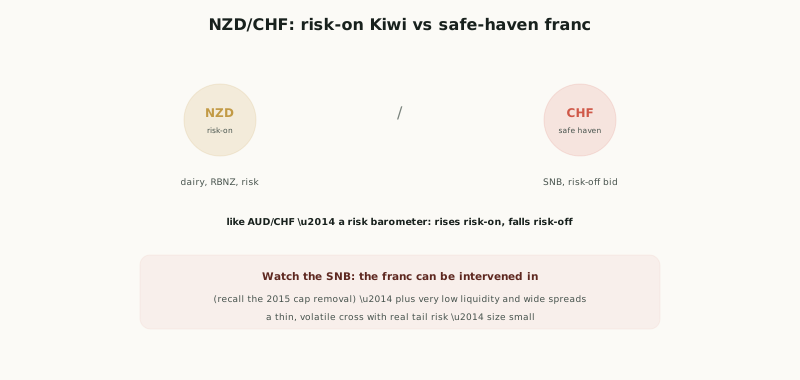
NZD/CHF works much like its better-known sibling AUD/CHF, because it shares the same fundamental structure: a risk-on currency versus a safe haven. The New Zealand dollar is a classic risk-on currency — it tends to strengthen when risk appetite is high and commodity/growth optimism prevails (NZD is tied to soft commodities like dairy and to Asia-Pacific demand). The Swiss franc is a classic safe haven — it strengthens in risk-off conditions as capital seeks safety. Because these sensitivities are opposite, the cross becomes a near-pure risk gauge: in risk-on conditions the Kiwi rises while the franc softens, pushing the pair up; in risk-off conditions the Kiwi is sold while the franc is bought, pushing the pair down. So, like AUD/CHF, NZD/CHF reflects and amplifies the prevailing risk mood — a rising pair signalling improving risk appetite, a falling one signalling fear. The differences from AUD/CHF are matters of degree and specifics: NZD's particular drivers (dairy prices, the Reserve Bank of New Zealand, China/Asia-Pacific demand) replace AUD's (though both are heavily China- and commodity-influenced), and crucially NZD/CHF is thinner — one of the lower-liquidity crosses, with wider spreads and a tendency to be more volatile as a result. It's a risk barometer, but a choppier, less liquid one than the Aussie equivalent.
The two key risks
NZD/CHF carries two risks that demand real respect. First, the SNB intervention tail risk shared by every franc pair. The Swiss National Bank has a history of actively managing the franc to stop it becoming too strong, including intervention and, most infamously, the 2015 removal of the EUR/CHF floor — which caused a massive, instantaneous franc surge that inflicted catastrophic losses on unprepared traders and even broke some brokers. It's rare, but it's a genuine policy tail risk: the SNB can act suddenly and dramatically, causing violent moves that gap straight through stops — meaning a stop-loss may not protect you at the price you expect. Second, NZD/CHF is one of the thinnest commonly-listed crosses, with low liquidity and wide spreads. Thin liquidity raises trading costs (the wide spread eats edge) and worsens slippage (orders can fill at worse prices, especially in fast moves), and it can amplify volatility (less liquidity means a given flow moves price further). The two risks compound: a low-liquidity pair experiencing an SNB-driven franc spike is a recipe for a violent, stop-jumping, slippage-heavy move. So NZD/CHF must be sized small and treated with caution — conservative position sizing (the wide stops a volatile, thin pair needs translate into small positions under the 1% rule), full awareness that stops can be gapped, and no careless leverage. This is emphatically not a beginner's pair.
Putting it together: NZD/CHF is a useful risk barometer — a clean read on global risk appetite, much like AUD/CHF — with the Kiwi's dairy/RBNZ/Asia specifics layered on. But its thin liquidity and the franc's SNB tail risk make it a pair to approach with genuine caution and respect. The sensible user is an experienced trader who values its risk-sentiment clarity, understands its drivers (risk mood, dairy, China, the RBNZ and SNB), and — above all — sizes conservatively for both its volatility and the ever-present possibility of a sudden franc move. On timing, the Kiwi is most active in the Asia-Pacific hours and the franc in the European/London session, so liquidity (already thin) varies through the day; the European hours tend to offer the better conditions for the CHF leg. As with every pair, NZD/CHF has no inherent edge — the edge is in understanding what it reflects and rigorously managing its specific, elevated risks. The honest framing: NZD/CHF is the Kiwi version of AUD/CHF — a risk-on currency (NZD: dairy, RBNZ, China) against a safe haven (CHF), so a clean barometer of global risk appetite that rises in risk-on and falls in risk-off. But it's thinner and more volatile than AUD/CHF, and it carries two key risks: the SNB intervention tail risk shared by all franc pairs (the 2015 cap removal), which can gap through stops, and low liquidity with wide spreads that raise costs and slippage. Size small, mind gap risk, trade the relevant sessions, and treat it as a pair for experienced traders only.
Trading it carefully
Like AUD/CHF, NZD/CHF is best used and traded as a risk-sentiment gauge — trade it aligned with where global risk appetite is heading, since sustained risk regimes push both legs the same way and can produce persistent trends. The practical question is when to choose NZD/CHF over AUD/CHF, given they're near-siblings. The honest answer: for a pure risk-barometer expression, AUD/CHF is usually the better choice — it's more liquid, with tighter spreads and cleaner execution. You'd specifically pick NZD/CHF when you have an NZD-specific view — a thesis on dairy prices, the RBNZ, or New Zealand's particular situation — that you want to express against the safe-haven franc, accepting the thinner conditions as the cost of that specificity. If you just want a risk gauge, reach for the more liquid Aussie version.
Because NZD/CHF is one of the thinnest crosses, execution demands extra care. The wide spread raises costs, so factor it into whether a trade's edge survives. Slippage is a real risk in fast moves (thin liquidity means orders can fill at worse prices), so be cautious with market orders during volatile periods and around news. Weekend and gap risk deserve heightened respect on a thin pair — and especially so given the franc's SNB tail risk: the Swiss National Bank can act suddenly (as in the 2015 cap removal), and on a low-liquidity cross such a move could be especially violent and gap brutally through stops. All of this points to the same discipline: size small (conservative positions that account for both the volatility and the tail risk), don't carry careless leverage, and treat NZD/CHF as a specialist's tool rather than a default. On sessions, the franc is most active in the European/London hours and the Kiwi in the Asia-Pacific, so the (already thin) liquidity is best for the CHF leg during European hours. The honest reminder: trade NZD/CHF as a risk gauge aligned with the risk regime, but prefer the more liquid AUD/CHF unless you have a specific NZD view; respect the thin liquidity (wide spreads, slippage, gap and weekend risk) and the franc's SNB tail risk by sizing small, avoiding careless leverage and market orders in fast conditions, and favour European hours for the CHF leg — a specialist's pair, not a default.
Where it fits
NZD/CHF is a specialist's pair — useful in a narrow set of circumstances and best avoided otherwise. Its natural user is an experienced trader who wants to express an NZD-specific view (dairy, the RBNZ, New Zealand's situation) against the safe-haven franc, and who accepts the thin conditions as the price of that specificity. For a general risk-barometer trade, the more liquid AUD/CHF is almost always the smarter pick; for most other purposes, more liquid pairs serve better. Combined with the franc's SNB tail risk, this firmly rules it out for beginners, who should master liquid majors and the risk-on/risk-off framework long before touching a thin franc cross. Approached with a clear NZD thesis, conservative sizing, careful execution (mindful of slippage and gaps) and full respect for the SNB risk, NZD/CHF is a tradeable specialist tool; approached casually, its thin liquidity and tail risk make it a poor default. The edge, as with every pair, is in the understanding and the risk management — never the pair alone.
NZD/CHF is the Kiwi version of AUD/CHF — a risk-on currency (NZD: dairy, RBNZ, China/Asia) against a safe haven (CHF) — so a clean barometer of global risk appetite: it rises in risk-on, falls in risk-off. But it's thinner and more volatile than AUD/CHF, and carries two key risks: the SNB intervention tail risk shared by all franc pairs (the 2015 cap removal), which can gap through stops; and low liquidity with wide spreads, raising costs and slippage (and amplifying volatility). The two compound — so size small (wide stops → small positions under the 1% rule), mind gap risk, trade the relevant sessions (European for CHF), and treat it as a pair for experienced traders only.