
AUD/CHF pits a textbook risk-on currency against a textbook safe haven — which makes it one of the cleanest barometers of global risk appetite in all of forex. When the world feels brave, it rises; when fear strikes, it falls. That makes it less a bet on two specific economies than a read on the market's mood. This guide covers trading AUD/CHF: why it's such a pure risk gauge, what drives each leg, and the all-important SNB caveat.
It combines the risk-on Aussie of AUD/USD with the safe-haven franc, making it a direct expression of risk-on/risk-off sentiment.
Key takeaways
Q: What is AUD/CHF?
A: AUD/CHF is the currency pair pricing the Australian dollar (AUD) against the Swiss franc (CHF) — how many Swiss francs one Australian dollar buys. It's a minor cross that's notable for pitting a classic risk-on, commodity-linked currency (the Aussie) against a classic safe-haven currency (the franc), which makes it a particularly clean gauge of global risk sentiment.
Q: Why is AUD/CHF a risk barometer?
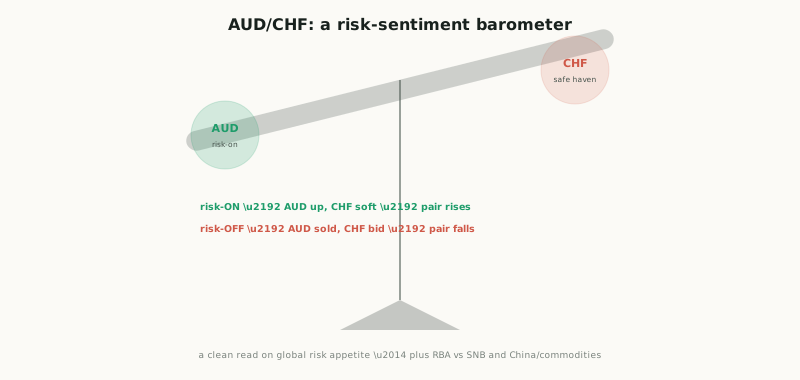
A: Because its two currencies respond to risk sentiment in opposite directions. In risk-on conditions, the Australian dollar tends to strengthen (risk appetite, commodities, growth) while the safe-haven franc softens, so the pair rises. In risk-off conditions, the Aussie is sold while the franc is bought as a haven, so the pair falls. This opposite sensitivity makes AUD/CHF amplify and clearly reflect the prevailing risk mood.
Q: What should I watch when trading AUD/CHF?
A: Global risk sentiment first and foremost, plus the Reserve Bank of Australia and Swiss National Bank, commodity prices and China (key for the Aussie), and crucially the SNB's stance on the franc — the Swiss central bank has intervened to weaken its currency before (notably the 2015 cap removal), which is a real tail risk for any CHF pair. It's also a minor cross with wider spreads and lower liquidity than the majors.
Why it's a risk barometer
What makes AUD/CHF special is that its two currencies respond to risk sentiment in opposite directions, so the pair amplifies and cleanly reflects the prevailing risk mood. The Australian dollar is a classic risk-on, commodity-linked currency: it tends to strengthen when risk appetite is high, growth optimism prevails, and commodities rally (Australia is a major commodity exporter, sensitive to global growth and China). The Swiss franc is a classic safe haven: it tends to strengthen in risk-off conditions as capital flees to safety. Because these two pulls are opposite, the cross becomes a near-pure risk gauge. In risk-on conditions, the Aussie rises while the safe-haven franc softens — a double push up for the pair. In risk-off conditions, the Aussie is sold while the franc is bought — a double push down. So AUD/CHF doesn't just respond to risk sentiment, it magnifies it: both legs move the same way for a given shift in mood, making the pair one of the most direct chart-readable expressions of "is the market brave or fearful right now?" Traders use it (and watch it) as a barometer — a rising AUD/CHF signals improving risk appetite, a falling one signals rising fear — useful even for those trading other instruments, as a read on the broad regime.
Drivers, sessions and the SNB caveat
While risk sentiment dominates, AUD/CHF still has its specific drivers. On the Aussie side: the Reserve Bank of Australia (rates and stance), Australian data, commodity prices, and especially China (Australia's largest trading partner — Chinese growth and demand heavily influence the AUD). On the franc side: the Swiss National Bank (SNB), Swiss data, and broad safe-haven flows. Relative monetary policy between the RBA and SNB (a divergence factor) shapes the pair's trend beyond the day-to-day risk swings. On timing, the Aussie is most active during the Sydney/Asian and into European hours, while the franc trades most through the European/London session, so liquidity is reasonable across the Asian-into-European window.
The crucial caveat for any franc pair, and one every CHF trader must internalise, is the SNB. The Swiss National Bank has a history of actively managing the franc to prevent it becoming too strong (which hurts Swiss exporters), including intervention and, most memorably, the 2015 removal of the EUR/CHF floor — which caused a massive, instantaneous franc surge that inflicted catastrophic losses on unprepared traders (and even broke some brokers). The lesson isn't that this happens often — it's rare — but that the franc carries a genuine policy/intervention tail risk: the SNB can act suddenly and dramatically, causing violent moves that gap through stops. So while AUD/CHF is a clean risk barometer, it's not a "safe" pair to size carelessly — the franc's SNB tail risk demands respect (conservative sizing, awareness that a stop may not protect you in an intervention spike). Add the usual minor-cross traits — wider spreads and lower liquidity than the majors — and AUD/CHF is best approached by traders who value its risk-barometer clarity, understand its specific drivers (China, the two central banks, risk mood), and crucially respect the SNB tail risk with disciplined risk management. As ever, the pair offers a useful lens and genuine opportunity, but no magic edge — the edge is understanding what it reflects and managing the risk. The honest framing: AUD/CHF prices the risk-on Australian dollar against the safe-haven Swiss franc, making it a clean, amplified barometer of global risk appetite — it rises in risk-on (AUD up, CHF soft) and falls in risk-off (AUD sold, CHF bid). Beyond risk mood, watch the RBA and SNB, commodities and China (for AUD), and safe-haven flows (for CHF). The crucial caveat is the SNB's history of intervening in the franc (the 2015 cap removal), a real tail risk for any CHF pair — so respect it with conservative sizing and gap awareness, alongside the usual wider-spread, lower-liquidity minor-cross traits.
Trading it as a risk gauge
AUD/CHF's defining usefulness is as a risk barometer, and that shapes how to trade and use it. Many traders watch it (even when not trading it) as a read on the broad risk regime — a steadily rising AUD/CHF confirms a risk-on environment, a falling one confirms risk-off — using that signal to inform other positions (for example, gaining confidence in a risk-on trade elsewhere when AUD/CHF agrees). When trading it directly, the pair tends to trend in sustained risk regimes: a prolonged risk-on phase (or risk-off panic) pushes both legs the same way for an extended run, so AUD/CHF can produce clean, persistent trends that suit a trend-following approach aligned with the prevailing mood. The key is recognising that you're really trading global risk sentiment, so your thesis should be a view on where risk appetite is heading — plus the China/commodity overlay (since AUD is heavily influenced by Chinese demand and commodity prices, a strong China/commodity backdrop reinforces the risk-on push).
Beyond the risk mood, watch the specific drivers: the RBA and SNB (their relative stance — a divergence factor — shapes the trend beneath the risk swings), Australian data, and Chinese/commodity developments. On correlations, AUD/CHF moves in sympathy with other risk-vs-haven crosses (notably AUD/JPY, another classic risk barometer using the safe-haven yen), so holding both is largely the same bet on risk sentiment — a correlation-risk trap to avoid doubling unintentionally (see correlations). On sessions, liquidity spans the Asian (AUD) into European (CHF) hours, with reasonable conditions across that window. And always keep the SNB tail risk in view — even a clean risk-barometer trend can be disrupted by a sudden franc move, so size conservatively. The honest reminder: AUD/CHF is best understood and traded as a risk-sentiment gauge — use it to read the regime and trade it aligned with where risk appetite is heading (it trends in sustained risk regimes), with the China/commodity overlay on the AUD leg; watch the RBA and SNB, avoid doubling it with correlated risk crosses like AUD/JPY, trade the Asian-into-European window, and never forget the franc's SNB tail risk when sizing.
Where it fits
AUD/CHF earns its place primarily as a risk-sentiment instrument — valuable both to trade directly (for those with a view on global risk appetite and the China/commodity backdrop) and to watch as a confirming gauge of the broad mood, even by traders focused elsewhere. It suits a trader who thinks in terms of risk regimes and wants a clean way to express or read them. It's more approachable than the wild GBP crosses (its moves are usually less extreme than GBP/NZD's), but the franc's SNB tail risk and the minor-cross spreads still place it above beginner level; newcomers should understand the risk-on/risk-off framework and the SNB caveat thoroughly before trading it.
The synthesis: use AUD/CHF as a barometer and trade it aligned with where risk appetite is heading, leaning on its tendency to trend in sustained regimes; layer in the China/commodity and RBA-versus-SNB specifics, avoid doubling it with correlated risk crosses like AUD/JPY, and keep conservative sizing for the franc's ever-present intervention risk. Read well, it's one of the cleaner expressions of market sentiment available in forex; the edge, as ever, is in understanding what it reflects and managing the risk, not in the pair itself.
AUD/CHF prices the risk-on Australian dollar against the safe-haven Swiss franc, making it a clean, amplified barometer of global risk appetite: it rises in risk-on (AUD up, CHF soft) and falls in risk-off (AUD sold, CHF bid) — both legs push the same way for a given mood shift. Beyond risk sentiment, watch the RBA and SNB, commodities and China (for the Aussie), and safe-haven flows (for the franc). The crucial caveat: the SNB has a history of intervening in the franc (the 2015 cap removal caused a violent surge) — a real tail risk for any CHF pair, so respect it with conservative sizing and gap awareness. Add the usual minor-cross wider spreads and lower liquidity. A great risk gauge — but not one to size carelessly.