A single backtest is easy to fool yourself with — you can always tune a strategy until it looks perfect on the past. Walk-forward analysis fixes the most dangerous part of that by forcing every test onto data the strategy has never seen. It's one of the most honest tools for telling a real edge from a curve-fit illusion, and a core technique for anyone serious about validating a system before risking money. This guide explains walk-forward analysis: what it is, why it beats a single backtest, and its limits.
It's the practical antidote to overfitting, a step beyond a basic backtest, and pairs with Monte Carlo and statistical significance for robust validation.
Key takeaways
Q: What is walk-forward analysis?
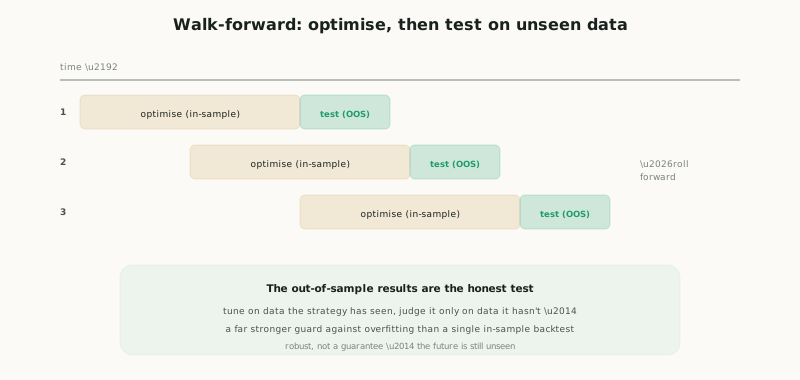
A: Walk-forward analysis is a way of testing a trading strategy that mimics how you'd actually use it over time. You optimise (tune) the strategy on one window of historical data — the 'in-sample' period — then test it, unchanged, on the next, unseen window — the 'out-of-sample' period. Then you roll both windows forward and repeat. By stitching together the out-of-sample results, you get a picture of how the strategy performs on data it was never tuned on.
Q: Why is walk-forward better than a single backtest?
A: Because a single backtest is optimised on the very data it's measured on, so it's easy to over-tune it until it fits the past's quirks — overfitting that looks great historically but fails live. Walk-forward separates tuning from testing: the strategy is always judged on data it hasn't seen, which is far closer to real trading and a much stronger guard against curve-fitting. The out-of-sample results are the honest measure.
Q: Does walk-forward analysis guarantee a strategy will work?
A: No. It's a more robust and honest test than an in-sample backtest, but it's still based on historical data, and the future can differ from any past — markets change, regimes shift, and no test can prove an edge will persist. Walk-forward reduces the risk of fooling yourself with overfitting, but it doesn't remove uncertainty. Treat strong walk-forward results as encouraging evidence, not a promise, and keep managing risk regardless.
What it is
Walk-forward analysis is a way of testing a strategy that mimics how you'd actually use it over time. You optimise (tune) the strategy on one window of historical data — the "in-sample" period — then test it, unchanged, on the next, unseen window — the "out-of-sample" period. Then you roll both windows forward (the old out-of-sample becomes part of the new in-sample) and repeat, walking through history step by step. Finally, you stitch together all the out-of-sample results — the performance on data the strategy was never tuned on — to judge the strategy. The key insight is the strict separation: you're allowed to tune on data the strategy has seen, but you only judge it on data it hasn't. This mirrors reality — in live trading, you set your parameters based on the past and then face an unknown future — so walk-forward asks the genuinely important question: "how does this strategy do on data it wasn't fitted to?" rather than the misleading question a plain backtest answers ("how well can I make this fit the past?"). It's the difference between testing whether you've found a real pattern versus whether you've merely memorised the answers.
Why it beats a single backtest — and its limits
Walk-forward is far better than a single backtest for one decisive reason: a plain backtest is optimised on the very data it's measured on, so it's trivially easy to over-tune it until it fits the past's specific quirks and noise — overfitting that produces a beautiful historical curve and then fails live. This is the single most common way traders fool themselves: they tweak parameters until the backtest looks spectacular, not realising they've fitted the strategy to random historical accidents that won't repeat. Walk-forward separates tuning from testing: because the strategy is always judged on data it hasn't seen, over-tuning to the in-sample period shows up as poor out-of-sample results — the test punishes curve-fitting rather than rewarding it. If a strategy holds up out-of-sample across multiple rolling windows, that's genuinely encouraging evidence it captures something real and repeatable, not just historical noise. It's also closer to real trading than a static backtest, since it explicitly models the "tune-then-face-the-unknown" cycle you actually live. For a quantitatively-minded trader, the out-of-sample gate is the honest measure — the result that actually counts — and a strategy that only shines in-sample but wilts out-of-sample should be treated as failed, however pretty its backtest.
But — crucially — walk-forward analysis does not guarantee a strategy will work. It's a more robust and honest test than an in-sample backtest, but it's still based on historical data, and the future can differ from any past: markets change, regimes shift, relationships break, and a black swan can invalidate everything that came before. No test — walk-forward included — can prove an edge will persist; it can only show the edge held up on unseen historical data, which is the best backward-looking evidence available but is not a forward guarantee. There are also subtler pitfalls to respect: if you run many walk-forward tests on many strategies, some will pass by chance (the multiple-testing problem — see statistical significance); the windows must be long enough to be meaningful (a tiny out-of-sample sample tells you little); and the same data and cost hygiene a backtest needs (realistic costs, slippage, no look-ahead) applies here too. The sound stance: treat strong walk-forward results as encouraging evidence, not a promise, combine them with Monte Carlo and significance checks, keep position sizes and risk management conservative regardless (because even a validated edge can fail), and stay alert for the strategy degrading in live trading (a sign the world has changed). Used this way — as the most honest backward-looking test rather than a crystal ball — walk-forward analysis is one of the most valuable tools for distinguishing a genuine edge from a comforting illusion. The honest framing: walk-forward analysis optimises a strategy on an in-sample window then tests it unchanged on the next unseen out-of-sample window, rolling forward and repeating, so you judge it only on data it wasn't tuned on. This beats a single backtest because it separates tuning from testing and punishes overfitting rather than rewarding it, giving a far more honest measure. But it's still historical, so it can't guarantee the future — markets change and edges can fail — so treat strong out-of-sample results as encouraging evidence, mind multiple-testing and sample size, and keep managing risk regardless.
The in-sample / out-of-sample split in practice
At its heart, walk-forward rests on one disciplined idea: the in-sample / out-of-sample split. Even without the full rolling machinery, you can capture most of the benefit with a simpler single split: reserve a chunk of data (often the most recent portion) as out-of-sample, never touch it during development — build, tune and optimise only on the in-sample portion — and then test once on the untouched out-of-sample data at the very end. If the strategy holds up on that data it has never seen, that's meaningful; if it falls apart, you've been saved from trading an overfit system. The iron discipline is to treat the out-of-sample data as sacred: the moment you start peeking at it, re-tuning after a poor OOS result, and re-testing, you've contaminated it — it's no longer "unseen," and you're back to overfitting (now to the OOS data too). A reserved sample is only an honest test once.
Full walk-forward extends this by rolling the split through history, and comes in two flavours worth knowing. Rolling (or "sliding") walk-forward uses a fixed-length in-sample window that moves forward (always tuning on, say, the last two years), which adapts to changing conditions but discards old data. Anchored walk-forward keeps the in-sample window's start fixed and lets it grow (always tuning on all data up to the test point), using more history but adapting more slowly. Neither is universally "right" — rolling suits markets that change regime, anchored suits more stable relationships — and which you choose is itself a modelling decision to make thoughtfully (and ideally not over-optimise). The unifying principle across all of it is the OOS gate: a strategy's real grade is its performance on data that played no part in building or tuning it, and a clean out-of-sample result is the single best protection a systematic trader has against fooling themselves. Guard the unseen data jealously, judge by it honestly, and you remove the most common path to a beautiful backtest and a losing account. The honest reminder: the in-sample/out-of-sample split is the heart of walk-forward — even a single reserved out-of-sample chunk, never touched during development and tested once at the end, captures most of the benefit, as long as you treat that data as sacred and don't peek or re-tune (which contaminates it); full walk-forward rolls the split through history, either rolling (fixed window) or anchored (growing window), but the principle is always the OOS gate: judge a strategy only on data that played no part in building it.
Walk-forward analysis optimises a strategy on an in-sample window, then tests it unchanged on the next unseen out-of-sample window, then rolls forward and repeats — so you judge it only on data it wasn't tuned on. This beats a single backtest because it separates tuning from testing and punishes overfitting rather than rewarding it — the out-of-sample results are the honest measure. But it's still historical: it can't guarantee the future (markets change, regimes shift, edges fade). So treat strong out-of-sample results as encouraging evidence, not a promise, beware multiple-testing and tiny samples, use realistic costs, and keep risk management conservative regardless — even a validated edge can fail.