
Moving your stop to your entry price turns a risky trade into a free one — if it keeps working, you can't lose. It's one of the most popular trade-management tactics around, intuitively appealing and genuinely useful. But it carries a real cost that traders often underestimate, and using it mechanically can quietly hurt your results. This guide explains break-even stops: how they work, the trade-offs, when to use them, and how to do it sensibly.
It's a specific application of the stop-loss, related to trailing stops and the management of risk and reward.
Key takeaways
Q: What is a break-even stop?
A: A break-even stop is when you move your stop-loss to your entry price after a trade has moved into profit by some amount. Once there, the trade can no longer lose money — if price reverses, you exit at roughly break-even (give or take spread/costs) rather than at a loss. It's a trade-management tactic for protecting capital once a position is working in your favour.
Q: When should you move a stop to break-even?
A: Common triggers include when price has moved a meaningful distance in your favour (for example, when the trade is up by the amount you initially risked, or has reached a logical structure level). The key is to give the trade enough room first — moving to break-even too early, before price has cleared normal noise, tends to get you stopped out prematurely on a small pullback that would otherwise have recovered.
Q: What's the downside of break-even stops?
A: Premature stop-outs. Markets routinely pull back before continuing, so a stop sitting exactly at your entry is vulnerable to being hit by ordinary noise — you exit at break-even, then watch price run to your original target without you. Moving to break-even reduces risk but can also reduce your win rate and cut winners short if done mechanically or too soon. It's a trade-off, not a free lunch.
The concept
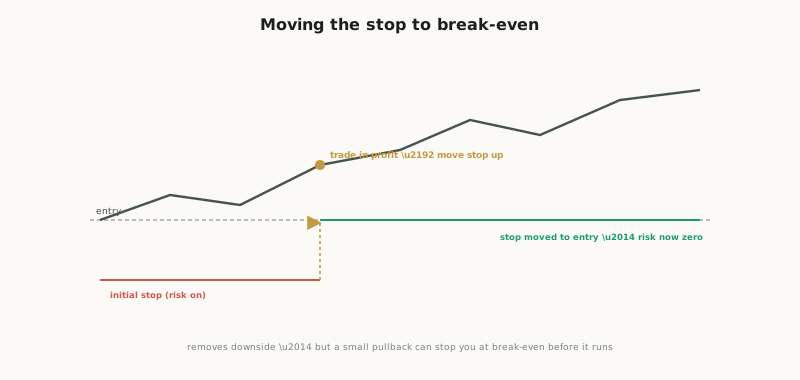
A break-even stop is simply moving your stop-loss to your entry price once the trade has moved into profit by some amount.
Break-even stops at a glance
The mechanic is straightforward: you enter with an initial stop at a sensible distance (carrying real risk), and then, after price has moved in your favour, you raise the stop to your entry price. From that point, the trade can no longer lose money — if price reverses and hits the break-even stop, you exit at roughly break-even (minus a little spread/cost) rather than at a loss. Psychologically and practically, this is appealing: you've taken the downside off the table and are now playing with "house money," free to let the trade run toward target with no risk of it turning into a loser. It feels like the prudent, disciplined thing to do, which is why it's so widely used.
The trade-off, and doing it well
But break-even stops are not a free lunch, and the cost is real: premature stop-outs. Markets do not move in straight lines — they routinely pull back before continuing, retracing to test prior levels (including, very often, the area around your entry) before resuming the move. A stop sitting exactly at your entry is therefore highly vulnerable to being clipped by ordinary noise: price dips back to your entry, stops you out at break-even, and then runs to your original target without you. This is one of the most frustrating experiences in trading, and it's a direct consequence of moving to break-even too eagerly. So the tactic involves a genuine trade-off: it reduces risk (good) but can also reduce your win rate and cut winners short (bad) — if applied mechanically or too soon, the cumulative effect of all those premature exits can outweigh the benefit of avoiding the occasional full loss, actually lowering your overall expectancy.
The skill, then, is in the timing and judgement. The cardinal rule is to give the trade room first: move to break-even only after price has travelled a meaningful distance in your favour and ideally cleared the zone of normal noise around your entry — not the moment you're a few pips up. Sensible triggers include moving to break-even once the trade is up by roughly the amount you initially risked (often expressed as 1R — see R-multiples), or once price has reached and held a logical structure level beyond which a pullback to your entry would be genuinely unlikely. Some traders move to "break-even plus a few pips" (to also cover costs and avoid a scratch), or only partially de-risk (moving the stop toward break-even rather than exactly to it, or banking part of the position — see scaling out). The worst approach is a rigid, too-tight "always move to break-even at +10 pips" rule applied regardless of context, which maximises premature stop-outs. Used with judgement — at the right moment, giving the trade room, in a way that fits the pair's volatility and your strategy — break-even stops are a useful risk-reduction tool; used reflexively and too early, they sabotage good trades. As with all trade management, the goal is protecting capital without needlessly strangling your winners, and that balance requires thought rather than a mechanical rule. The honest framing: a break-even stop moves your stop to entry once a trade is in profit, so it can no longer lose — appealing because it removes the downside. But the cost is premature stop-outs: markets pull back through the entry area as normal noise, so a stop right at entry gets clipped before price runs to target, which can lower your win rate and expectancy if done too early or mechanically. Do it with judgement — give the trade room first (e.g. move at ~1R or a logical level, sometimes break-even-plus), fit it to volatility and strategy, and avoid rigid too-tight rules. It reduces risk but isn't free; balance protection against strangling winners.
Alternatives and a smarter approach
Rather than treating "move to break-even" as a binary on/off decision, the more sophisticated approach is to see it as one option among several for managing a winning trade, and to choose based on your strategy and edge profile. A popular middle path is partial de-risking: instead of moving the whole stop to break-even, scale out a portion of the position at a first target (banking some profit) and let the rest run with a wider stop — this locks in a gain and reduces risk without the all-or-nothing fragility of a stop sitting exactly at entry (see scaling out). Another is break-even-plus: moving the stop to entry plus a few pips (covering costs so a "break-even" exit isn't actually a small loss after spread). A third is to skip the break-even step entirely in favour of a trailing stop that follows price at a sensible distance, or a structure-based stop that moves up to sit below each new higher low — both of which protect profit while giving the trade room, rather than parking the stop in the noise zone at entry.
The deeper point is that whether break-even helps or hurts depends on the character of your edge. If your strategy has a high win rate with trades that tend to "go and not look back," aggressive break-even moves cost little and protect a lot. But if your edge relies on letting winners run through pullbacks to capture large R-multiples (a lower-win-rate, larger-winner profile), then mechanically moving to break-even will amputate exactly the trades that would have paid for everything — the big winners that pull back to your entry before exploding higher. This is why the same break-even rule can help one trader and wreck another: it interacts with the whole expectancy structure of the strategy. The only way to know its true effect is to test it — compare your results (ideally in your journal or a backtest) with and without the break-even rule, and let the data say whether it adds or subtracts. Don't adopt break-even stops because they feel safe; adopt (or reject) them because they measurably improve your edge. The honest reminder: treat break-even as one option among several — partial scaling-out, break-even-plus, trailing or structure-based stops often beat a rigid stop-at-entry; and whether break-even helps depends on your edge profile (it suits high-win-rate "go" trades, but amputates the big winners of a run-your-winners strategy), so test it with and without rather than assuming it's safer.
The broader lesson is that break-even stops sit inside the larger craft of trade management — the art of nurturing a position once it's open — where the constant tension is between protecting what you have and giving the trade enough freedom to reach its potential. Lean too far toward protection (tight break-evens, quick exits) and you bleed your winners; lean too far toward freedom (no protection, hoping) and you give back gains and risk losses. There is no universal right answer, only the answer that fits your strategy, tested against your results. Treat break-even not as a reflex but as a deliberate, evidence-checked choice, and it becomes a useful tool rather than a quiet drag on your edge.
A break-even stop moves your stop to your entry once a trade is in profit, so it can no longer lose — appealing because it takes the downside off the table. But the cost is real: premature stop-outs. Markets pull back through the entry area as normal noise, so a stop sitting right at entry gets clipped before price runs to target — lowering your win rate and expectancy if done too early or mechanically. Do it with judgement: give the trade room first (e.g. move at ~1R or once a logical level holds, sometimes "break-even plus"), fit it to the pair's volatility and your strategy, and avoid rigid too-tight rules. It reduces risk but isn't a free lunch — balance protecting capital against needlessly strangling your winners.