
Twice a year, the clocks change — and with them, the times your trading sessions open and close. Worse, different regions switch on different dates, so for a few weeks each spring and autumn the sessions drift out of their usual alignment. It's a small detail, but one that quietly trips up traders who watch only their local clock and wonder why London suddenly "opens an hour early." This guide explains how daylight saving time affects forex: why session times shift, why misalignment happens, and how to track sessions reliably.
It's a practical footnote to the trading sessions, the overlaps, and the best times to trade.
Key takeaways
Q: How does daylight saving time affect forex trading?
A: Forex runs 24 hours across global sessions tied to financial centres' local working hours. When a region puts its clocks forward or back for daylight saving, the local times of that centre's session shift by an hour relative to a fixed reference (and relative to your clock if you don't also change). So the London or New York session you're used to opening at a certain hour can move by an hour around DST changes — along with the session overlaps and the daily rollover.
Q: Why do sessions get misaligned around DST?
A: Because different regions change their clocks on different dates — and the Southern Hemisphere shifts the opposite way to the Northern. The US, UK, EU and Australia don't all switch on the same day, so for a few weeks each spring and autumn their relative time differences are temporarily unusual. During these windows, session opens, the key overlaps, and rollover times don't line up the way they do for most of the year, which can briefly change when liquidity and volatility appear.
Q: How do I track forex sessions reliably through DST?
A: Anchor your thinking to a fixed reference like GMT/UTC rather than your local clock or a memorised local time. Many traders use a forex market-hours tool or a chart set to a server/UTC time, and simply re-check session times around the known DST change dates. The key is to expect the one-hour shifts and the brief misalignment windows, and to verify rather than assume your usual session times still hold.
Why session times shift
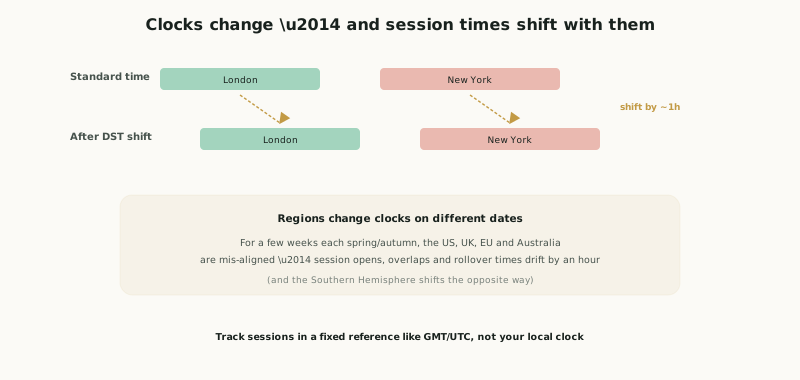
Forex runs 24 hours across global sessions tied to the local working hours of the major financial centres — Sydney, Tokyo, London and New York. That's the key: a session "opens" when that centre's business day begins in its own local time. So when a region puts its clocks forward or back for daylight saving, the local working hours stay the same in that city's clock, but they shift by an hour relative to a fixed reference (like GMT/UTC) — and relative to your clock, if you live somewhere that doesn't change at the same time (or at all). The practical upshot: the London or New York session you're used to seeing open at a particular hour on your screen can move by an hour around DST changes — and so do the session overlaps (including the all-important London–New York overlap) and the daily rollover time. Nothing about the market has actually changed; it's purely a clock effect — but if you've memorised session times in your local time, they'll suddenly seem "wrong" until you account for the shift.
The misalignment weeks, and how to cope
The genuinely tricky part is the misalignment that arises because different regions change their clocks on different dates — and, crucially, the Southern Hemisphere shifts the opposite way to the Northern (when the Northern Hemisphere "springs forward," the Southern is heading into autumn and falling back). The US, UK/EU and Australia don't all switch on the same day: there are typically gaps of a week or more between, say, the US changing and the UK/EU changing in spring and autumn. During these brief windows — a few weeks each spring and autumn — the relative time differences between the major centres are temporarily unusual: the normal gap between London and New York, or between Sydney and Tokyo, is briefly an hour off its year-round value. The consequence for traders is that, in these windows, session opens, the key overlaps, and rollover times don't line up the way they do for most of the year, which can subtly change when liquidity and volatility appear — the London–NY overlap might be an hour longer or shorter than usual, for instance, or the Sydney/Tokyo handover shift. It rarely causes anything dramatic, but it can briefly confuse session-based timing if you're not expecting it.
Coping with all this is simple once you know to expect it. The single best habit is to anchor your thinking to a fixed reference — GMT/UTC — rather than your local clock or a memorised local time, since a UTC-based view of the sessions only shifts when a specific region changes (and you'll know which). Many traders use a forex market-hours tool (which adjusts for DST automatically) or set their charts to a consistent server/UTC time, so the sessions are marked correctly year-round. Beyond that, simply re-check session times around the known DST change dates (late March / late October in Europe, with the US and Australia on their own nearby schedules) rather than assuming your usual times still hold — a quick verification during those few weeks avoids being caught out. And be mildly aware that the misalignment windows can briefly alter when the most active periods fall, so if your strategy is tightly tied to a specific session or the overlap, double-check the timing during the changeover. None of this is complicated, but it's the kind of small, unglamorous detail that distinguishes a trader who understands the market's plumbing from one who's repeatedly puzzled by sessions "moving" — expect the one-hour shifts, expect the brief misalignment, track everything in a fixed reference, and verify rather than assume. The honest framing: forex sessions follow financial centres' local working hours, so when a region's clocks change for daylight saving, that session (and the overlaps and rollover) shift by about an hour versus a fixed reference and versus your clock. Because regions switch on different dates — and the Southern Hemisphere moves opposite to the Northern — sessions briefly misalign for a few weeks each spring and autumn, subtly changing when liquidity and the key overlaps fall. Cope by anchoring to GMT/UTC (or a DST-aware market-hours tool), re-checking times around the change dates, and verifying rather than assuming your usual session times still hold.
Why it matters in practice
For a casual trader the DST shifts are a minor curiosity, but for anyone whose approach is tied to timing they genuinely matter. Session-based strategies are the most affected: a London breakout, an Asian-session play, or any setup keyed to a specific session open or the overlap will fire at a different clock time after a DST change — trade it by your unchanged local time and you'll be early or late by an hour, hitting the wrong part of the session. The London–New York overlap can even change length during the misalignment weeks, briefly lengthening or shortening the prime window. There's also a subtle data and backtesting trap: if your charts or historical data aren't consistently timezone-aligned, DST can introduce off-by-one-hour errors that quietly corrupt session-based analysis and backtests (a reason serious traders keep everything in a fixed UTC/server time). And news timing can confuse — a release you associate with a certain local hour may shift relative to your clock around the changeovers.
It helps to know roughly when the changes happen, since the regions are deliberately staggered. In the Northern Hemisphere, the US typically springs forward on the second Sunday of March and falls back on the first Sunday of November, while the UK and EU shift on the last Sundays of March and October — so for a couple of weeks in both spring and autumn, the US has changed but Europe hasn't (or vice versa), and the usual London–New York time gap is temporarily an hour off. Meanwhile the Southern Hemisphere (Australia, New Zealand) runs on the opposite calendar — entering autumn/winter as the North enters spring/summer — so the Sydney session's alignment with the others shifts the other way. You don't need to memorise every date, but knowing that late March/early November (US) and late March/October (Europe) are the danger zones — and that the Southern Hemisphere is inverted — lets you flag those few weeks for an extra timing check. The practical bottom line: if your trading is time-sensitive, treat the DST changeover weeks as moments to re-verify your session, overlap, news and rollover times, keep your platform/data in a fixed reference, and don't let an hour's clock shift quietly throw off a strategy that depends on being in the right place at the right time. The honest reminder: DST matters most for time-tied trading — session-based strategies fire at a different clock time, the London–NY overlap can change length, and unaligned data can introduce off-by-one-hour backtest errors and news-time confusion; the staggered change dates (US 2nd Sun Mar / 1st Sun Nov, EU last Sun Mar/Oct, Southern Hemisphere inverted) create a few danger-zone weeks, so re-verify your session, overlap, news and rollover times then, and keep everything in a fixed UTC/server reference.
Forex sessions follow financial centres' local working hours, so when a region's clocks change for daylight saving, that session — plus the overlaps and the rollover — shifts by about an hour versus a fixed reference (and versus your clock). Because regions switch on different dates, and the Southern Hemisphere moves opposite to the Northern, the sessions briefly misalign for a few weeks each spring and autumn — subtly changing when liquidity and the key overlaps fall. Nothing about the market changes; it's a clock effect. Cope: anchor to GMT/UTC (or use a DST-aware market-hours tool), re-check session times around the known change dates, and verify rather than assume your usual times still hold — an unglamorous detail that catches out the unprepared.