Every decision you make spends a little mental energy, and that energy is finite. As a trading session wears on, decision after decision quietly drains your judgement — which is why your late, tired trades are so often your worst. Decision fatigue is a real, well-documented, and manageable force, and ignoring it is costly — it can quietly undo a strategy that's perfectly sound on paper. This guide explains decision fatigue: what it is, how it affects trading, and how to protect your decision quality.
It's a close relative of stress and burnout, a hidden driver of overtrading, and best countered with a trading routine.
Key takeaways
Q: What is decision fatigue?
A: Decision fatigue is the deterioration in the quality of your decisions after making many of them — the mental energy required for careful, deliberate choices is limited, and it depletes as you use it. After a long run of decisions, people tend to make worse ones: more impulsive, more prone to shortcuts and biases, or avoiding decisions altogether. In trading, this means your judgement is sharpest when fresh and degrades as a session of constant decisions wears on.
Q: How does decision fatigue affect trading?
A: Trading demands a stream of high-stakes decisions — what to trade, when to enter, how big, where to exit, whether to adjust — each draining mental energy. As fatigue sets in, you become more likely to take impulsive trades, abandon your rules, chase setups, or make sloppy errors. This is a key reason late-session and end-of-day trades are often the worst, and why trading while already mentally tired (from work or life) tends to go badly.
Q: How do you reduce decision fatigue in trading?
A: Pre-make as many decisions as possible with a written plan and rules, so you're following decisions rather than making fresh ones under pressure. Simplify and reduce the number of choices (fewer instruments, clearer criteria, checklists). Trade less rather than constantly. Take regular breaks to recover, protect your peak mental hours for trading, and avoid trading when already depleted. The goal is to spend your limited decision energy on what matters and conserve the rest.
What it is
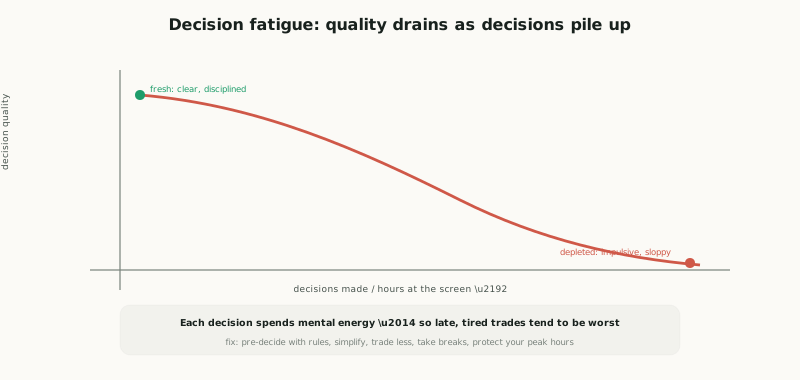
Decision fatigue is the deterioration in the quality of your decisions after making many of them. The mental energy required for careful, deliberate choices (the effortful System 2 thinking) is limited, and it depletes as you use it — like a muscle that tires. After a long run of decisions, people reliably make worse ones: more impulsive, more prone to shortcuts and biases (falling back on automatic System 1 responses), or avoiding decisions altogether (paralysis or defaulting to the easy option). It's why judges, doctors and shoppers all make measurably poorer decisions late in a long sequence — and trading, which is nothing but a stream of consequential decisions, is acutely exposed. The simple, important truth: your judgement is sharpest when fresh and degrades as a session of constant decisions wears on — not because you've become less skilled, but because the fuel for good decisions has run low.
Decision fatigue at a glance
How it hits trading, and how to manage it
Trading is uniquely vulnerable to decision fatigue because it demands a continuous stream of high-stakes decisions: what to trade, whether a setup qualifies, when to enter, how big to size, where to place the stop and target, whether to adjust or exit, whether to take the next trade — each one draining mental energy. As fatigue sets in over a session, you become more likely to take impulsive trades, abandon your rules, chase setups you'd normally skip, or make sloppy execution errors (wrong size, fat-finger mistakes, forgetting the stop) — all hallmarks of a depleted decision-maker defaulting to the lazy, automatic system. This is a key reason late-session and end-of-day trades are so often the worst in a trader's record (the morning discipline gives way to afternoon sloppiness), and why trading while already mentally tired — after a draining day job, poor sleep, or life stress — tends to go badly: you start the session with the tank already low. Decision fatigue also feeds directly into overtrading (a tired mind takes marginal trades it should pass) and compounds stress and burnout. Recognising it reframes a common experience: those puzzling late-day mistakes by a trader who "knows better" usually aren't a knowledge or skill failure but an energy failure.
The good news is that decision fatigue is highly manageable once you respect it. The most powerful fix is to pre-make as many decisions as possible: a written trading plan and clear rules mean you're following decisions made calmly in advance rather than making fresh ones under pressure with a depleting tank — this offloads the System 2 work to a time when your energy was full (it's the same logic as why successful people reduce trivial daily choices to save mental energy for important ones). Simplify and reduce the number of choices: trade fewer instruments, use clear, mechanical entry criteria (so a setup either qualifies or it doesn't, no agonising), and run a checklist rather than re-evaluating from scratch each time. Trade less, not constantly: every marginal decision spends energy, so being selective conserves it for the good opportunities (and conveniently also reduces overtrading). Take regular breaks to let your decision energy recover — stepping away from the screen genuinely restores judgement — and protect your peak mental hours for trading (trade when you're fresh, not when you're already spent). And avoid trading when depleted altogether: if you're exhausted, ill, or mentally drained from life, recognise that your decision quality is compromised and either trade minimally or not at all. The unifying principle is to spend your limited decision energy on what matters and conserve the rest — treating mental energy as the finite, precious resource it is, exactly as you treat your trading capital. The honest framing: decision fatigue is the drop in decision quality after making many decisions — deliberate mental energy is finite and depletes, so you become impulsive, bias-prone or paralysed as a session wears on, which is why late and tired trades are often the worst. Manage it by pre-making decisions with a written plan and rules, simplifying and reducing choices (fewer instruments, checklists), trading less, taking breaks to recover, protecting your peak hours, and not trading when already depleted — spend your decision energy on what matters and conserve the rest.
The willpower connection
Decision fatigue is closely tied to self-control, and the link has a sharp practical sting for traders. The deliberate effort of making decisions and the effort of resisting impulses appear to draw on the same limited pool of mental energy — so a day spent making choices and exercising willpower leaves less of both in reserve. For a trader this means that after a long session of disciplined decisions — passing on marginal setups, sticking to the plan, resisting the urge to revenge-trade — your capacity to keep resisting is depleted, which is precisely when the impulsive, rule-breaking trade slips through. The discipline that was effortless in the morning becomes a struggle by afternoon, not because your commitment changed but because the fuel for self-control ran low. Research also suggests depleted decision-makers tend to default to the riskier or easier option — which, in trading, is exactly the wrong tendency (over-sizing, chasing, skipping the stop).
The practical implication is liberating once you accept it: willpower and discipline are finite, so don't rely on them — engineer around them instead. This is the deepest reason the entire discipline and routine toolkit works by reducing the demand on in-the-moment self-control rather than expecting heroic willpower: pre-made rules mean you don't have to decide (and resist) afresh each time; automation (preset stops, targets, daily limits) removes the most willpower-hungry decisions entirely; and protecting your peak hours means trading when self-control is full. It also argues for reducing other decisions in your day (the famous habit of successful people simplifying trivial choices to preserve mental energy for important ones applies directly), and for treating a depleted state as a hard stop — when you notice your discipline flagging, that's the signal to step away, not to push through on fumes. The trader who understands the willpower connection stops berating themselves for "lacking discipline" late in the day and instead builds a system that doesn't demand discipline they don't have — which is both more effective and far kinder. The honest reminder: decision-making and self-control draw on the same finite energy, so a day of decisions and resisting impulses leaves less willpower exactly when the impulsive trade tempts you (and depleted minds default to the riskier option); since willpower is finite, don't rely on it — engineer around it with pre-made rules, automation and protected peak hours, reduce other daily decisions, and treat a depleted state as a signal to stop rather than push through.
Decision fatigue is the drop in decision quality after making many decisions — deliberate (System 2) mental energy is finite and depletes, so you turn impulsive, bias-prone or paralysed as a session wears on. That's why late and tired trades are often your worst — it's an energy failure, not a skill one (and a hidden driver of overtrading). Manage it: pre-make decisions with a written plan and rules (follow, don't re-decide), simplify and cut choices (fewer instruments, checklists), trade less, take breaks to recover, protect your peak hours, and don't trade when depleted (tired, ill, stressed). Treat mental energy like capital — finite and precious: spend it on what matters, conserve the rest.