Your brain runs two thinking systems: a fast, intuitive, emotional one and a slow, deliberate, logical one. Almost every costly trading mistake traces back to the fast system hijacking decisions that needed the slow one. Understanding the two — and keeping the right one in charge — is arguably the foundation of trading psychology, the framework beneath all the individual biases and emotions. This guide explains fast and slow thinking: what the two systems are, why most errors come from the fast one, and how to keep the deliberate one in control.
It's the unifying lens behind the cognitive biases, underpins trading discipline, and is the cognitive basis for emotional control.
Key takeaways
Q: What are System 1 and System 2 thinking?
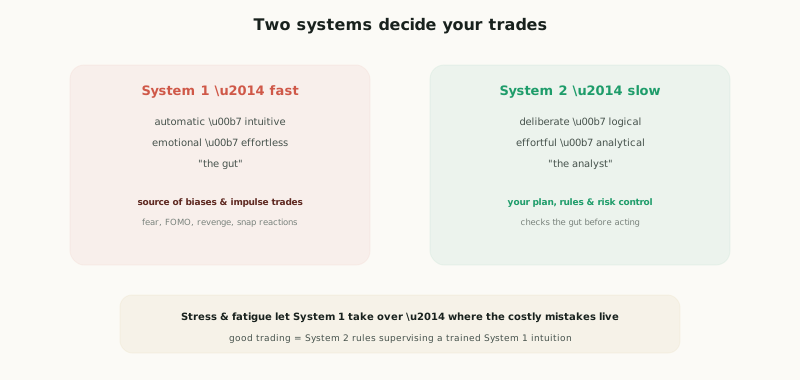
A: They're the two modes of thought popularised by psychologist Daniel Kahneman. System 1 is fast, automatic, intuitive and emotional — it makes snap judgements with little effort (the 'gut'). System 2 is slow, deliberate, logical and effortful — it reasons things through carefully (the 'analyst'). Both are essential, but they're suited to different tasks, and trouble arises when the fast, emotional system takes over decisions that really needed slow, careful reasoning.
Q: Why do most trading mistakes come from System 1?
A: Because System 1 is where biases and emotional reactions live. Under stress, fatigue or excitement, the fast system takes over and produces impulsive, bias-driven decisions — chasing a move out of FOMO, revenge trading after a loss, freezing in fear, or seeing patterns that aren't there. These feel compelling in the moment precisely because System 1 is automatic and confident. The slow, deliberate System 2 — which would check the impulse against your plan — gets bypassed.
Q: How do you keep System 2 in charge while trading?
A: By building structure that doesn't rely on willpower in the moment: a written trading plan and rules made calmly in advance (so System 2 has already done the thinking), checklists before entering trades, predefined stops and risk limits, and routines that reduce in-the-moment decisions. Managing stress and fatigue helps too, since both hand control to System 1. The aim isn't to eliminate intuition but to ensure deliberate rules supervise it.
The two systems
The framework, popularised by psychologist Daniel Kahneman (in Thinking, Fast and Slow), divides thought into two modes. System 1 is fast, automatic, intuitive and emotional — it makes snap judgements with little effort (the "gut"). System 2 is slow, deliberate, logical and effortful — it reasons things through carefully (the "analyst"). Both are essential and neither is "bad": System 1's speed is vital (you couldn't function if every decision required laborious analysis), and System 2's rigour is what handles complex, novel problems. The catch is that they're suited to different tasks, and trouble arises when the fast, emotional system takes over decisions that really needed slow, careful reasoning.
| Feature | System 1 (fast) | System 2 (slow) |
|---|---|---|
| Speed | Instant, automatic | Slow, effortful |
| Style | Intuitive, emotional | Logical, analytical |
| In trading | Snap reactions, "the gut" | Your plan, rules, risk control |
| Risk | Source of biases & impulse trades | Effortful — tires & gets bypassed |
In trading terms, System 1 is the part that reacts — the instant urge to chase a move, the flash of fear, the gut "feeling" about a trade — while System 2 is the part that follows your plan, checks the setup against your rules, and calculates your risk. The whole art is getting the right system to handle each job.
Why errors come from System 1, and how to keep System 2 in charge
Most trading mistakes come from System 1 because that's where biases and emotional reactions live. The fast system is the home of loss aversion, confirmation bias, recency bias, the herd instinct and the rest — these aren't deliberate choices but automatic patterns System 1 produces. Critically, under stress, fatigue or excitement, System 2 (which is effortful and tires easily) steps back and System 1 takes over, producing the impulsive, bias-driven decisions that wreck accounts: chasing a move out of FOMO, revenge trading after a loss, freezing in fear, seeing patterns that aren't there (see the illusion of control). These feel compelling and confident in the moment precisely because System 1 is automatic and doesn't signal its own uncertainty — the gut feels sure even when it's wrong. Meanwhile the slow, deliberate System 2 — which would check the impulse against your plan, ask "does this fit my rules?", and weigh the risk — gets bypassed exactly when you need it most. This is the core mechanism behind nearly all of trading psychology: the market constantly triggers fast, emotional System 1 responses (fear when losing, greed when winning, urgency when moving), and the trader's job is to not let those responses execute trades.
So the central skill is keeping System 2 in charge — and the key insight is that you can't do this by sheer willpower in the heat of the moment (when System 1 is loudest and System 2 is most depleted). Instead, you build structure that does the System 2 thinking in advance, so the deliberate decisions are already made before emotion strikes. A written trading plan and rules, made calmly in advance, mean System 2 has done the hard reasoning when it was fresh and unpressured — in the moment you just follow the plan rather than re-deciding under emotional fire. Checklists before entering force a brief, deliberate System 2 check ("does this meet all my criteria?") that catches System 1 impulses. Predefined stops and risk limits (and a daily loss limit) remove the most dangerous in-the-moment decisions from System 1's reach. Routines that reduce the number of decisions you make (see trading routines and decision fatigue) preserve System 2's limited energy for what matters. And managing stress and fatigue directly — rest, breaks, not trading when exhausted or rattled — keeps System 2 online, since both stress and tiredness hand control to System 1. Crucially, the goal is not to eliminate intuition: experienced traders develop a trained System 1 (genuine pattern-recognition from screen time) that's valuable — but it must be supervised by System 2's rules, not given free rein. In short, you engineer your trading so that deliberate, pre-made rules govern your decisions, and the fast, emotional system can't quietly take the wheel. The honest framing: your mind runs System 1 (fast, intuitive, emotional — the gut, and the home of biases) and System 2 (slow, deliberate, logical — your plan and rules); both matter but for different jobs. Most trading errors come from System 1 taking over under stress, fatigue or excitement — producing impulsive, bias-driven trades that feel confident but bypass careful reasoning. You keep System 2 in charge not by willpower but by structure: a written plan and rules made calmly in advance, checklists, predefined stops and limits, routines that cut decisions, and managing stress/fatigue — letting deliberate rules supervise a trained intuition.
Training intuition: when the gut is worth trusting
A natural question is whether System 1 — the "gut" — is ever trustworthy in trading, or always to be overridden. The honest answer, drawn from the research on expert intuition (Kahneman and Gary Klein explored exactly this), is: it depends on the environment. Intuition becomes genuinely reliable in domains that are regular (with stable, learnable patterns) and offer rapid, clear feedback — which is why a chess master or a firefighter can trust their trained gut. The problem is that markets are largely the opposite: noisy, ever-changing, with delayed and ambiguous feedback (a good decision can lose and a bad one can win, thanks to randomness). In that environment, naive intuition — a beginner's gut feeling — is dangerous, because it's really just emotion and bias wearing the costume of insight.
That said, a trained System 1 can still be valuable, and developing one is part of mastering trading. The key is the deliberate practice that turns raw impulse into genuine pattern-recognition: screen time (watching price behave, over and over, in the conditions you trade), journaling (so you get the feedback loop the market doesn't readily provide — see the learning curve), and honest review that separates good decisions from good outcomes (process over outcome). Over time, this builds an intuition that can flag genuine patterns — but even then, the discipline holds: a trained gut feeling is worth investigating with System 2 and checking against your rules, never blindly obeyed. The crucial distinction to keep clear is between trained pattern-recognition (earned through deliberate practice and feedback, worth a System 2 second look) and raw emotional impulse (fear, greed, FOMO masquerading as "instinct," to be overridden). Beginners almost never have the former and constantly mistake the latter for it — which is why the safest default early on is to distrust the gut and lean hard on the rules, earning the right to a trained intuition only through years of disciplined screen time. The honest reminder: intuition is only reliable in regular, high-feedback environments — and markets are noisy with delayed feedback, so naive gut feeling is dangerous (it's bias in disguise); a trained System 1 built through deliberate screen time, journaling and honest review can add value, but even then it should be checked by System 2 and your rules, never obeyed blindly — and beginners should distrust the gut and lean on the rules until a real intuition is earned.
Your mind runs System 1 (fast, intuitive, emotional — the "gut," and the home of biases) and System 2 (slow, deliberate, logical — your plan and rules); both matter, for different jobs. Most trading errors come from System 1 taking over under stress, fatigue or excitement — impulsive, bias-driven trades (FOMO, revenge, freezing) that feel confident but bypass careful reasoning. You keep System 2 in charge not by willpower in the moment but by structure made calmly in advance: a written plan and rules, checklists, predefined stops and limits, routines that cut decisions, and managing stress/fatigue. Don't eliminate intuition — supervise a trained System 1 with System 2's rules. This is the foundation beneath all of trading psychology.