Once you understand one simple relationship — pips moved, times what each pip is worth, times how many lots — you can work out exactly how much any forex trade makes or loses. It's the maths behind every number on your screen, and it's far less intimidating than it first looks. This guide explains how profit and loss works in forex: the formula, what determines pip value, and a clear worked example.
It builds directly on pips, lots and leverage and underpins position sizing and going long and short.
Key takeaways
Q: How is profit and loss calculated in forex?
A: Profit or loss equals the number of pips the price moved in your favour (or against you) multiplied by the value of each pip, multiplied by your position size in lots. In short: pips moved × pip value × lots. If price moves in your direction the result is a profit; if it moves against you, the same calculation gives your loss. It's the same maths whether you're long or short.
Q: What is a pip worth?
A: Pip value depends on the pair and your lot size. For a standard lot (100,000 units) of most pairs, one pip is worth about $10 when the quote currency is the US dollar; a mini lot (10,000 units) is about $1 per pip, and a micro lot (1,000 units) about $0.10. The exact value varies with the pair and is converted into your account currency, but your platform shows it and it scales directly with lot size.
Q: Does profit and loss work the same when shorting?
A: Yes. Whether you go long (buying, profiting if price rises) or short (selling, profiting if price falls), profit and loss is calculated the same way: pips moved in your favour × pip value × lots. The only difference is direction — a long profits from a rising price, a short from a falling one. In both cases a move against you produces a loss of the same magnitude as an equal move in your favour would have produced.
The formula
All forex profit and loss comes down to one calculation:
The P&L formula
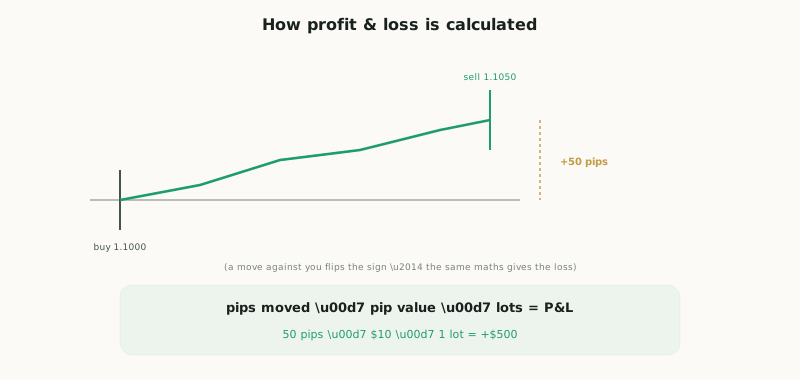
Profit or loss equals the number of pips the price moved in your favour (or against you), multiplied by the value of each pip, multiplied by your position size in lots. In short: pips moved × pip value × lots. If price moves in your direction, the result is a profit; if it moves against you, the same calculation gives your loss. That's the whole thing — every profit and loss figure you'll ever see is just this relationship at work. The two pieces beginners need to nail down are what a pip is (the standard unit of price movement — for most pairs, the fourth decimal place, e.g. a move from 1.1000 to 1.1001 is one pip; for JPY pairs it's the second decimal) and what each pip is worth, which depends on the pair and your lot size.
Pip value, lot size, and a worked example
The piece that varies is pip value — how much money one pip represents — and it depends on the pair and your lot size (see pips, lots and leverage for the units). The convenient anchor to remember: for a standard lot (100,000 units) of most pairs where the quote currency (the second one) is the US dollar, one pip is worth about $10. Because pip value scales directly with lot size, that means a mini lot (10,000 units) is about $1 per pip, and a micro lot (1,000 units) about $0.10 per pip. So the same 50-pip move is worth $500 on a standard lot, $50 on a mini, or $5 on a micro — your lot size is the dial that sets how much each pip is worth to you (which is exactly why it's the key lever in position sizing). The precise pip value varies a little by pair and is converted into your account currency, but your platform calculates and displays it, so you rarely compute it by hand.
A worked example makes it concrete. Suppose you go long (buy) EUR/USD at 1.1000, expecting it to rise, with a position of one standard lot (pip value ~$10). Price rises to 1.1050 and you close. The move in your favour is 1.1050 − 1.1000 = 0.0050 = 50 pips. Plug into the formula: 50 pips × $10 × 1 lot = +$500 profit. Now suppose instead price had fallen to 1.0950 — a 50-pip move against you — the same maths gives 50 × $10 × 1 = $500, this time a loss. And if you'd traded a mini lot instead, every figure would be a tenth: the 50-pip win would be +$50, the loss −$50. Two final points round out the picture. First, going short works identically: if you'd sold (gone short) at 1.1000 expecting a fall, and price dropped 50 pips to 1.0950, that's +$500 by the same formula (a short profits from a falling price — see going long and short); the direction differs, the maths doesn't. Second, your real net result also includes trading costs — the spread (and any commission or overnight swap) — so a trade actually starts slightly negative by the spread and your true P&L is the gross figure minus costs. But the core engine never changes: pips moved × pip value × lots. Master that one relationship and you can read — and plan — the financial outcome of any trade before you place it, which is the foundation of sensible risk management. The honest framing: forex P&L is simply pips moved × pip value × lots — a profit if price moved your way, a loss (same maths) if against. Pip value depends on the pair and lot size: roughly $10 per pip on a standard lot, $1 on a mini, $0.10 on a micro (where the quote currency is USD), scaling directly with size. Example: buy EUR/USD at 1.1000, sell at 1.1050 = 50 pips; on one standard lot that's +$500. Shorting works identically (profit from a falling price), and your real result subtracts trading costs like the spread. Master this one formula and you can size and plan any trade.
Realised vs unrealised, and net P&L
Two distinctions complete the picture. First, unrealised vs realised P&L. While a trade is open, its profit or loss is unrealised (also called "floating" or "open") — it fluctuates tick by tick as price moves and isn't locked in; it only becomes realised when you close the trade. This matters because your account equity = your balance (realised) plus any unrealised P&L on open positions, so a floating loss reduces your equity (and your available margin) before you've actually closed anything — which is exactly how an unmanaged losing position can quietly erode your account and, in the extreme, trigger a margin call. The number on your screen for an open trade is the unrealised figure; it isn't "real" money won or lost until you exit.
Second, gross vs net P&L — your real result includes costs. The formula (pips × pip value × lots) gives the gross move, but your net profit or loss subtracts: the spread (you effectively start each trade down by it), any commission your broker charges, and any overnight swap if you hold positions past the daily rollover. So a trade that's "+10 pips gross" might be meaningfully less net of a 1–2 pip spread and costs — a difference that matters enormously for short-term, high-frequency styles (where costs can dwarf the gross edge) and far less for longer-term trades. There's also an account-currency wrinkle: if a pair's quote currency isn't your account currency, your P&L is converted into your account currency at the prevailing rate, so the exact figure depends on that conversion (your platform handles it automatically). None of this changes the core engine — pips × pip value × lots — but knowing that open P&L floats and affects equity, and that net P&L is gross minus costs, is what turns the formula into an accurate picture of what's actually happening to your money. The honest reminder: while open, P&L is unrealised (floating) and moves your equity and available margin before you close — only closing realises it; and your net result is the gross formula minus costs (spread, commission, swap), which matters most for short-term styles, with P&L converted into your account currency where the quote currency differs.
The reason this formula is worth truly internalising is that it lets you flip trading from reactive to planned. Because you can compute the money outcome of any price move before you enter — know your stop distance in pips, your pip value, and your lot size, and you know your exact risk in pounds or dollars — you can size every trade so a loss costs only what you've decided to risk (the basis of position sizing and the 1% rule). P&L stops being a surprise revealed after the fact and becomes a number you set in advance, which is the difference between gambling and trading a controlled edge.
Forex profit and loss is simply pips moved × pip value × lots — a profit if price moved your way, a loss (same maths) if against. Pip value depends on the pair and lot size: roughly $10 per pip on a standard lot, $1 on a mini, $0.10 on a micro (where the quote currency is USD), scaling directly with size — so lot size is the dial for what each pip is worth. Example: buy EUR/USD at 1.1000, sell at 1.1050 = 50 pips; on one standard lot that's +$500. Shorting works identically (profit from a falling price), and your real result subtracts trading costs like the spread. Master this one formula and you can size and plan any trade in advance.