Every forex pair shows not one price but two — a bid and an ask. Understanding why, and which one applies when you buy or sell, is one of the first real "aha" moments in trading. And the gap between them — the spread — is a cost you pay on every single trade, so it's well worth grasping early. This guide explains the bid-ask spread: why there are two prices, which you trade on, and what makes spreads wider or tighter.
It's the foundation of trading costs, central to reading a quote, and shaped by liquidity.
Key takeaways
Q: What is the bid-ask spread?
A: The bid-ask spread is the difference between the two prices quoted for a currency pair: the bid (the lower price, at which you can sell) and the ask (the higher price, at which you can buy). The gap between them is the spread, measured in pips. It exists because the market maker or broker sells to you slightly higher than they'll buy from you, and that difference is effectively their fee and your cost.
Q: Why do you buy at the ask and sell at the bid?
A: Because you always trade on the less favourable side of the two prices. When you buy, you pay the higher ask; when you sell, you receive the lower bid. This is how the market maker profits from providing liquidity — they're willing to sell to you at the ask and buy from you at the bid, pocketing the spread. The practical effect is that a brand-new trade starts slightly in the red by the size of the spread.
Q: What makes a spread wider or tighter?
A: Liquidity is the main driver. Highly liquid major pairs (like EUR/USD) during active sessions have very tight spreads, because there are many buyers and sellers. Spreads widen for less-liquid exotic and minor pairs, during quiet off-session hours, around major news, and in volatile or stressed conditions. Wider spreads mean higher costs, so trading liquid pairs at active times keeps this cost down.
Two prices, and which you trade on
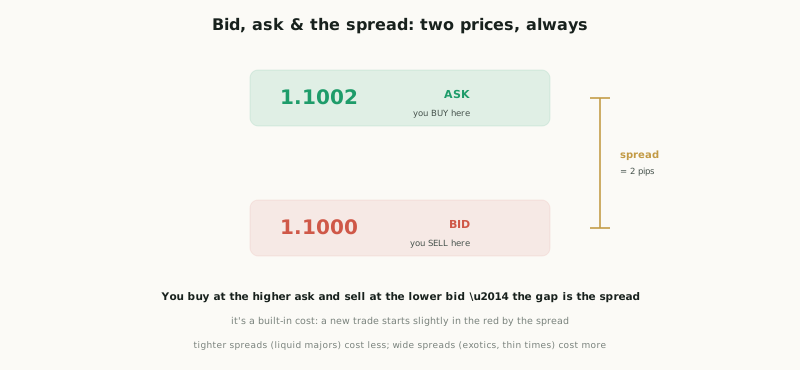
A forex quote always has two prices: the bid (the lower price, at which you can sell) and the ask (also called the offer — the higher price, at which you can buy). The gap between them is the spread, measured in pips. The crucial rule to internalise: you always trade on the less favourable side. When you buy, you pay the higher ask; when you sell, you receive the lower bid. Why? Because there's a counterparty (a market maker or your broker) on the other side providing the liquidity, and they're willing to sell to you at the ask and buy from you at the bid — pocketing the difference, the spread, as their compensation for making the market. So the spread is effectively their fee and your cost. The most important practical consequence: a brand-new trade starts slightly in the red by the size of the spread. If you buy at the ask and immediately sell, you'd sell at the (lower) bid — so you'd be down by the spread before the market has moved at all. The price has to move in your favour by at least the spread just for you to break even. This is why the spread is a real, recurring cost on every trade, even though it's not billed as a separate "fee."
Why spreads vary, and what it means for you
Spreads are not fixed — they vary by pair and conditions, and the main driver is liquidity (how many buyers and sellers are active). Highly liquid major pairs (like EUR/USD) during active sessions have very tight spreads — often a fraction of a pip to a pip or two — because there are many participants competing, narrowing the gap between the best buy and sell prices. Spreads widen in the opposite conditions: for less-liquid exotic and minor pairs (fewer participants, so a structurally wider gap — see exotics), during quiet off-session hours (when major centres are closed), around major news releases (where liquidity briefly evaporates), and in volatile or stressed conditions generally. So the same pair can have a tight spread during the busy London–New York overlap and a much wider one in the thin overnight hours. There are also two broad spread types brokers offer: variable (floating) spreads that change with market conditions, and fixed spreads that stay constant (but are usually set a little wider to compensate the broker for the risk).
The practical takeaways for a beginner are straightforward. First, the spread is a genuine cost, so factor it into every trade — it's part of the cost of trading alongside any commission and overnight swap — and it matters more the shorter your timeframe (a scalper crossing the spread many times a day pays it far more often than a position trader, so spread costs can dominate a high-frequency approach). Second, tighter is cheaper: trading liquid pairs at active times keeps the spread (and thus this cost) down, while trading exotics or in thin hours costs you more on every entry and exit. Third, compare brokers partly on their typical spreads (a key part of their pricing — see choosing a broker), bearing in mind that "commission-free" brokers usually just build their charge into a wider spread, so there's no truly free trading — the cost is simply in the spread, the commission, or both. Understanding the bid-ask spread turns a confusing "why are there two prices and why am I instantly down a bit?" into a clear grasp of how trading actually costs you — which is the first step to keeping those costs sensibly low. The honest framing: every pair has two prices — the bid (lower, where you sell) and the ask (higher, where you buy) — and the gap between them is the spread, the market maker's compensation and your built-in cost, so a new trade starts down by the spread and needs the price to move in your favour by at least that much to break even. Spreads are driven by liquidity: tight on liquid majors in active sessions, wider on exotics, in quiet hours, around news, and in volatile conditions. It's a real, recurring cost (worse the shorter your timeframe), so trade liquid pairs at active times and compare brokers on spreads — "commission-free" usually just means a wider spread.
The spread in practice
On your platform, the spread is simply the difference between the buy and sell prices shown for a pair (often displayed directly, e.g. "0.8 pips"), and it's quietly applied every time you trade — you'll notice a new position opens slightly negative, which is the spread, not a market move. To translate it into money, the spread costs you spread (in pips) × pip value × lots — so a 1-pip spread on a standard lot (~$10/pip) costs about $10 per round trip, on a mini lot about $1, and so on. That's small per trade, but it adds up with frequency: a position trader making a handful of trades a month barely notices it, whereas a scalper crossing the spread dozens of times a day pays it over and over, so for short-term styles the spread can be one of the largest costs and a make-or-break factor in whether the strategy is even viable.
A few practical points help you manage it. Brokers use different pricing models: some advertise "commission-free" but build their charge into a wider spread, while others (often ECN/raw-spread accounts) offer very tight spreads plus a separate commission — so to compare costs fairly you must add spread + commission together, not just look at the spread (see the cost of trading and choosing a broker); for active traders the commission-plus-tight-spread model is often cheaper overall, for occasional traders the all-in spread is simpler. Watch for spread widening: spreads are tight in liquid conditions but blow out around major news, in the thin hours around the daily rollover, over weekends, and in volatility — so entering or exiting at those moments costs more, sometimes dramatically. The sensible habits: prefer liquid majors at active times for the tightest spreads, avoid trading right through news or in dead hours unless necessary, match your broker's pricing model to your trading frequency, and always remember the spread is a real cost baked into every trade that your gross profit must overcome first. The honest reminder: the spread shows as the buy/sell price gap and costs spread × pip value × lots per trade — trivial occasionally but huge for high-frequency styles like scalping; compare brokers on spread plus commission together (not spread alone), watch for spreads widening around news, rollover, weekends and volatility, and favour liquid majors at active times to keep this built-in cost low.
Every pair has two prices: the bid (lower — where you sell) and the ask (higher — where you buy). The gap between them is the spread — the market maker's compensation and your built-in cost — so a new trade starts down by the spread and needs price to move in your favour by at least that much just to break even. Spreads are driven by liquidity: tight on liquid majors (like EUR/USD) in active sessions, wider on exotics, in quiet hours, around news, and in volatile conditions. It's a real, recurring cost (worse the shorter your timeframe), so trade liquid pairs at active times to keep it down, and compare brokers on spreads — "commission-free" usually just means a wider spread, since no trading is truly free.