The traders who feel most certain are often the ones who know the least — a quirk of human psychology called the Dunning-Kruger effect. A little knowledge breeds outsized confidence, which the market is only too happy to punish. Understanding the curve from beginner bravado to expert humility can save you from its costliest stage — the dangerous early phase where confidence wildly outruns competence. This guide explains the Dunning-Kruger effect: what it is, how it shows up in trading, and how to guard against it.
It's the deeper mechanism behind overconfidence, maps onto the trader's learning curve, and is why realistic expectations and humility matter so much.
Key takeaways
Q: What is the Dunning-Kruger effect?
A: It's a cognitive bias where people with limited knowledge or skill in an area overestimate their competence — because they lack the very expertise needed to recognise how much they don't know. As genuine competence grows, confidence often first crashes (you realise how complex the subject really is) before gradually recovering to a more calibrated, humble level. In short: a little knowledge breeds the most confidence, while true experts tend to be more aware of their limits.
Q: How does the Dunning-Kruger effect show up in trading?
A: Classically as beginner overconfidence. New traders who've had a few wins, or read a bit, often feel they've 'figured it out' and trade large, skip risk management, and take on too much — right before the market humbles them. The painful losses that follow are the 'valley' where they realise how much they didn't know. Those who survive it go on to build real, hard-won skill, usually with far more humility and respect for risk than they started with.
Q: How do you guard against it?
A: Assume you know less than you think, especially early on. Keep risk small while you're learning (so the inevitable humbling is survivable, not account-ending), stay curious and keep studying, treat early wins as possibly luck rather than proof of skill, and seek honest feedback through a trading journal and results over a large sample. Genuine humility — respecting how hard trading is and how much randomness is involved — is both a sign of growing competence and a protection against blowing up.
What it is
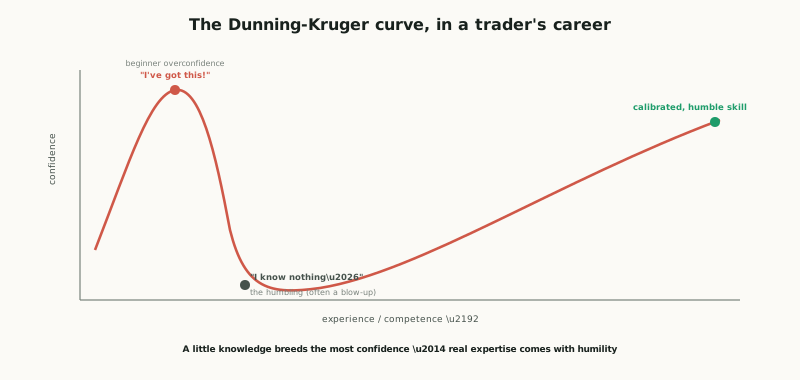
The Dunning-Kruger effect is a cognitive bias where people with limited knowledge or skill in an area overestimate their competence — because they lack the very expertise needed to recognise how much they don't know. It's a cruel catch-22: the same incompetence that causes poor performance also robs you of the ability to see that performance is poor, so the less you know, the more confident you can feel. As genuine competence grows, confidence often first crashes (you start to grasp how complex and uncertain the subject really is, and realise the early confidence was unfounded) before gradually recovering to a more calibrated, humble level (where confidence finally matches real skill). The shorthand: a little knowledge breeds the most confidence, while true experts tend to be acutely aware of their limits. It's why genuine experts in any field so often hedge and qualify ("it depends," "I could be wrong"), while novices speak in absolutes — the expert knows the complexity the novice can't yet see.
The confidence-competence journey
How it shows up in trading, and how to guard against it
In trading, the Dunning-Kruger effect shows up classically as beginner overconfidence — and it's especially dangerous here because trading actively feeds the illusion. New traders who've had a few wins (easily just luck over a small sample), or read a bit and grasped the basics, often feel they've "figured it out" — and act on it: they trade large, skip risk management (which seems like needless caution to someone who "knows" they're right), and take on too much, right before the market humbles them. The danger is acute because early random wins can inflate the confidence at exactly the wrong moment (the market hands the novice "proof" of a skill they don't have), encouraging ever-bigger risks until the inevitable reversal. The painful losses that follow are the "valley" — the humbling phase where they finally realise how much they didn't know (about risk, probability, psychology, how hard this actually is). It's a brutal but common rite of passage, and many traders blow up an account here. Those who survive it — crucially, those who hadn't bet too big to recover — go on to build real, hard-won skill, usually with far more humility and respect for risk than they started with. The whole arc maps directly onto the trader's learning curve: the peak of false confidence, the crash, and the slow climb to genuine competence.
Guarding against it comes down to deliberate, structural humility — and the single most important point is that the goal isn't to avoid the learning journey (you can't) but to survive its dangerous early peak. Assume you know less than you think, especially early on — treat your own confidence with suspicion precisely because Dunning-Kruger means early confidence is unreliable. Above all, keep risk small while you're learning, so the inevitable humbling is survivable, not account-ending — this is the key protection, because it turns the "valley" from a catastrophe into a lesson (the overconfident beginner who risks 1% per trade gets educated; the one who risks 20% gets wiped out). Stay curious and keep studying (the more you genuinely learn, the faster you move past false confidence toward real understanding). Treat early wins as possibly luck rather than proof of skill (demand a large sample before believing you have an edge). And seek honest feedback through a trading journal and real results over time (objective data counters the flattering internal story). Ultimately, genuine humility — respecting how hard trading is and how much randomness is involved — is both a sign of growing competence and a protection against blowing up. The traders who last tend to be the ones who, paradoxically, are least sure they've got it all figured out. The honest framing: the Dunning-Kruger effect is when limited skill breeds overconfidence (you don't know enough to see what you don't know), with confidence crashing as real competence grows before recovering to calibrated humility. In trading it shows as dangerous beginner overconfidence — amplified by lucky early wins — leading to oversized risk right before the market's humbling. Guard against it by assuming you know less than you think, keeping risk small so the humbling is survivable, staying curious, treating early wins as possible luck, seeking honest feedback, and cultivating genuine humility — which is both a mark of skill and protection against ruin.
The flip side: expert self-doubt
The Dunning-Kruger curve has a less-discussed other end, and it matters once you're past the beginner stage. As genuine competence grows, many traders swing from overconfidence to its opposite: excessive self-doubt. Having been humbled in the "valley," and now aware of how much complexity and randomness the market holds, a developing trader can under-rate their own ability — hesitating on valid setups, second-guessing a sound plan, or feeling like an "impostor" who's just been lucky (the related impostor phenomenon). This is the mirror image of the beginner's problem, and it has its own costs: hesitation, paralysis, cutting winners short out of disbelief, and abandoning a good method at the first setback because you doubt it (and yourself).
The healthy target is neither pole but calibrated confidence — the recovered, mature stage where your confidence matches your actual, demonstrated competence. This means trusting your tested process and your edge (confidence earned through a real track record, not bravado) while genuinely respecting the uncertainty inherent in markets (humility about what you can't control or predict). A calibrated trader can act decisively on a valid setup and accept they'll be wrong on plenty of individual trades — holding confidence and humility together rather than swinging between them. The journey, then, isn't from overconfidence to self-doubt but ideally through both to a balanced middle: confident enough to execute your plan without hesitation, humble enough never to bet the farm on certainty. Recognising both failure modes — the beginner's bravado and the developing trader's excessive doubt — helps you steer toward that calibrated centre, which is where durable, professional trading lives. The honest reminder: the Dunning-Kruger curve has a flip side — competent traders often swing to excessive self-doubt and impostor feelings, causing hesitation, paralysis and abandoning sound methods; the healthy target is neither overconfidence nor self-doubt but calibrated confidence — trusting your tested process and edge while respecting market uncertainty, acting decisively on valid setups yet accepting you'll be wrong on many individual trades.
If there's one takeaway, it's to hold your own confidence lightly: let it be earned slowly by results over a large sample, never granted freely by a good week or a clever-sounding idea.
The Dunning-Kruger effect is when limited skill breeds overconfidence — you don't know enough to see what you don't know — with confidence crashing as real competence grows, before recovering to calibrated humility (true experts know their limits; novices feel certain). In trading it shows as dangerous beginner overconfidence, amplified by lucky early wins, driving oversized risk right before the market's humbling (the "valley," where many blow up). Guard against it: assume you know less than you think, keep risk small while learning (so the humbling is a lesson, not ruin), stay curious, treat early wins as possible luck, seek honest feedback via a journal, and cultivate real humility — both a sign of growing skill and protection against blowing up. The traders who last are rarely the most certain.