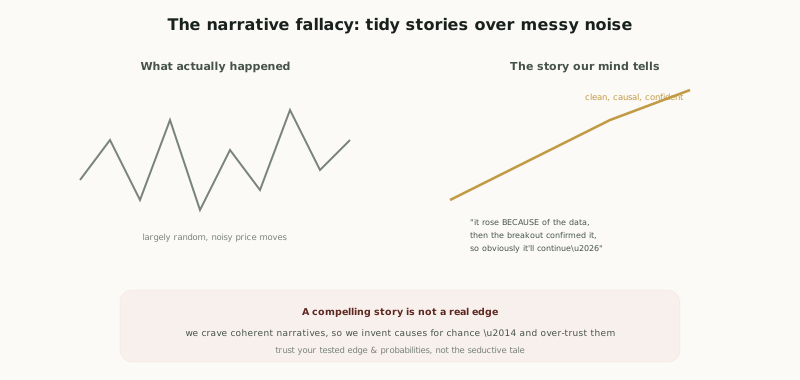
Humans crave stories. Faced with messy, noisy price action, our minds instantly weave a clean tale of cause and effect — "it rose because of the data, so it'll keep rising." The trouble is that a compelling story is not a real edge, and mistaking one for the other is one of the subtlest traps in trading — subtle because the story feels like genuine understanding. This guide explains the narrative fallacy: what it is, why it's dangerous for traders, and how to trade probabilities instead of tales.
It's the natural enemy of thinking in probabilities, feeds on the same soil as the illusion of control and hindsight bias, and is amplified by confirmation bias.
Key takeaways
Q: What is the narrative fallacy?
A: The narrative fallacy, a term popularised by Nassim Taleb, is our tendency to construct coherent cause-and-effect stories from events that are largely random or far more complex than the story allows. We're wired to find meaning and causation, so we impose tidy narratives on messy reality — and then believe them. In trading, it means inventing confident explanations for price moves that are substantially noise, and trusting those stories more than the evidence justifies.
Q: Why is the narrative fallacy dangerous for traders?
A: Because a compelling story feels like understanding and breeds false confidence. If you've woven a neat tale for why a currency 'must' keep rising, you'll over-trust the trade, ignore contrary evidence, and size too big — all on the strength of a story, not a tested edge. Markets are noisy and partly random, so much of what we 'explain' is chance dressed up as causation. The story can be wrong while feeling completely convincing.
Q: How do you avoid the narrative fallacy?
A: Think in probabilities rather than stories. Anchor decisions on a tested edge and base rates — what tends to happen across many similar situations — not on a persuasive one-off narrative. Hold explanations loosely, stay open to being wrong, and be suspicious of any story that makes a trade feel certain. Distinguish a genuine, evidence-backed reason from a seductive after-the-fact tale, and let risk management protect you for when the story (inevitably, sometimes) proves false.
What it is
The narrative fallacy — a term popularised by Nassim Taleb — is our tendency to construct coherent cause-and-effect stories from events that are largely random or far more complex than the story allows. We're wired to find meaning and causation (it's how the human brain makes sense of the world, and it served our ancestors well), so we impose tidy narratives on messy reality — and then, crucially, believe them. The market is a perfect storm for this: prices move for countless overlapping reasons (and a large dose of randomness), yet every day brings confident explanations ("the dollar fell because of the jobs data," "stocks rose because of optimism on rates") that compress this irreducible complexity into a single, satisfying cause. Often these stories are after-the-fact rationalisations — the move happened, and the explanation was reverse-engineered to fit (note how the same news is used to explain a rise and, on another day, a fall). In trading, the narrative fallacy means inventing confident explanations for price moves that are substantially noise, and then trusting those stories more than the evidence justifies — treating a neat tale as if it were genuine, reliable understanding of what will happen next. The story isn't necessarily wrong, but our certainty in it is almost always unwarranted given how noisy and multi-causal markets really are.
Why it's dangerous, and how to avoid it
The narrative fallacy is dangerous for traders because a compelling story feels like understanding and breeds false confidence. If you've woven a neat tale for why a currency "must" keep rising — a story with a clear cause, a logical chain, a satisfying conclusion — you'll over-trust the trade, ignore contrary evidence (it doesn't fit the story, so you dismiss it), and size too big (the story makes the outcome feel certain), all on the strength of a narrative rather than a tested edge. The deeper problem is that markets are noisy and partly random, so much of what we "explain" is chance dressed up as causation — meaning the very confidence the story gives you is built on a foundation of noise mistaken for signal. And because a good story is so persuasive, it can be completely wrong while feeling completely convincing — there's no internal alarm that distinguishes a true explanation from a seductive false one; both feel equally compelling from the inside. This is what makes it so insidious: the fallacy doesn't feel like a bias, it feels like insight. It also compounds with other biases — a strong narrative powers confirmation bias (you collect evidence that fits the story), survives on hindsight ("I knew it would happen, the story was obvious"), and fuels the illusion of control (if you can explain it, you feel you can predict it).
You avoid it by thinking in probabilities rather than stories. Anchor decisions on a tested edge and base rates — what tends to happen across many similar situations — not on a persuasive one-off narrative. The shift is from "here's a great story for why this trade works" to "across many trades like this, what's the actual edge and probability?" — grounding yourself in data and expectancy rather than the seductive tale of the moment (see thinking in probabilities). Hold explanations loosely: it's fine — even useful — to have a thesis, but hold it as a provisional, uncertain view ("this might be why, and I could be wrong") rather than a certain truth, staying genuinely open to being wrong and to updating when evidence shifts. Be suspicious of any story that makes a trade feel certain — in a probabilistic, noisy market, certainty itself is the warning sign; the more compelling and complete a narrative feels, the more skeptical you should be of your own confidence in it. Distinguish a genuine, evidence-backed reason from a seductive after-the-fact tale (ask: "is this supported by a real, tested edge, or does it just sound good?"). And — always — let risk management protect you for when the story proves false, which it inevitably sometimes will: position size and stops are your defence against the day your beautiful narrative meets an indifferent market. The mature stance is to use stories as loose, falsifiable hypotheses while trusting probabilities and your tested process for the actual decisions — enjoying the narratives without being ruled by them. The honest framing: the narrative fallacy is our tendency to build tidy cause-and-effect stories for price moves that are largely random or far more complex, then believe them — inventing confident explanations for what is substantially noise. It's dangerous because a compelling story breeds false confidence (you over-trust, ignore contrary evidence and oversize), and a story can be completely wrong while feeling convincing. Avoid it by thinking in probabilities and base rates rather than one-off stories, holding explanations loosely, being suspicious of any narrative that makes a trade feel certain, distinguishing evidence-backed reasons from seductive tales, and letting risk management protect you for when the story proves false.
News, gurus and the story machine
The narrative fallacy isn't just something your own mind does — you're surrounded by a vast story machine that manufactures narratives for you, and it deserves special wariness. The financial media exists, in large part, to explain markets: every move gets a confident headline ("stocks fell as investors worried about rates"), every wiggle a tidy cause. But much of this is narrative imposed on noise after the fact — journalists need a story by deadline, so one is supplied, whether or not the move had a single clean cause (tellingly, the same development is often cited to explain opposite moves on different days). Social media is worse still, full of confident voices spinning compelling stories about where a market "must" be heading. Consuming this stream uncritically feeds your own narrative fallacy, loading you with borrowed stories that feel like analysis.
Most dangerous of all are gurus selling narratives: persuasive figures whose entire product is a compelling story (about a coming crash, a sure-thing trade, a secret method) designed to sound authoritative and certain. The very persuasiveness that makes a guru popular is often a warning sign — markets are uncertain and probabilistic, so anyone radiating certainty via a slick narrative is either fooling themselves or selling you something (see social media and trading and signal sellers). The defence is to consume commentary skeptically: treat market explanations and forecasts as entertainment or loose hypotheses, not signals — interesting to hear, useful occasionally as ideas to test, but never a basis for a trade on their own. Ask of any market story: "is this backed by a tested edge, or does it just sound compelling?" and remember that a confident narrator is not a reliable one. The disciplined trader enjoys the stories while anchoring decisions in their own tested process and probabilities, immune to being swept along by whichever tale is loudest today. In a world engineered to sell you narratives, that skepticism is a genuine edge. The honest reminder: you're surrounded by a story machine — financial media explains every move with a tidy after-the-fact cause, social media spins confident tales, and gurus sell persuasive narratives whose very certainty is a warning sign in a probabilistic market; defend yourself by consuming commentary skeptically, treating explanations and forecasts as entertainment or loose hypotheses rather than signals, asking whether a story is backed by a tested edge or just sounds compelling, and anchoring decisions in your own process and probabilities rather than the loudest tale.
The narrative fallacy is our tendency to build tidy cause-and-effect stories for price moves that are largely random or far more complex — then believe them, inventing confident explanations for what is substantially noise. It's dangerous because a compelling story breeds false confidence (you over-trust the trade, ignore contrary evidence and oversize), and a story can be completely wrong while feeling convincing — the fallacy feels like insight, not bias. Avoid it: think in probabilities and base rates rather than one-off stories, hold explanations loosely (a thesis, not a certainty), be suspicious of any narrative that makes a trade feel certain (certainty is the warning sign), distinguish an evidence-backed reason from a seductive tale, and let risk management protect you for when the story proves false. Use stories as loose hypotheses — trust probabilities for decisions.