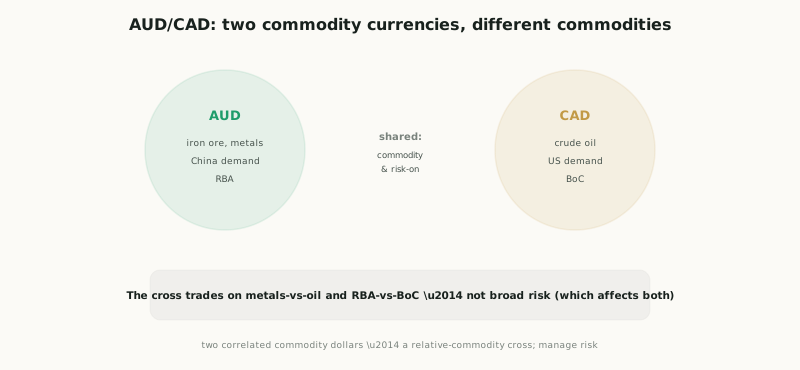
Both the Aussie and the Loonie are commodity dollars, both risk-sensitive — so when you pair them against each other in AUD/CAD, you strip out much of the broad global-risk story they share and lay bare what's left: metals versus oil, China versus the US, and the RBA against the BoC. That makes AUD/CAD a "relative commodity" cross with its own distinctive logic, less of a pure risk barometer than either currency's dollar pair. This guide explains trading AUD/CAD: why correlation shapes it, what drives it, and its best sessions.
It's a study in currency correlation and commodity currencies, built from the AUD/USD and USD/CAD legs.
Key takeaways
Q: What is the AUD/CAD pair?
A: AUD/CAD is a cross pair (no US dollar) pairing the Australian dollar against the Canadian dollar — two 'commodity dollars'. Both are commodity-exporting, risk-sensitive currencies, but they're tied to different commodities and economies: Australia to industrial metals, iron ore and China, Canada to crude oil and the US. The cross isolates these relative differences.
Q: What drives AUD/CAD?
A: The relative commodity and economic drivers of the two countries, plus the rate differential between the Reserve Bank of Australia (RBA) and the Bank of Canada (BoC). Because Australia is leveraged to metals and Chinese demand while Canada is leveraged to oil and US demand, AUD/CAD often reflects the relative performance of metals versus oil and of the Chinese versus US economies, rather than broad global risk.
Q: Why does broad risk sentiment matter less for AUD/CAD?
A: Because both the Australian and Canadian dollars are commodity, risk-sensitive currencies that tend to rise and fall together with global risk appetite. When you pair them against each other, much of that shared risk-on/risk-off movement cancels out, leaving the relative difference — metals vs oil, China vs US, RBA vs BoC. So AUD/CAD is less of a pure risk barometer than AUD/USD or other risk pairs.
Why correlation shapes the pair
The key to AUD/CAD is that its two currencies are partially correlated: both are commodity currencies tied to resource exports, and both are risk-sensitive (they tend to strengthen when global risk appetite is high and weaken in risk-off). When you pair them against each other, a good deal of that shared movement — the broad risk-on/off swings that lift or sink both — cancels out, leaving the smaller relative difference between them. The practical consequence is that AUD/CAD is less of a pure risk barometer than AUD/USD: a broad risk-off day that hammers the Aussie usually hits the Loonie too, so the cross moves less than you might expect. What's left to drive it is whatever makes the two economies differ — and that's where the interesting analysis lies.
What sets the two apart
Although both are commodity dollars, they're leveraged to different commodities and economies, and the table highlights the distinctions that actually move the cross.
| Factor | Australia (AUD) | Canada (CAD) |
|---|---|---|
| Key commodity | Iron ore, metals | Crude oil |
| Key trade partner | China | United States |
| Central bank | RBA | BoC |
| Leveraged to | Chinese demand, metals prices | Oil prices, US economy |
So AUD/CAD effectively trades on the relative performance of these factors: when metals and Chinese demand outperform oil and the US economy, the Aussie tends to gain on the Loonie (AUD/CAD up); when oil rallies hard or the US outperforms China, the Loonie tends to gain (AUD/CAD down). The RBA–BoC rate differential overlays this with a monetary-policy anchor. A vivid example: a surge in oil prices with soft iron-ore demand would tend to push AUD/CAD lower (CAD strength, relative AUD weakness), whereas a Chinese stimulus boom lifting metals while oil stagnates would push it higher. This is why an AUD/CAD trader watches two different commodity complexes (metals/iron ore and oil) and the China-versus-US growth picture, rather than a single risk gauge.
On sessions, AUD/CAD spans a wide clock. The Sydney and Tokyo sessions are most relevant for the AUD side (Australian data, Chinese data and Asian risk sentiment), while the New York session drives the CAD side (oil markets, Canadian data, US flows) — so the pair has active periods at quite different times, with the deepest liquidity generally during the London and New York hours. As a cross, it carries wider spreads and thinner liquidity than the majors, though its tendency for broad risk to cancel out can make it somewhat steadier than a wild cross like GBP/CAD — it's more about relative commodity and policy shifts than dramatic swings. As always, no cross is magic: AUD/CAD offers a clean way to express a relative view on two commodity economies, not a guaranteed edge, and demands confirmation and disciplined risk management. The honest framing: AUD/CAD pairs two commodity, risk-sensitive dollars, so broad risk-on/off largely cancels out, leaving the relative difference — Australia's metals and China links versus Canada's oil and US links, plus the RBA–BoC rate gap. It trades on metals-vs-oil and China-vs-US rather than a pure risk gauge: an oil surge with soft metals pushes it down, a China-led metals boom pushes it up. Active across Asian (AUD) and New York (CAD) hours, deepest in London/NY; as a cross it has wider spreads but is often steadier than uncorrelated crosses. A relative-commodity view to analyse, not a guarantee; manage risk.
Trading AUD/CAD
AUD/CAD's distinctive value is as a vehicle for a relative view between two commodity economies — a more refined bet than simply being "risk-on" or "risk-off." If you believe industrial metals and Chinese demand will outperform oil and the US, AUD/CAD is a clean way to express it (expecting the pair to rise), and vice versa; you're effectively trading metals-versus-oil and China-versus-US without the noise of broad risk sentiment, which largely cancels across the two risk currencies. This makes the pair appealing to traders who want to isolate a specific commodity or regional theme rather than take a blunt directional risk bet. It also means the watch-list is particular: keep an eye on iron-ore and metals prices and Chinese data on the AUD side, crude oil and US data on the CAD side, and the RBA-versus-BoC rate path tying it together.
On style, the partial cancelling of broad risk tends to make AUD/CAD comparatively steadier and more range-bound than an uncorrelated cross like GBP/CAD — the two legs don't usually diverge violently — which lends itself to range-trading and mean-reversion approaches around established levels, as well as to slower swing trades that play a developing metals-vs-oil or China-vs-US theme. That relative calm, though, is a tendency, not a guarantee: a big idiosyncratic shock (an oil spike, a China stimulus surprise, a divergent central-bank move) can push the legs apart and trend the pair. A few mechanics: as a cross, AUD/CAD has wider spreads than the majors, so factor that into shorter-term trades; and watch correlations carefully, since the pair shares legs with AUD/USD, USD/CAD and AUD/NZD — it's easy to accidentally double a metals or oil exposure across a portfolio. The pair also has a modest carry element via the RBA–BoC differential. As always, AUD/CAD offers a clean relative-commodity lens to analyse, not a guaranteed edge — confirm setups, size for the wider spread, and manage risk per trade. The honest reminder: use AUD/CAD to express a focused metals-vs-oil or China-vs-US view, lean on its range-bound tendency while respecting that shocks can trend it, watch both commodity complexes plus the RBA–BoC gap, and mind your cross-pair correlations — a precise relative tool, never a free edge.
The China factor
One asymmetry deserves special attention, because it's often the single biggest swing factor in AUD/CAD: China. Australia is heavily leveraged to the Chinese economy — China is its dominant trading partner and the main buyer of its iron ore and other industrial metals — so Australian export revenue, and the Aussie dollar, are unusually sensitive to Chinese growth, stimulus and industrial demand. Canada, by contrast, is far more tied to the United States (its dominant partner) and to the global oil market, with much less direct China exposure. This means AUD/CAD often behaves as a relative China-versus-US barometer: positive Chinese news — a stimulus package, strong industrial data, robust metals demand — tends to lift the Aussie more than the Loonie, pushing AUD/CAD up, while Chinese weakness or a slowdown drags the Aussie and pushes the pair down (even as Canada, leaning on the US, is comparatively insulated). A vivid case: a Chinese construction or infrastructure boom that lifts iron-ore prices would tend to rally AUD/CAD, whereas a Chinese property slump that hits metals demand would weigh on it, largely independent of what oil is doing. For a trader, this makes AUD/CAD a useful, relatively clean way to express a China view within the FX market — watch Chinese PMIs, growth data, stimulus announcements and the iron-ore price as leading inputs for the AUD leg — while recognising it's one factor among several (oil, the RBA–BoC gap and relative data also matter). It's another reason the pair rewards traders who think in terms of relative economic themes rather than blunt directional bets.
In sum, reading AUD/CAD means holding several relative threads at once: metals and Chinese demand pulling the Aussie, oil and the US economy pulling the Loonie, and the RBA–BoC rate path tying the two together — with broad risk sentiment mostly cancelling out. The pair's edge for a trader is precisely that it filters out the blunt risk-on/off noise and leaves these cleaner relative themes. Approach it as a thoughtful relative-value instrument, lean on its range-bound tendency while respecting that a big China, oil or policy surprise can trend it, and the cross rewards the kind of patient, theme-driven analysis that suits its character.
AUD/CAD pairs two commodity, risk-sensitive dollars, so broad risk-on/off largely cancels out, leaving the relative difference: Australia's metals and China links versus Canada's oil and US links, plus the RBA–BoC rate gap. It trades on metals-vs-oil and China-vs-US rather than a pure risk gauge — an oil surge with soft metals pushes it down, a China-led metals boom pushes it up. Active across Asian hours (AUD side) and the New York session (CAD/oil side), deepest in London/NY. As a cross it has wider spreads, but the cancelling of broad risk often makes it steadier than an uncorrelated cross. A clean way to express a relative view on two commodity economies — not a guaranteed edge; trade with confirmation and risk management.