EUR/AUD pits a stable European heavyweight against a commodity-driven, risk-sensitive currency from the other side of the world. The euro represents one of the world's largest, most developed economic blocs; the Australian dollar is a classic "commodity currency" whose fortunes rise and fall with global risk appetite, raw-material prices and China. The result is a lively cross that doubles as a barometer of market mood. This guide explains trading EUR/AUD: what the pair is, what drives it, its character and best sessions, and its correlations.
It's a cross built from the EUR/USD and AUD/USD legs, and is best understood alongside risk sentiment.
Key takeaways
Q: What is the EUR/AUD pair?
A: EUR/AUD is a cross pair (it contains no US dollar) pitting the euro against the Australian dollar. It effectively combines the EUR/USD and AUD/USD legs, setting a large, stable European economy against Australia's commodity-exporting, risk-sensitive one. It tends to be more volatile and carry wider spreads than a major like EUR/USD.
Q: What drives EUR/AUD?
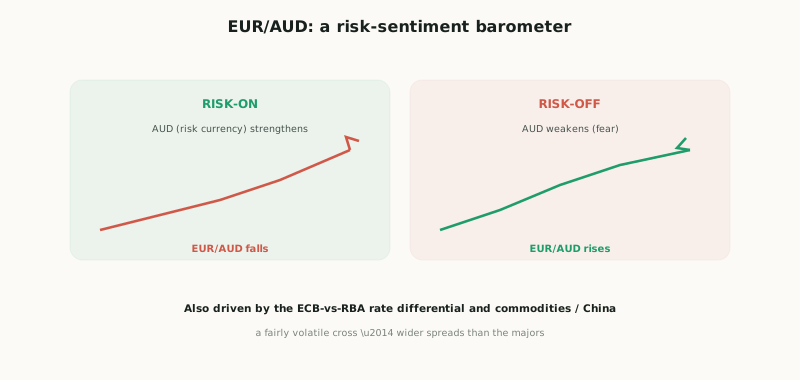
A: Three main forces: the interest-rate differential between the ECB and the Reserve Bank of Australia (RBA); risk sentiment, since the Australian dollar is a risk-on/'commodity' currency that strengthens in good times; and commodity prices and China's economy (Australia's largest export market). Because AUD rises in risk-on, EUR/AUD tends to fall when risk appetite is high and rise when fear dominates.
Q: When is the best time to trade EUR/AUD?
A: When its two currencies are active. The Australian dollar is most active during the Asian (Sydney/Tokyo) session, while the euro is most active during the European/London session. EUR/AUD therefore sees meaningful activity across both, rather than in a single tight overlap as EUR/USD does during the London–New York window.
The pair at a glance
EUR/AUD is a cross pair — it contains no US dollar — combining the euro (base) and the Australian dollar (quote). The snapshot below captures its essentials.
EUR/AUD snapshot
Because it's derived from two currencies each measured against the dollar, EUR/AUD effectively reflects the EUR/USD divided by AUD/USD relationship — so movements in either leg, including USD-driven ones, feed through. As a cross of two non-dollar currencies, it typically carries wider spreads than a major like EUR/USD and tends to be more volatile, with broader daily ranges.
What drives it, and when to trade it
Three forces dominate EUR/AUD. The first is the monetary-policy differential between the European Central Bank (ECB) and the Reserve Bank of Australia (RBA): the gap between their interest rates (and the market's expectations for each) is a powerful driver, and underpins any carry dynamic in the pair (historically the AUD has often been the higher-yielder). The second, and especially characterful, is risk sentiment. The Australian dollar is a quintessential risk-on / "commodity" currency — it tends to strengthen when markets are optimistic and weaken when fear takes hold — while the euro behaves more neutrally. As a result, EUR/AUD tends to fall when risk appetite is high (AUD strong) and rise when markets turn risk-off (AUD weak), making the pair a useful barometer of, and a way to trade, global market mood. The third is commodities and China: Australia is a major exporter of raw materials (iron ore, metals), and China is its largest export market, so strong commodity prices and Chinese growth tend to lift the AUD (lowering EUR/AUD), while the euro responds to its own drivers — ECB policy, Eurozone growth and politics (see commodities and currencies).
On timing, the best approach is to trade EUR/AUD when its currencies are active. The Australian dollar is most active during the Sydney and Asian sessions, while the euro comes alive in the European/London session — so EUR/AUD sees meaningful activity across both windows, rather than concentrating in a single tight overlap as EUR/USD does during the London–New York period. On correlations, EUR/AUD is positively correlated with EUR/USD (the shared euro leg) and moves inversely to the Australian dollar's strength, so it tends to track opposite to risk-on AUD pairs like AUD/USD and AUD/JPY (useful awareness for avoiding unintentionally doubled-up risk — see currency correlations). As with every pair guide on this site, this describes the pair's typical character and drivers, not a prediction — volatility and spreads vary with conditions and broker, the relationships are tendencies that can shift, and sound risk management applies on every trade. The honest framing: EUR/AUD is a cross pitting the euro against the risk-sensitive, commodity-linked Australian dollar — driven by the ECB-vs-RBA rate differential (and carry), heavily by risk sentiment (AUD rises in risk-on, so EUR/AUD tends to fall in risk-on and rise in risk-off), and by commodities and China (Australia's key market). It's a fairly volatile cross with wider spreads than the majors, derived from its EUR and AUD legs, and best traded when its currencies are active (the Asian session for AUD, the London/European session for EUR). Like all crosses it reflects two sets of drivers; character and spreads vary, so manage risk.
How traders approach EUR/AUD
For traders, EUR/AUD's defining usefulness is as a risk-sentiment expression. Because the pair tends to rise in risk-off and fall in risk-on, a trader with a view on global market mood can express it cleanly here: someone expecting deteriorating sentiment (weaker Aussie) might look to the long side, while someone positioning for a risk rally might lean short. This makes EUR/AUD a natural vehicle for the kind of macro, sentiment-led trading that pairs poorly with the steadier majors, and it often trends persistently when a sustained risk regime takes hold (a long risk-off stretch can drive an extended EUR/AUD uptrend), while chopping in a range when sentiment is directionless. Reading whether the broader environment is trending or ranging — and matching your approach (trend-following versus range tactics) to it — is half the battle on this pair.
On the fundamental calendar, the events that move EUR/AUD cluster around its two central banks and the Aussie's external drivers. ECB meetings and Eurozone data (growth, inflation, politics) drive the euro leg; RBA meetings and Australian data — employment, inflation, and crucially Chinese data and commodity prices (iron ore in particular) — drive the Aussie leg, often sharply. A trader watching this pair should keep an eye on Chinese economic releases and metal prices as much as on the two central banks, since a surprise from China or a swing in commodities can move the AUD (and so the pair) quickly. The rate differential also sets up a potential carry consideration: when the Australian yield sits above the Eurozone's, being short EUR/AUD (effectively long the higher-yielder) earns positive carry, and vice versa — a factor for longer holds, though never a reason to ignore price risk.
Two practical points round out the approach. First, cost: as a cross, EUR/AUD carries wider spreads than EUR/USD and can have meaningful overnight swap charges, so it's less suited to high-frequency scalping and better to swing or position trading where the wider spread is a smaller fraction of the move you're targeting. Second, combine fundamentals with technicals: the sentiment and rate story tells you the likely bias and which regime you're in, while support/resistance, trend structure and your chosen setups time the actual entries and exits — neither alone is enough. As with every pair, none of this is a formula for guaranteed profit: EUR/AUD's tendencies (the risk-barometer behaviour, the China/commodity sensitivity, the carry) are reliable enough to inform a view but can break or be overwhelmed by events, so position sizing, stops and risk management remain non-negotiable on every trade. Treated this way — as a characterful, sentiment-driven cross best traded with a clear read on the risk environment, an eye on China and commodities, and disciplined risk control — EUR/AUD offers genuine opportunity beyond the well-worn majors.
EUR/AUD versus other ways to trade the Aussie
If your view is really about the Australian dollar, it's worth knowing how EUR/AUD compares with the other ways to express it. Trading AUD/USD mixes your Aussie view with a US dollar view — fine if you have both, but it means USD-specific events (Fed decisions, US data) drive half the pair. Trading AUD/JPY pairs the Aussie against another risk-sensitive currency (the yen), amplifying the pure risk-sentiment dimension — it's one of the market's sharpest risk barometers, but also dominated by JPY-specific factors. EUR/AUD, by contrast, sets the Aussie against the relatively neutral, stable euro, so it expresses an Australian-dollar-and-risk view with the euro as a steadier counterweight, relatively free of the US dollar's influence. None of these is "better" in the abstract — the right choice depends on what your view actually is: a clean USD-vs-AUD call points to AUD/USD; a strong risk-sentiment play might suit AUD/JPY; a view on the Aussie measured against a stable European anchor (or a specific ECB-vs-RBA divergence) points to EUR/AUD. Thinking in these terms — choosing the pair whose two legs match the view you hold — is part of trading currencies well, and it's a habit worth building on any cross.
EUR/AUD is a cross (no USD) pitting the euro against the risk-sensitive, commodity-linked Australian dollar — effectively EUR/USD ÷ AUD/USD. Three main drivers: the ECB-vs-RBA rate differential (and carry); risk sentiment (AUD is a risk currency, so EUR/AUD tends to fall in risk-on and rise in risk-off — a market-mood barometer); and commodities/China (strong commodities and Chinese growth lift AUD, lowering EUR/AUD). It's a fairly volatile cross with wider spreads than the majors. Best traded when its currencies are active — the Asian session (AUD) and the European/London session (EUR). It's positively correlated with EUR/USD and moves inversely to AUD strength. Character and spreads vary with conditions — manage risk on every trade.