Combine the often-jumpy pound with the risk-sensitive Aussie and you get one of the larger-moving crosses on the board. GBP/AUD sets Britain's currency — lively and event-driven — against Australia's commodity-linked, risk-sensitive dollar, and the combination produces big ranges and sharp swings. It rewards traders who actively want movement, and punishes those who underestimate it. This guide explains trading GBP/AUD: what the pair is, what drives it, its notably volatile character, and its best sessions.
It's a cross built from the GBP/USD and AUD/USD legs, and like EUR/AUD it's closely tied to risk sentiment.
Key takeaways
Q: What is the GBP/AUD pair?
A: GBP/AUD is a cross pair (no US dollar) pitting the British pound against the Australian dollar. It combines two relatively lively currencies — the pound, which moves on UK events and Bank of England policy, and the risk-sensitive, commodity-linked Aussie — making it one of the more volatile crosses, with wide daily ranges and wider spreads than the majors.
Q: What drives GBP/AUD?
A: The interest-rate differential between the Bank of England (BoE) and the Reserve Bank of Australia (RBA); risk sentiment, since the Australian dollar strengthens in risk-on and weakens in risk-off; commodity prices and China (which drive the AUD leg); and UK-specific factors like BoE policy and British economic and political news (which drive the GBP leg). Because AUD is risk-sensitive, GBP/AUD tends to rise in risk-off and fall in risk-on.
Q: Is GBP/AUD volatile?
A: Yes — it's one of the more volatile crosses. It combines two lively currencies, so it can post large daily ranges and sharp swings, and carries wider spreads than majors. That volatility appeals to traders seeking movement, but it demands careful position sizing and risk management, since the larger swings can hit stops or magnify losses if underestimated.
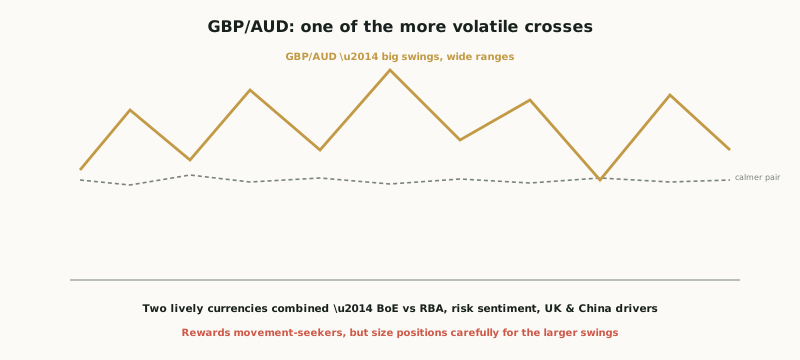
A volatile cross
The defining feature of GBP/AUD is its volatility. It combines two relatively lively currencies — the pound, which can move sharply on UK economic data, Bank of England decisions and British political news, and the Australian dollar, which swings with global risk sentiment and commodity prices. Stack those two together in a single cross and you get one of the more volatile pairs on the board: wide daily ranges, sharp swings, and pip movements that can dwarf those of a steadier major. That carries two practical implications. First, the volatility is the attraction for traders who want movement and opportunity — there's plenty of range to work with. Second, and crucially, it demands respect: the larger swings mean stops can be hit more easily, losses can compound faster, and position sizes must be smaller to keep risk controlled (a fixed-percentage risk on a wide-ranging pair translates to fewer lots than on a calm one). As a cross, it also carries wider spreads than the majors. The pair suits experienced, risk-aware traders far better than beginners drawn in by the big moves — the same volatility that creates opportunity creates danger if position sizing and stops aren't disciplined.
What drives it, and when to trade it
The drivers mirror EUR/AUD's, with the pound replacing the euro on one side. The monetary-policy differential between the Bank of England (BoE) and the Reserve Bank of Australia (RBA) — their rates and rate expectations — is a core driver. Risk sentiment matters greatly: the Australian dollar is a risk-on / commodity currency that strengthens in optimism and weakens in fear, and although the pound has some risk sensitivity of its own, the AUD's risk behaviour tends to dominate the pair's risk dynamic — so GBP/AUD generally rises in risk-off (AUD weak) and falls in risk-on (AUD strong). Commodities and China drive the AUD leg (strong raw-material prices and Chinese growth lift the Aussie, pulling GBP/AUD down), while UK-specific factors — BoE policy, British growth, inflation and politics — drive the GBP leg and can inject sharp, pound-specific volatility.
On timing, trade GBP/AUD when its currencies are active: the Australian dollar during the Sydney and Asian sessions, and the pound during the London session, where GBP is at its most active and the pair's pound-driven volatility often peaks. On correlations, GBP/AUD shares the AUD leg with other Aussie pairs (moving inversely to AUD strength, much like EUR/AUD) and the GBP leg with pound pairs — so it tends to move similarly to EUR/AUD (shared inverse-AUD behaviour) and to track the pound's fortunes, useful awareness for managing correlated exposure (see currency correlations). As always, this is the pair's typical character, not a forecast — volatility and spreads vary with conditions and broker, and the relationships are tendencies. Given the pair's swings, disciplined position sizing and stops matter more here than on most pairs. The honest framing: GBP/AUD pits the pound against the risk-sensitive, commodity-linked Aussie — driven by the BoE-vs-RBA rate differential, risk sentiment (AUD's sensitivity means GBP/AUD tends to fall in risk-on and rise in risk-off), commodities and China (AUD leg), and UK factors (GBP leg). It's one of the more volatile crosses (big ranges, wider spreads), combining two lively currencies — rewarding for those who want movement but demanding careful position sizing for the larger swings. Best traded when its currencies are active (Asian for AUD, London for GBP), and manage risk especially given the volatility.
Approaching GBP/AUD's volatility
Everything about trading GBP/AUD flows from its volatility, and the first discipline is position sizing. Because the pair posts wide daily ranges, a sensible stop-loss sits further away than it would on a calm pair — and a wider stop, for the same fixed-percentage risk, means a smaller position. A trader risking 1% of a £10,000 account (£100) with a 150-pip stop on GBP/AUD must size far smaller than someone using a 40-pip stop on a quiet pair; cramming on a "normal" position size here is how the pair's swings turn a routine trade into an outsized loss. Respecting the volatility through smaller, properly calculated sizing is the single most important habit on this cross, and it's why GBP/AUD suits experienced, risk-aware traders rather than beginners lured by the big moves.
Used well, though, that volatility is an asset. GBP/AUD can produce large, clean trends when its drivers align — a divergence between BoE and RBA policy paths, or a sustained risk regime, can send the pair on extended runs that trend-followers prize — and its wide ranges give intraday and swing traders room to work. The key is matching tactics to the pair's behaviour: trend-following to ride the big directional moves, with stops wide enough to survive the noise, rather than tight scalping that the volatility will shake out. On the fundamental side, watch both sets of catalysts: BoE meetings and UK data (growth, inflation, employment) and British political news, which can spark sharp pound-led moves; and RBA meetings plus Australian data, Chinese releases and commodity prices on the Aussie side. With two event-prone currencies, GBP/AUD has plenty of scheduled risk — a reason to know the calendar and to be cautious around major releases on either side.
The practical cautions echo those of any volatile cross, with extra weight. Spreads are wider than on the majors and overnight swap costs can be meaningful, so the pair favours swing and position trading over high-frequency approaches. And the risk-sentiment behaviour (rising in risk-off, falling in risk-on, via the Aussie) means GBP/AUD often moves with, and can be doubled up against, other AUD pairs — worth checking to avoid unintended correlated exposure (see currency correlations). Above all, hold the honest line: the pair's volatility is simultaneously its opportunity and its hazard, and the difference between the two comes down almost entirely to risk management — smaller sizes, sensible wide stops, awareness of the calendar, and never treating the big, exciting moves as a reason to abandon discipline. Approached with that respect, GBP/AUD is a rewarding cross for those who want movement; approached carelessly, it's one of the faster ways to damage an account.
Who should trade GBP/AUD
It's worth being plain about suitability. GBP/AUD is not a beginner's pair. Its wide ranges and sharp swings can look thrilling on a chart, but they translate into faster, larger account moves that punish the very habits new traders are still unlearning — oversized positions, stops placed too tight for the volatility, and emotional reactions to big intraday gyrations. A beginner is far better served cutting their teeth on a steadier major like EUR/USD, where the calmer behaviour is more forgiving of inexperience. GBP/AUD suits the trader who already has a reliable process — disciplined position sizing scaled to volatility, consistent stop placement, an understanding of how to follow trends and manage risk — and who actively wants the movement that the pair provides. For such a trader, the volatility is raw material; for an unprepared one, it's a hazard. If you're drawn to GBP/AUD, the honest question to ask is whether your risk management is robust enough to handle a pair that moves this much — if it isn't yet, the pair will expose that quickly, and it's better to build the discipline on quieter pairs first. There's no rush: the volatility will still be there when you're ready for it.
GBP/AUD is a cross (no USD) pitting the pound against the risk-sensitive, commodity-linked Australian dollar — and it's one of the more volatile crosses, combining two lively currencies into big ranges and sharp swings (with wider spreads than majors). Drivers: the BoE-vs-RBA rate differential; risk sentiment (AUD's sensitivity dominates — GBP/AUD tends to rise in risk-off, fall in risk-on); commodities/China (AUD leg); and UK factors (GBP leg). Best traded when its currencies are active — the Asian session (AUD) and the London session (GBP). The volatility is both the attraction and the danger: size positions smaller and keep stops disciplined, as the larger swings hit risk harder. Character and spreads vary with conditions — this pair especially rewards risk awareness.