
It's the dream that draws many people to forex: quitting the job, trading from a laptop, living off the markets. It's not impossible — but it's far harder and rarer than the social-media hype suggests, and believing the hype is how a lot of people lose money and time. An honest look at what making a living from trading actually takes — and why realism is your friend — is far more useful than another fantasy. This guide answers the question candidly: the realistic odds, what it requires, why most lose, and why you shouldn't quit your job to start.
It's the honest companion to realistic expectations, connects to how much money you need, and counters the hype in common myths.
Key takeaways
Q: Can you really make a living trading forex?
A: It is possible, but it's hard and rare. The honest reality is that the large majority of retail traders lose money, especially early on; a minority become consistently profitable after years of work, and a smaller minority make enough to live on. It's achievable for some dedicated, well-capitalised, disciplined traders — but it's nothing like the easy, fast income often portrayed online. Treating it as a realistic possibility for a few, not a likely outcome for most, is the right mindset.
Q: What does it actually take to trade for a living?
A: A combination that's harder than it sounds: enough trading capital (you can't live off tiny returns on a tiny account), a genuine, tested edge, years of skill development and screen time, strong psychology and discipline, and the ability to tolerate irregular, unpredictable income. You also need separate savings to live on while you learn, because income from trading is lumpy and unreliable. Most who attempt it underestimate every one of these requirements.
Q: Should I quit my job to trade forex?
A: Almost certainly not, at least not to start. Quitting to trade puts you under financial pressure that wrecks the calm, patient decision-making trading requires — trading scared money is a recipe for failure. The sensible path is to learn and build a track record while keeping your income, prove consistent profitability over a long period first, and only consider going full-time once you have a proven edge, sufficient capital, and a financial cushion. Build slowly; don't bet your livelihood on a hope.
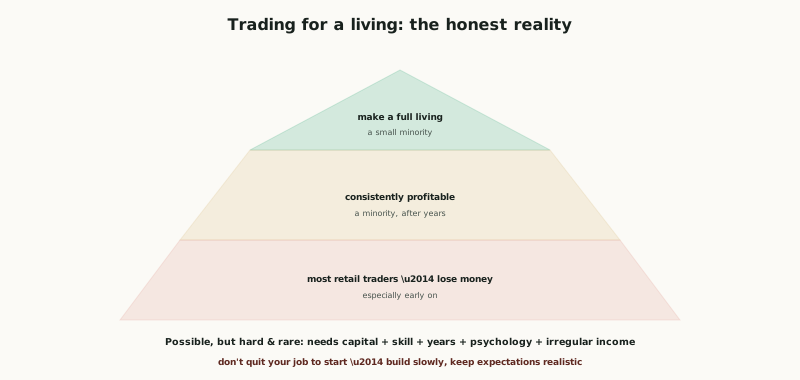
The honest reality
Can you really make a living trading forex? It is possible, but it's hard and rare — and an honest answer has to lead with that. The reality, supported by broker disclosures and industry data, is that the large majority of retail traders lose money, especially early on; a minority become consistently profitable after years of work; and a smaller minority still make enough to actually live on. So it's achievable for some — dedicated, well-capitalised, disciplined traders do make a living — but it's nothing like the easy, fast, laptop-on-a-beach income so often portrayed online (much of which comes from people selling courses and signals, not from trading itself). The right mindset is to treat trading for a living as a realistic possibility for a few, not a likely outcome for most — the same way you'd regard making a living as a professional athlete or musician: genuinely attainable for some, but demanding, competitive, and not the default result of simply wanting it. This isn't discouragement for its own sake; it's the accurate picture, and starting with an accurate picture is what lets the people who can succeed approach it sensibly (while sparing others from betting their savings on a misconception).
What it takes, and why not to quit your job
What it actually takes is a combination that's harder than it sounds — and most who attempt it underestimate every element. You need enough trading capital: you simply can't live off tiny returns on a tiny account (a good annual return on a £2,000 account won't pay rent, so realistic full-time trading needs substantial capital — see how much money you need). You need a genuine, tested edge — a real, proven method, not a hunch. You need years of skill development and screen time (the learning curve is long, and there are no shortcuts). You need strong psychology and discipline (the hardest part for most — see trading psychology). And you need the ability to tolerate irregular, unpredictable income: trading income is lumpy — good months, bad months, drawdowns — with no steady paycheck, which is psychologically and practically demanding. You also need separate savings to live on while you learn and through the inevitable rough patches. Every one of these is a real barrier, and the combination is why so few clear it.
This is the single most important practical warning: almost certainly do not quit your job to trade, at least not to start. Quitting to trade puts you under exactly the financial pressure that wrecks the calm, patient decision-making trading requires — when your rent and bills depend on this month's trades, you're trading scared money, and scared money trades badly (cutting winners early, holding losers, forcing trades that aren't there, abandoning the plan out of desperation). The cruel irony is that needing trading income makes you worse at trading, so quitting your job to trade often guarantees the failure you were hoping to avoid. The sensible path is the opposite of the hype: learn and build a track record while keeping your income, so you can trade calmly with money you can afford to lose; prove consistent profitability over a long period first (not a lucky month or two — a sustained record across different conditions); and only consider going full-time once you have a proven edge, sufficient capital to generate a real income, and a financial cushion to live on through drawdowns. Build slowly; don't bet your livelihood on a hope. There is no rush — the market will still be there in five years, and the traders who last are almost always the ones who transitioned gradually and from a position of security, never those who burned the boats and traded out of desperation. If anyone is urging you to quit your job and trade full-time quickly, treat it as a serious red flag — that advice serves them (often selling you something), not you.
None of this means the dream is invalid — it means it should be pursued realistically and safely. Plenty of people trade profitably alongside other income, treating it as a serious skill they build over years; some eventually do reach full-time, almost always via the gradual, well-capitalised, track-record-first path above. The healthiest framing is to fall in love with the process (becoming a good trader) rather than fixating on the outcome (quitting your job), to keep your expectations realistic, and to protect your financial security and wellbeing throughout — trading should add to your life, not jeopardise it. The honest framing: making a living trading forex is possible but hard and rare — most retail traders lose, especially early; a minority become consistently profitable after years; fewer still live off it. It demands real capital, a tested edge, years of skill, strong psychology, and tolerance for irregular income, plus savings to live on — most underestimate all of these. Above all, don't quit your job to start: financial pressure creates scared-money trading that causes the very failure you fear, so learn while keeping your income, prove a long track record, and only go full-time from a position of proven edge, sufficient capital and security. Build slowly and keep expectations realistic.
A realistic path — if you still want to pursue it
If, eyes open, you still want to aim for trading as a living, there's a sane way to pursue it. Start by doing the maths honestly: "making a living" means generating a real income, so work backwards — if you'd need, say, a certain annual sum to live on, and a realistic (not fantasy) return on capital is modest, the capital required is far larger than most beginners imagine. That calculation alone reframes the goal: trading for a living is as much about having enough capital as about being a good trader, and undercapitalised "going full-time" is doomed regardless of skill. Treat trading as a part-time skill first, built over years alongside other income, keeping a genuine track record across different market conditions to prove (to yourself, honestly) that you have a real, durable edge — not a lucky streak.
Then scale gradually and stay diversified: grow your trading capital and size slowly as your results justify it, keep other income streams rather than betting everything on trading, and build the financial cushion that lets you trade calmly through drawdowns. Above all, adopt the healthy mindset: fall in love with the process of becoming a skilled trader rather than fixating on the outcome of quitting your job, and recognise there's absolutely no shame in trading part-time forever — plenty of skilled traders sensibly keep it as a profitable supplementary pursuit rather than a sole livelihood, which removes the pressure and often makes them better traders. The goal isn't really "quit your job"; it's "become genuinely good at this and let your situation evolve safely from there." Pursued that way — realistic maths, part-time first, proven track record, gradual scaling, diversified income, process-focused — the dream becomes something you can chase without risking your security or wellbeing. The honest reminder: if you still want to pursue trading for a living, do it sanely — work out the real capital required from a realistic return and income need, treat it as a part-time skill built over years with a genuine track record, scale gradually while keeping other income and a cushion, focus on the process over the outcome, and accept there's no shame in trading part-time forever; let your situation evolve safely rather than betting your livelihood on a hope.
Making a living trading forex is possible but hard and rare: most retail traders lose (especially early), a minority become consistently profitable after years, and fewer still live off it. It demands real capital, a tested edge, years of skill, strong psychology, and tolerance for irregular income — plus separate savings to live on (most underestimate all of these). Above all: don't quit your job to start — financial pressure creates scared-money trading that causes the very failure you fear. Learn while keeping your income, prove a long, consistent track record, and only go full-time from a position of proven edge, sufficient capital and a financial cushion. Build slowly, keep expectations realistic, and protect your security and wellbeing — anyone urging you to quit and trade full-time fast is a red flag.