Forex marketing runs on seductive myths: easy money, secret indicators, robots that print profits while you sleep. These myths aren't harmless — believing them is one of the main reasons beginners lose money, because they set false expectations and steer people straight into the hype, the over-risking and the scams. This guide debunks the most common forex myths and gives the honest reality behind each, so you can start with clear eyes rather than a head full of marketing.
It's the antidote to the hype, and a companion to realistic expectations, common beginner mistakes and common scams.
Key takeaways
Q: Is forex trading easy money?
A: No — this is the most damaging myth. Forex trading is a genuinely difficult skill, and the large majority of retail traders lose money, especially beginners. Marketing portrays it as a fast, easy path to riches because that sells courses, signals and brokerage, but the reality is that consistent profitability takes education, practice, discipline and risk management over a long time, and even then it's far from guaranteed.
Q: Can indicators or robots predict the market?
A: No. Indicators are tools that summarise past price in useful ways, but they're probabilistic aids, not crystal balls — none predicts the future reliably. Likewise, most 'trading robots' and paid signal services that promise effortless profits are hype or outright scams; if a system genuinely printed money automatically, no one would sell it cheaply. There is no shortcut that removes the need for skill, judgement and risk management.
Q: Do you need a large account to trade forex?
A: No — you can start with a small account, and beginners arguably should. What matters far more than account size is risk management and survival: a small account traded sensibly outlasts a large one traded recklessly. Starting small keeps early mistakes cheap while you learn. The myth that you need a big account often pushes beginners to over-fund and then over-risk, which is exactly the wrong approach.
The myths and the reality
Here are the most common and damaging forex myths, each paired with the honest reality.
Myth vs reality
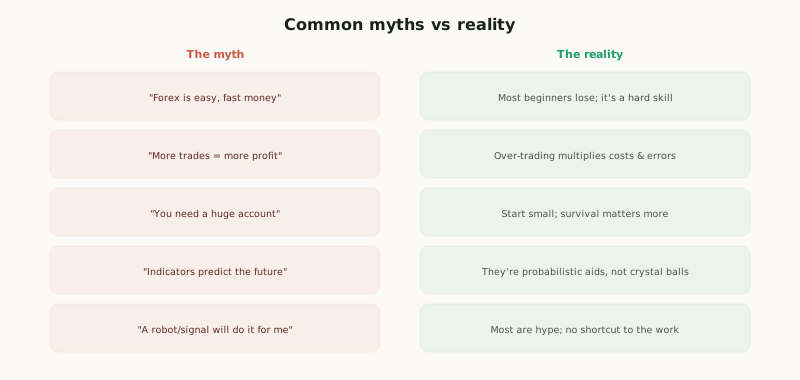
"Forex is easy, fast money." This is the most damaging myth of all. Forex is a genuinely difficult skill, and the large majority of retail traders — especially beginners — lose money. The "easy riches" framing exists because it sells (courses, signals, brokerage), not because it's true; consistent profitability takes education, practice, discipline and risk management over a long time, and even then isn't guaranteed (see realistic expectations). "More trades equals more profit." The opposite is usually true: over-trading multiplies your costs and your chances to make emotional errors, and most traders would do better taking fewer, higher-quality trades — activity is not the same as profitability. "You need a huge account." No — you can (and arguably should) start small. What matters far more than size is risk management and survival: a small account traded sensibly outlasts a large one traded recklessly, and starting small keeps early mistakes cheap while you learn (see how much to start with).
"Indicators predict the future." They don't. Indicators are tools that summarise past price in useful ways, but they're probabilistic aids, not crystal balls — none reliably forecasts what price will do next, and treating them as predictive is a classic beginner trap (the entire technical-analysis toolkit works on probabilities and confirmation, not certainty). "A robot or signal service will trade profitably for you." Be very sceptical: most "trading robots" (EAs) and paid signal services promising effortless profits are hype or outright scams. The logic is simple — if a system genuinely printed money automatically, why would anyone sell it cheaply rather than just use it? There is no shortcut that removes the need for skill, judgement and risk management (and this myth shades directly into the scams that prey on beginners). A few other myths deserve a quick mention: "you have to predict the market" (you don't — you manage probabilities and risk, not forecasts); "professionals win most of their trades" (many profitable traders win less than half, relying on risk-reward and expectancy); and "more leverage means more profit" (leverage magnifies losses just as much, and over-leverage is a top account-killer).
The thread connecting all these myths is that they each promise an easier path than reality offers — and that promise is precisely what hype and scams exploit. The honest, unglamorous truth is that forex trading is a hard skill requiring education, screen time, discipline and disciplined risk management, with no shortcut, secret indicator or robot that bypasses the work; most people lose, success takes years, and even then it's uncertain. That sounds discouraging, but it's actually empowering: knowing the myths are false protects you from the courses, signals and "systems" that profit from beginners' hope, lets you set realistic expectations, and points you toward what actually matters — genuine education, demo practice, small live sizing, and relentless risk management. Approaching forex with clear eyes, free of the myths, is itself a meaningful edge over the many who don't. The honest framing: the big forex myths are that it's easy/fast money (most lose; it's a hard skill), that more trades mean more profit (over-trading multiplies costs and errors), that you need a huge account (start small; survival matters more), that indicators predict the future (they're probabilistic aids, not crystal balls), and that a robot or signal will trade profitably for you (mostly hype or scams — no shortcut). Related myths: you must predict the market (you manage probabilities), pros win most trades (many win under half, relying on risk-reward), and more leverage means more profit (it magnifies losses). All promise an easier path than reality offers; knowing they're false protects you and points you to real education, practice and risk management.
Why these myths persist
It's worth understanding why these myths are so pervasive, because seeing the machinery behind them makes you far more resistant. The blunt answer is incentives: a whole industry profits from beginners believing forex is easy. Course-sellers and "mentors" make money selling the dream of quick riches, not the unglamorous truth that it's hard and most lose; signal services and "trading robot" vendors sell shortcuts that mostly don't work (if they did, the seller would use them, not sell them cheaply); and some less scrupulous brokers benefit from a churn of over-trading, over-leveraged beginners. The "easy money" myth isn't an innocent misunderstanding — it's actively manufactured and marketed because it sells. Layered on top is social media, where the incentives get worse: influencers post rented Lamborghinis and screenshots of winning trades (real or faked) to build an audience they can monetise, creating a relentless stream of "proof" that easy riches are normal — while the losses, which are the typical outcome, are never posted.
That last point reveals a deeper distortion: survivorship bias. The few who got lucky or genuinely succeeded are visible and loud; the many who lost are invisible and silent (people rarely broadcast their blown accounts). So the picture a beginner absorbs — from ads, social media, success stories — is wildly skewed toward winning, making the myths feel true even though the statistics (most retail traders lose) tell the opposite story. Inoculating yourself against all this comes down to a few habits: follow the incentives (ask "what is this person selling, and how do they profit from me believing this?" — the answer usually explains the message); be deeply sceptical of anyone promising easy or guaranteed profits (the surest sign of hype or a scam); curate your information diet (favour honest, education-focused sources over hype-merchants, and limit exposure to the influencer feeds engineered to mislead); and anchor on the statistics, not the anecdotes (the visible winners are survivorship bias; the invisible majority lost). Understanding that the myths persist because they're profitable to spread — not because they're true — is itself a strong defence, turning the marketing from something that lures you in into something you can see straight through. The honest reminder: these myths persist because an industry profits from spreading them — course- and signal-sellers, robot vendors, hype influencers — amplified by social media and survivorship bias (winners are visible, the losing majority isn't). Defend yourself by following the incentives, distrusting promises of easy profit, curating your sources, and anchoring on the statistics rather than the anecdotes.
The reassuring flip side of all this is that seeing through the myths is itself an advantage. While the majority chase easy-money promises, buy the courses and signals, over-leverage and burn out, the trader who started with clear eyes — expecting difficulty, respecting the odds, focusing on education and risk management — is already ahead simply by not being misled. Realism isn't pessimism here; it's the foundation that makes genuine progress possible. The myths promise a shortcut that doesn't exist, but the honest path — learn properly, practise, manage risk, be patient — is open to anyone willing to walk it, and far more likely to lead somewhere real.
The big forex myths: it's easy, fast money (no — most beginners lose; it's a hard skill); more trades = more profit (no — over-trading multiplies costs and errors); you need a huge account (no — start small; survival matters more); indicators predict the future (no — probabilistic aids, not crystal balls); and a robot or signal will trade for you (mostly hype or scams — if it truly printed money, why sell it?). Related: you must predict the market (you manage probabilities, not forecasts); pros win most trades (many win under half, relying on risk-reward); more leverage means more profit (it magnifies losses). Every myth promises an easier path than reality offers — which is exactly what hype and scams exploit. The truth: it's a hard skill with no shortcut. Knowing that protects you and points you to real education, practice and risk management.