So much of trading psychology comes down to a single skill: noticing what you feel without immediately acting on it. Mindfulness — the practice of present-focused, non-reactive awareness — trains exactly that. It won't make you a great trader on its own, but it can widen the crucial gap between an emotional impulse and a reckless click — the gap where discipline actually lives. This guide covers mindfulness and meditation in trading: how it can help, whether you need it, and a simple way to apply it.
It's a practical tool for emotional control, supports resilience and managing stress, and shares ground with the calm focus of a flow state.
Key takeaways
Q: How can mindfulness help trading?
A: Mindfulness — the practice of paying attention to the present moment without judgement — trains you to notice emotions and urges as they arise without automatically acting on them. In trading, that creates a small but vital pause between a trigger (a loss, a sharp move) and your response, giving your rational, rule-following self a chance to act instead of your impulsive one. It can also reduce stress and reactivity, helping you stay calmer and more disciplined under pressure.
Q: Do you have to meditate to be a good trader?
A: No — it's one optional tool among many, not a requirement. Plenty of disciplined traders never meditate, and mindfulness alone won't give you an edge or replace a sound strategy and risk management. But many traders find that some form of mindfulness practice — meditation, breathing exercises, or simply pausing to notice their state — helps them manage the emotional reactivity that derails good plans. Treat it as a possible aid to discipline, not a magic solution.
Q: What's a simple way to apply mindfulness to trading?
A: Build in a deliberate pause. Before acting on a strong urge — to chase, to revenge trade, to abandon your plan — take a breath and simply notice the feeling: 'I'm feeling the urge to do this, but I don't have to obey it.' Naming the emotion creates distance from it. Stepping away from the screen, slow breathing, and a brief check-in on your mental state before trading all apply the same principle: observe first, then respond by your rules rather than your impulses.
How it can help
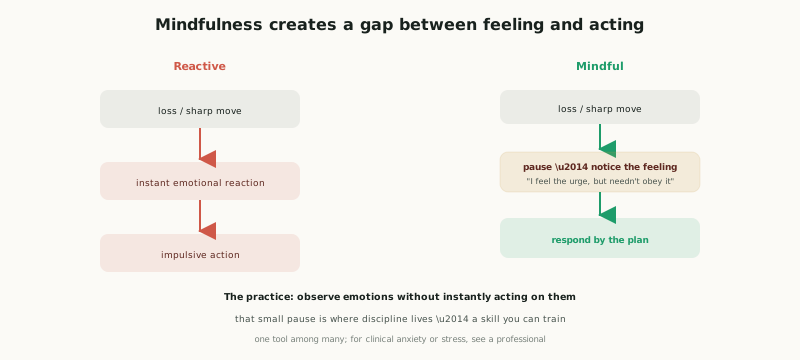
Mindfulness — the practice of paying attention to the present moment without judgement — trains you to notice emotions and urges as they arise without automatically acting on them. This is its core relevance to trading. Normally, a trigger (a loss, a sharp adverse move, a missed opportunity) produces an instant emotional reaction (fear, frustration, the urge to chase), which flows straight into impulsive action (revenge trading, abandoning the plan, panic-closing) — stimulus to reaction to action, with no gap. Mindfulness inserts a small but vital pause in that chain: you notice the emotion ("I'm feeling the urge to chase this") as a passing mental event rather than an instruction you must obey, and that noticing creates a moment of choice — a chance for your rational, rule-following self (the deliberate System 2) to act instead of your impulsive one. As the comparison shows:
| Stage | Reactive trader | Mindful trader |
|---|---|---|
| Trigger | A loss / sharp move | A loss / sharp move |
| Next | Instant emotional reaction | Pause — notice the feeling |
| Then | Impulsive action | "I feel the urge, but needn't obey it" |
| Outcome | Breaks the plan | Responds by the plan |
Beyond that in-the-moment pause, a regular mindfulness practice can also reduce stress and reactivity more generally, helping you stay calmer and more disciplined under pressure over time — a steadier baseline from which the heat of a losing streak or a fast market is less likely to hijack you. In essence, mindfulness directly trains the one capacity that underlies almost all of trading psychology: the ability to feel something without being controlled by it.
Do you need it, and how to apply it
An honest, balanced point first: you do not have to meditate to be a good trader — it's one optional tool among many, not a requirement. Plenty of disciplined traders never meditate, and mindfulness alone won't give you an edge or replace a sound strategy and risk management (no amount of calm awareness makes a losing system win). It's also not a cure-all — it's a skill that helps with the emotional/behavioural side, which matters, but it sits alongside, not above, the fundamentals of edge and risk. That said, many traders find that some form of mindfulness practice — formal meditation, simple breathing exercises, or just pausing to notice their state — genuinely helps them manage the emotional reactivity that derails good plans. So treat it as a possible aid to discipline worth experimenting with, not a magic solution and not an obligation; if it helps you, use it, and if it's not for you, that's entirely fine — there are other routes to emotional control.
A simple way to apply it needs no incense or hour-long sessions: build in a deliberate pause. Before acting on a strong urge — to chase, to revenge trade, to abandon your plan, to oversize — take a breath and simply notice the feeling: "I'm feeling the urge to do this, but I don't have to obey it." The act of naming the emotion creates distance from it (you become the observer of the urge rather than its servant), and in that distance lies your freedom to choose the disciplined action. Other simple applications use the same principle: stepping away from the screen when emotions run high (physical distance creating mental distance), slow breathing to calm the body's stress response before deciding, and a brief check-in on your mental state before trading ("am I calm and clear, or rattled and reactive?" — and trading lightly or not at all if the latter). The unifying idea across all of these is observe first, then respond by your rules rather than your impulses. A small, practical caveat to keep things grounded and healthy: this is offered as a general performance and discipline aid — if you're dealing with clinical anxiety, depression, or significant stress, mindfulness apps and breathing exercises are not a substitute for proper support, and it's worth speaking to a qualified professional. Used sensibly, though, the simple habit of pausing to notice before acting is one of the most accessible ways to strengthen the emotional discipline that good trading demands. The honest framing: mindfulness — present-focused, non-judgemental awareness — trains you to notice emotions without instantly acting on them, inserting a vital pause between a trigger and your response so your rule-following self can act instead of your impulsive one (and it can lower stress and reactivity over time). You don't have to meditate to trade well — it's one optional aid, not a requirement or a substitute for strategy and risk management — but many find it helps. Apply it simply: pause and name the feeling before acting on an urge, step away when heated, breathe, and check your state before trading — observe first, then respond by your rules. For clinical issues, see a professional.
Building the habit
If you do want to try mindfulness as a trading aid, the key is to make it practical and sustainable rather than aspirational. Start tiny: a few minutes is plenty — the goal isn't lengthy formal meditation but building the capacity to notice and pause, and a short, consistent practice beats an ambitious one you abandon in a week. The most directly useful applications are the trading-specific check-ins: a brief pre-session pause to settle and assess your state ("am I calm and ready, or distracted and reactive?"), and in-session pauses before acting on any strong urge. The breath is the simplest anchor — a few slow breaths physically dial down the stress response and create the small gap in which a better decision can form — and it's always available, requiring nothing but a moment's attention.
A couple of habits compound the benefit. Journaling your emotional state alongside your trades (noting how you felt entering and managing each one) builds self-awareness over time and reveals patterns — you might discover, say, that your worst trades cluster on days you noted feeling "rushed" or "frustrated," which makes the pre-trade check-in concrete and motivating (it pairs naturally with a trading journal). And remember consistency over intensity: a small daily practice that sticks reshapes your baseline reactivity far more than occasional intense sessions. Throughout, keep the honest perspective from earlier: this is a trainable skill and an optional aid, not a requirement or a substitute for edge, strategy and risk management — and not a treatment for clinical conditions, for which a qualified professional is the right resource. Approached as a light, consistent habit of pausing to notice before acting, mindfulness can quietly strengthen the emotional discipline that everything else in trading psychology depends on. The honest reminder: build the habit practically — start tiny (a few minutes), use trading-specific check-ins (a pre-session state-check and in-session pauses before acting on urges), anchor on the breath, journal your emotional state alongside trades to spot patterns, and favour consistency over intensity; keep it in perspective as a trainable, optional aid — not a requirement, a substitute for strategy and risk management, or a treatment for clinical conditions, for which you should see a professional.
Mindfulness — present-focused, non-judgemental awareness — trains you to notice emotions without instantly acting on them, inserting a vital pause between a trigger (a loss, a sharp move) and your response, so your rule-following self can act instead of your impulsive one (and it can lower stress and reactivity over time). You don't have to meditate to trade well — it's one optional aid, not a requirement or a substitute for strategy and risk management — but many find it helps with the emotional side. Apply it simply: pause and name the feeling before acting on an urge ("I feel it, but needn't obey it"), step away when heated, breathe, and check your state before trading — observe first, respond by your rules. For clinical anxiety or stress, this isn't a substitute for proper support — see a professional.