
New traders drown in choice. There are dozens of currency pairs, an endless supply of strategies and indicators, and a market open 24 hours a day — so the natural temptation is to watch everything, try everything, and trade at all hours. The result is usually overwhelm, inconsistency, and shallow understanding of everything and mastery of nothing. The 5-3-1 strategy is a simple, sensible antidote: narrow your focus to 5 pairs, 3 strategies, and 1 time of day, and master those instead. This guide explains the 5-3-1 framework: what it is, the focus philosophy behind it, and its honest limits.
It's a structuring tool that supports building a trading plan, eases the early learning curve, and helps you apply the broader trading strategies with focus.
Key takeaways
Q: What is the 5-3-1 trading strategy?
A: The 5-3-1 strategy is a focus framework for forex traders, especially beginners: trade around 5 currency pairs, master about 3 trading strategies, and trade at 1 consistent time of day. Rather than a specific entry system, it's a way to combat overwhelm by narrowing your focus to a manageable set you can genuinely master.
Q: Why does the 5-3-1 approach work?
A: Because it forces focus and consistency. Beginners typically spread themselves too thin — watching too many pairs, chasing too many strategies, trading at random times — which leads to overwhelm, inconsistency and shallow understanding. Concentrating on a few pairs, a few strategies and one session builds deeper expertise, a repeatable routine, and trades that are easier to review and improve.
Q: Are the numbers 5, 3 and 1 fixed?
A: No — they're guidelines, not magic numbers. The point is the principle of focus and depth over breadth, not the exact figures. You might trade four pairs or two strategies; what matters is keeping your focus narrow enough to master your chosen pairs, setups and session. The framework structures your learning; it isn't a trading edge by itself.
What 5-3-1 means
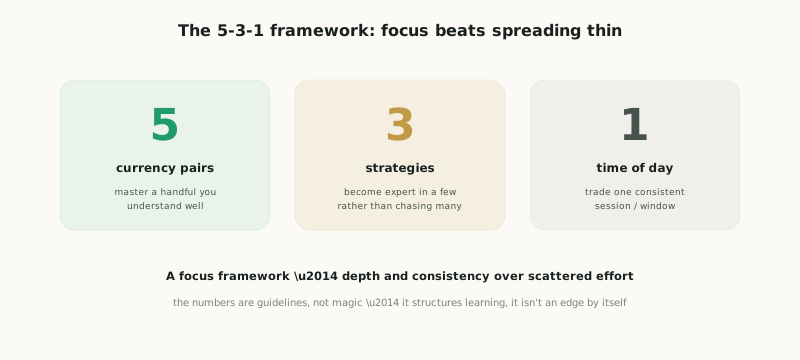
The 5-3-1 strategy isn't a specific entry signal — it's a focus framework, and its three numbers each target a common beginner failing. 5 currency pairs: choose around five pairs to focus on and master (ideally majors you understand), rather than scattering your attention across dozens — you'll learn how your pairs move, their typical ranges, their character, and how they behave in your session. 3 strategies: master around three trading strategies or setups and become genuinely expert in them, rather than constantly chasing the next shiny method — depth in a few beats dabbling in many. 1 time of day: trade at one consistent time — a specific session or window that suits both your schedule and your chosen pairs — building a repeatable routine rather than trading randomly whenever you happen to look. The unifying principle is focus and consistency: concentrating your limited attention and energy so you can develop real competence, a stable routine, and a body of comparable trades you can actually learn from.
Why focus works — and the honest limits
The framework works because it directly counters the way beginners typically sabotage themselves. Spreading across too many pairs means never truly understanding any of them; chasing too many strategies means never mastering one; trading at random times means no routine, no consistency, and no fair basis for review. By narrowing on all three fronts, 5-3-1 enables deeper expertise (you come to know your handful of pairs and setups intimately), a consistent routine (same pairs, same setups, same time — which supports discipline and a calmer state), and easier review and improvement (a focused, comparable set of trades is far easier to journal, analyse and refine than a scattered mess across markets and methods). It aligns beautifully with the realities of the learning curve and the discipline of a proper trading plan — trading is a skill built through focused, deliberate practice, and you can't practise deliberately if your attention is scattered everywhere.
The honest limits matter, so you use it sensibly. First, the numbers aren't magic: 5, 3 and 1 are guidelines, not sacred figures — the principle is focus and depth over breadth, and you might sensibly settle on four pairs or two strategies; what matters is keeping your scope narrow enough to master. Second, and crucially, 5-3-1 is a structuring framework, not a profit edge by itself — it organises your focus and learning, but it doesn't tell you what the three strategies should be or contain any entry signal; you still need actual, sound strategies, proper risk management, and the whole process of developing skill. Think of it as scaffolding for your development, not the building itself. Used that way — as a sensible discipline that channels your effort into mastery rather than scattering it — 5-3-1 is genuinely valuable, especially for beginners overwhelmed by the sheer breadth of choice. The honest framing: the 5-3-1 strategy is a focus framework (not a specific entry system): trade around 5 pairs, master about 3 strategies, at 1 consistent time of day. Its value is focus and consistency — combating the beginner trap of spreading too thin (too many pairs, too many strategies, random times), enabling deeper mastery, a consistent routine, and easier review. The numbers are guidelines, not magic, and it's not a profit edge by itself — it's a sensible structure that supports developing skill. A genuinely useful framework for focus, especially for beginners overwhelmed by choice — pair it with actual strategies, risk management, and the patient learning process.
Putting 5-3-1 into practice
Turning the framework into a real plan means making three concrete choices. For your 5 pairs, most traders are best served starting with majors — they're liquid, well-behaved, cheaper to trade, and richly documented — perhaps EUR/USD, GBP/USD, USD/JPY and a couple of others you find readable; pick pairs that actually move during the time you'll trade, and that don't all behave identically (some correlation awareness avoids "five pairs" really being one bet). For your 3 strategies, choose setups that suit your personality and your pairs and timeframe — perhaps one trend-following approach, one breakout setup, and one pullback or reversal method — and commit to learning them deeply rather than collecting more. For your 1 time, pick a window that fits both your schedule and your pairs' activity: if you trade EUR/USD and GBP/USD, the London session or the London–New York overlap is a natural choice; the point is to show up at the same time consistently so you learn how your market behaves then.
With those chosen, the framework becomes a routine: same pairs, same setups, same session, repeated until they're second nature — and this repetition is precisely what makes a journal so powerful, because a focused, comparable stream of trades is easy to review and learn from. On evolving it: 5-3-1 is a starting structure, not a life sentence. As you gain genuine competence and consistency, you can thoughtfully add a pair, a strategy, or a session — but do so deliberately and slowly, only after mastering what you have, never by reverting to the scattered, chase-everything habits the framework was meant to cure. The common pitfalls are exactly those: secretly watching twenty pairs "just to see," abandoning your three strategies the moment one has a losing run to chase a new one off social media, or drifting from your chosen time. Each defeats the purpose. The discipline to stay focused — to resist the constant temptation of novelty and breadth — is the whole value of 5-3-1, and it's harder than it sounds. Treated as a genuine commitment to depth over breadth, supported by a journal and proper risk management, it gives a developing trader the focus and consistency that are among the strongest predictors of eventually getting good — which is exactly why such a simple framework is so widely recommended for beginners.
Why beginners especially benefit
The 5-3-1 framework is aimed squarely at beginners because the problem it solves is most acute early on. A new trader faces a bewildering buffet — dozens of pairs, countless indicators and strategies, a market that never sleeps, and a social-media firehose pushing a new "holy grail" every week. The natural but ruinous response is to sample everything: jumping between pairs, abandoning a strategy after two losses for whatever's trending online, trading whenever boredom strikes. This scattergun approach guarantees the one thing that prevents improvement — a complete absence of consistency to learn from. By imposing hard limits on pairs, strategies and timing, 5-3-1 converts that chaos into a focused, repeatable practice in which genuine skill can actually accumulate. It also quietly supports good psychology: a narrow, familiar routine reduces the overwhelm, decision-fatigue and FOMO that drive so many beginner mistakes, and makes the learning curve a little less brutal. None of this makes 5-3-1 a money-maker on its own — a beginner still has to choose sound strategies, manage risk, and put in the years — but as a way to structure those early years for maximum learning rather than maximum noise, it's hard to beat. The traders who improve fastest are rarely those who tried the most things; they're those who focused on a few things and got genuinely good at them, which is exactly what 5-3-1 is designed to encourage.
The 5-3-1 strategy is a focus framework (not an entry system): 5 pairs to focus on and master, 3 strategies to become expert in, 1 time of day to trade consistently. Its value is focus and consistency — it counters the beginner trap of spreading too thin (too many pairs/strategies/random times), enabling deeper mastery, a consistent routine, and easier review of a comparable set of trades. The numbers are guidelines, not magic (four pairs or two strategies is fine — the principle is depth over breadth), and it's not a profit edge by itself: it structures your learning but contains no signal, so you still need real strategies, risk management and the patient process of building skill. Think of it as scaffolding for your development — genuinely useful for focus, especially when you're overwhelmed by choice.