When countries impose tariffs and retaliate, the ripples reach the currency market — but not in a simple way. A trade war disrupts flows, stokes inflation and growth fears, and above all breeds uncertainty, and the currency effects can cut both ways. The instinct to reach for an easy rule ("tariffs on a country, so its currency falls") usually misleads; untangling the actual channels matters far more. This guide explains how trade wars and tariffs affect currencies: the mechanisms, why the effects are complex and two-sided, the role of risk-off flows, and why uncertainty so often dominates.
It's closely tied to geopolitics and currencies, plays out through risk-on/risk-off sentiment and safe-haven flows, and touches the current account.
Key takeaways
Q: How do trade wars and tariffs affect currencies?
A: Through several channels at once, which is why the effect is complex. Tariffs can alter trade flows and the trade balance (affecting currency demand), stoke inflation (imported goods cost more) and growth fears (disrupted supply chains, retaliation), and shift central-bank expectations. They also drive risk sentiment: trade tensions tend to be risk-off events, sending capital toward safe-haven currencies. The net effect on any one currency depends on which channels dominate.
Q: Does a country's currency fall when it's hit by tariffs?
A: Not necessarily — it's genuinely ambiguous. Tariffs on a country's exports can hurt its growth and weaken its currency, but the picture is muddied by retaliation, by central-bank responses, and by safe-haven flows. In the US-China trade tensions, for example, the moves reflected a tangle of growth fears, policy expectations and risk sentiment rather than a clean 'tariffs down, currency down' rule. The specific channels and market psychology decide the outcome.
Q: Why does uncertainty matter so much in trade wars?
A: Because markets dislike uncertainty, and trade wars generate it in abundance — unpredictable escalation, retaliation and policy shifts make the future harder to price. This uncertainty itself weighs on risk appetite and investment, often triggering risk-off moves toward safe havens regardless of the specific tariff details. So beyond the direct trade effects, the climate of unpredictability is frequently the dominant force on currencies during a trade conflict.
The channels
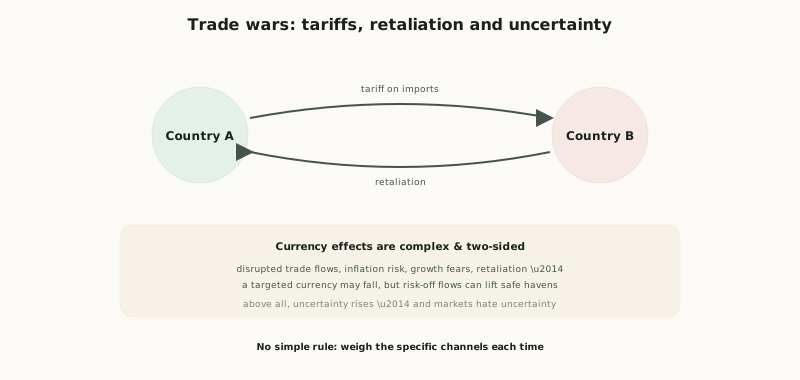
Trade wars affect currencies through several channels at once, which is precisely why the net effect is so hard to call. Trade flows and the balance: tariffs alter what's imported and exported, shifting the trade balance and thus the underlying demand for currencies (in theory, fewer imports could support a currency, but it's rarely that clean). Inflation: tariffs make imported goods more expensive, which can raise inflation — potentially nudging the central bank toward higher rates (currency-supportive) or squeezing consumers (growth-negative). Growth: disrupted supply chains, higher costs, and retaliation against exporters all threaten growth, which tends to weaken a currency and shift central-bank expectations toward easing. Risk sentiment: trade tensions are typically risk-off events, sending capital toward safe havens (USD, JPY, CHF, gold) and away from riskier and trade-exposed currencies. With all these channels pulling in different directions — some currency-positive, some negative — the net effect on any one currency depends on which channels dominate at the time, and that varies case by case.
Why it's two-sided, and why uncertainty rules
It's tempting to assume "a country hit by tariffs sees its currency fall," but the reality is genuinely ambiguous, and acting on the simple rule can burn you. Tariffs on a country's exports can hurt its growth and weaken its currency — but that clean story is muddied by retaliation (which hurts the other side too), by central-bank responses (a bank might ease, weakening the currency, or the inflation impulse might argue for tightening), and by safe-haven flows (which can send capital into certain currencies regardless of who's tariffed). The US–China trade tensions are the classic illustration: the currency moves reflected a tangle of growth fears, shifting policy expectations, managed-currency dynamics and global risk sentiment — not a tidy "tariffs up, targeted currency down" relationship. Sometimes the currency of a tariff-imposing country weakened on the growth and uncertainty hit; sometimes safe-haven demand supported it. The lesson is that the specific channels and the market psychology of the moment decide the outcome — so rather than applying a reflex rule, you have to ask which channels are dominant this time: Is the market focused on growth damage (negative) or on safe-haven demand (which currency benefits)? Is inflation or growth the bigger worry? Is the central bank likely to respond? Treating trade-war currency effects as obvious is a recipe for being wrong-footed; treating them as a balance of competing forces to be weighed each time is the only sound approach.
If there's one force that most often dominates, it's uncertainty itself. Markets dislike uncertainty, and trade wars generate it in abundance: unpredictable escalation, surprise retaliation, on-again-off-again negotiations and abrupt policy shifts make the future genuinely harder to price. This uncertainty itself — quite apart from the specific tariff numbers — weighs on risk appetite and investment (businesses delay decisions, investors de-risk), which frequently triggers risk-off moves toward safe havens regardless of the tariff details. So during a trade conflict, the climate of unpredictability is often the dominant currency driver: the safe havens (US dollar, yen, franc, gold) tend to benefit from the flight to safety, while risk-sensitive and trade-exposed currencies (the commodity currencies, emerging-market currencies, and others geared to global growth) tend to suffer — a pattern driven by sentiment as much as by the trade mechanics. For traders, the practical guidance is: treat trade-war episodes primarily as risk-sentiment and uncertainty events (watch the safe-haven vs risk-currency split), weigh the competing channels rather than applying a simple rule, expect headline-driven volatility (markets lurch on each escalation or de-escalation — see event risk), and respect that the unpredictability that defines trade wars makes them especially hard to trade with confidence. As with all fundamentals, this explains the forces at work, not a guaranteed direction — so combine it with the risk picture, the price action, and disciplined risk management. The honest framing: trade wars and tariffs move currencies through several competing channels — trade flows, inflation, growth, central-bank expectations and risk sentiment — so the effect is complex and two-sided, with no simple "tariffs down, currency down" rule (the US–China episode was a tangle of growth fears, policy and sentiment). Above all, trade wars breed uncertainty, which markets hate, frequently triggering risk-off flows to safe havens (USD/JPY/CHF/gold) and away from risk and trade-exposed currencies. So treat them as risk-sentiment events, weigh which channels dominate each time, expect headline volatility, and manage risk.
Trading trade-war episodes
If trade-war currency effects are too tangled for a simple rule, how should a trader actually approach them? The most reliable framework is to treat them primarily as risk-sentiment events and map the likely beneficiaries and casualties. The beneficiaries in a risk-off, uncertainty-driven episode are usually the safe havens — the US dollar, Japanese yen, Swiss franc and gold tend to attract flight-to-safety flows as tensions escalate. The casualties are typically the risk-sensitive and trade-exposed currencies — the commodity currencies (AUD, NZD, CAD), the emerging-market currencies, and currencies of economies heavily reliant on the disrupted trade — which tend to weaken as global growth fears rise. Mapping this split gives you a far better starting point than guessing which tariffed country's currency "should" fall.
Beyond the map, expect headline-driven whipsaws and trade them with humility. Trade wars unfold through a stream of escalations and de-escalations — a new tariff threat sparks risk-off (safe havens up, risk currencies down), while a hint of a deal sparks a relief rally (the reverse) — and these headlines are unpredictable and abrupt, producing violent two-way moves (classic event risk). This makes the affected central banks important too: watch whether a trade shock is pushing a bank toward easing (growth fears) or worrying it about inflation (tariff-driven price rises), as that shifts the currency. Fading extreme over-reactions to a single headline can work but is dangerous (the next headline can extend the move), so it demands caution and confirmation. Above all, given the genuine unpredictability, the prudent response is to reduce size and tighten risk during active trade-war phases — the unusually high headline risk and two-way volatility punish oversized, over-confident positions. The honest reminder: trade trade-war episodes as risk-sentiment events — map the beneficiaries (safe havens: USD/JPY/CHF/gold) against the casualties (comdolls, EM, trade-exposed currencies); expect abrupt headline-driven whipsaws (escalation = risk-off, de-escalation = relief rally); watch whether affected central banks lean to easing or inflation-fighting; fade extreme over-reactions only cautiously; and reduce size given the unpredictability.
The deeper lesson trade wars teach is humility about simple cause-and-effect in macro. It feels as though tariffs "should" have an obvious currency effect, yet the reality is a web of offsetting channels filtered through fickle market psychology — which is exactly why disciplined traders lean on the risk-sentiment read and the price action rather than a confident macro thesis. When the headlines are flying, the safest assumption is that uncertainty itself is the trade: favour the havens, respect the two-way risk, and keep positions small enough that the next surprise headline can't hurt you badly.
Trade wars and tariffs move currencies through several competing channels — trade flows/balance, inflation, growth, central-bank expectations, and risk sentiment — so the effect is complex and two-sided, with no simple "tariffs → currency falls" rule (the US–China episode was a tangle of growth fears, policy and sentiment, not a tidy relationship). Above all, trade wars breed uncertainty, which markets hate — frequently triggering risk-off flows into safe havens (USD/JPY/CHF/gold) and out of risk and trade-exposed currencies (comdolls, EM), driven by sentiment as much as mechanics. So treat them as risk-sentiment events, weigh which channels dominate each time (don't apply a reflex rule), expect headline-driven volatility, and manage risk.