CAD/CHF blends two very different stories: the oil-sensitive Canadian dollar and the safe-haven Swiss franc. The result is a cross that reacts to both energy prices and risk sentiment — a less-traded pair with its own distinct character. This guide covers trading CAD/CHF: what it is, what drives each leg, the SNB caveat that applies to every franc pair, and its lower-liquidity nature.
It pairs the oil-linked "loonie" of USD/CAD with the safe-haven franc, sitting at the intersection of commodities and risk.
Key takeaways
Q: What is CAD/CHF?
A: CAD/CHF is the currency pair pricing the Canadian dollar (CAD) against the Swiss franc (CHF) — how many Swiss francs one Canadian dollar buys. It's a minor cross that combines an oil-linked commodity currency (the Canadian dollar) with a safe-haven currency (the Swiss franc), giving it a character shaped by both energy prices and risk sentiment. It has lower liquidity and wider spreads than the majors.
Q: What drives CAD/CHF?
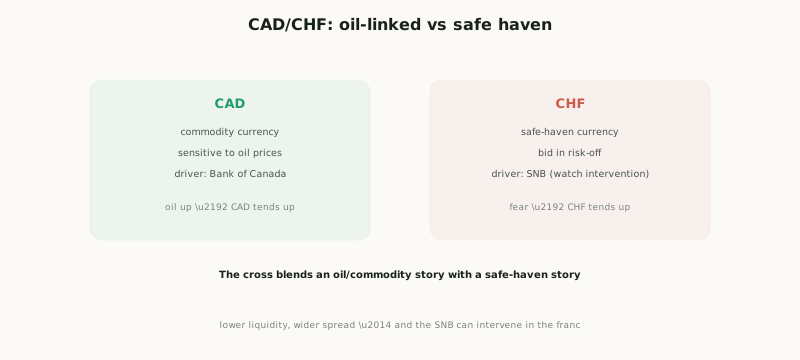
A: On the Canadian side: oil and energy prices (Canada is a major oil exporter, so a higher oil price tends to support the CAD), the Bank of Canada, and risk sentiment. On the Swiss side: the Swiss National Bank, safe-haven flows (the franc strengthens in risk-off), and Swiss data. The cross blends an oil/commodity story with a safe-haven story, so it can respond to both energy markets and shifts in global risk appetite.
Q: What's the main risk in trading CAD/CHF?
A: Like all franc pairs, the key risk is the Swiss National Bank's history of intervening in the franc — most dramatically the 2015 removal of the EUR/CHF floor, which caused a violent franc surge. This is a real tail risk that can gap through stops. CAD/CHF is also a minor cross with lower liquidity and wider spreads than majors, so it warrants conservative sizing and awareness of both the SNB risk and energy-market volatility.
The pair at a glance
CAD/CHF snapshot
CAD/CHF prices the Canadian dollar against the Swiss franc. As a minor cross, it carries lower liquidity and wider spreads than the majors, and its personality comes from combining two contrasting currency types: a commodity currency and a safe-haven currency. That blend means it can respond to drivers from both worlds — the energy market on one side, the risk-sentiment/haven dynamic on the other — giving it a character distinct from a straightforward risk-barometer cross.
What drives it, and the SNB caveat
On the Canadian side, the dominant specific driver is oil and energy prices: Canada is a major oil exporter, so a higher oil price tends to support the CAD (and a falling oil price to weigh on it) — making the loonie a classic petro-influenced commodity currency. Add the Bank of Canada (rates and stance) and broad risk sentiment (CAD has a mild risk-on lean). On the Swiss side, the franc is driven by the Swiss National Bank, safe-haven flows (it strengthens when global fear rises), and Swiss data. So CAD/CHF can move on oil-market developments, on risk-sentiment shifts (which affect the franc's haven bid and CAD's risk lean), and on the relative monetary policy of the BoC versus the SNB (a divergence factor). Reading it well means watching the energy market and the risk mood and the two central banks. On timing, both currencies are most active during the European/London and into the North American hours (the franc European, the loonie North American), so the London–New York window tends to offer the best liquidity.
The essential caveat — shared by every franc pair — is the SNB intervention tail risk. The Swiss National Bank has a long history of actively managing the franc to stop it becoming too strong, including intervention and the infamous 2015 removal of the EUR/CHF floor, which triggered a violent, instantaneous franc surge that caused catastrophic losses for the unprepared (and broke some brokers). It's rare, but it's a genuine policy tail risk: the SNB can act suddenly and dramatically, causing moves that gap straight through stops. So CAD/CHF, despite often trading more quietly than the wild GBP crosses, must not be sized carelessly — the franc's SNB risk demands conservative sizing and the awareness that a stop may not protect you in an intervention spike. Combined with the pair's lower liquidity and wider spread (raising costs), the sensible approach is to treat CAD/CHF as a distinctive oil-vs-haven cross worth understanding on its own terms, traded by those with a view on energy and/or risk, with strict risk management and full respect for the SNB tail risk. No pair has a built-in edge; the edge is in understanding its drivers and managing its specific risks. The honest framing: CAD/CHF prices the oil-linked Canadian dollar against the safe-haven Swiss franc — a minor cross blending an energy/commodity story with a haven story, with lower liquidity and wider spreads than majors. CAD is driven by oil prices and the BoC; CHF by safe-haven flows and the SNB. Watch energy markets, risk sentiment and the two central banks. The key caveat is the SNB's history of intervening in the franc (the 2015 cap removal) — a real tail risk that can gap through stops — so size conservatively, mind gap risk, and respect both the SNB and energy-market volatility.
Trading approach: oil and risk together
Trading CAD/CHF well means holding two lenses at once: the energy story (CAD) and the risk/haven story (CHF). The clearest setups arise when both lenses agree. A scenario of rising oil and a risk-on mood is doubly bullish for the pair — oil lifts the CAD while risk-on softens the franc — producing a clean push up; conversely, falling oil in a risk-off panic is doubly bearish, as the CAD sags while the safe-haven franc is bid. When the two lenses conflict (say oil rallies but fear grips the market), the pair can chop or stall as the forces offset, which is a signal to be more cautious or stand aside. So your thesis should combine a view on energy with a view on risk sentiment, and the highest-conviction trades are where they point the same way.
Concretely, that means watching the oil market (WTI/Brent prices and energy news) as a leading input for the CAD leg, alongside the Bank of Canada, plus the risk mood and the SNB for the franc leg — their relative policy (a divergence factor) shaping the longer trend. On correlations, the CAD leg tends to track oil and other CAD pairs (like USD/CAD inversely and CAD/JPY), so be mindful of stacking correlated CAD or oil exposure (see correlations). On behaviour, CAD/CHF can range when oil and risk are quiet and trend when a clear energy or risk theme takes hold, so adapt your approach to the regime. On sessions, the franc is most active in the European/London hours and the loonie into the North American session, so the London–New York overlap tends to offer the best liquidity for this otherwise thinner cross. And, as with every franc pair, keep the SNB intervention tail risk front of mind: size conservatively, mind gap risk, and don't let a quiet-looking pair lull you into oversizing. The honest reminder: trade CAD/CHF through both an energy lens (CAD/oil, BoC) and a risk lens (CHF/haven, SNB), favouring setups where oil and risk sentiment agree; watch the oil market and both central banks, avoid stacking correlated CAD/oil exposure, adapt to range-vs-trend regimes, trade the London–NY window, and always respect the SNB tail risk with conservative sizing.
Where it fits
CAD/CHF is a specialist's cross rather than a core pair, and it suits a specific kind of trader: one who has a view on energy markets and/or risk sentiment and wants a vehicle that combines both, without the US dollar in the mix. For a trader already watching oil, it offers a way to express that energy view against a stable safe-haven counterpart; for a risk-focused trader, it adds an oil dimension to the haven dynamic. But it's emphatically not a beginner pair — the dual oil-and-risk drivers demand more understanding than a simple major, the lower liquidity and wider spread raise the bar, and the franc's SNB tail risk means even an apparently calm position can be hit by a sudden, violent move. Newcomers should build experience on liquid majors like EUR/USD or the more liquid commodity pair USD/CAD before venturing into thinner franc crosses.
The synthesis: read CAD/CHF through its two lenses (oil and risk), trade with most conviction when they agree, watch the energy market and both central banks, stay alert to its range-vs-trend regime, and — above all — never let its often-quiet behaviour tempt you into oversizing a pair that carries a genuine intervention tail risk on the franc leg. Approached with that respect and a clear oil-and-risk thesis, CAD/CHF is a distinctive, tradeable cross; approached casually, its thin liquidity and SNB risk can punish. The edge, as always, lies in understanding the pair's specific drivers and managing its specific risks, not in the pair itself.
CAD/CHF prices the oil-linked Canadian dollar against the safe-haven Swiss franc — a minor cross blending an energy/commodity story with a haven story, with lower liquidity and wider spreads than the majors. CAD is driven by oil prices and the Bank of Canada; CHF by safe-haven flows and the SNB. Watch energy markets, the risk mood, and the two central banks' relative policy. The key caveat — as with every franc pair — is the SNB's history of intervening in the franc (the 2015 cap removal caused a violent surge): a real tail risk that can gap through stops, so size conservatively and mind gap risk. Respect both the SNB tail risk and energy-market volatility, with disciplined risk management.