
The Swiss franc and the Japanese yen are the market's two great safe havens — both bid when fear rises, both low-yield currencies favoured as funding legs for carry trades. Pair them in CHF/JPY, and much of the broad risk story they share cancels out, leaving a comparatively quiet cross that turns on relative haven demand and the SNB-versus-BoJ policy gap — but one that carries a sharp tail-risk from central-bank intervention. This guide explains trading CHF/JPY: why it's distinctive, what drives it, the intervention danger, and its best sessions.
It pairs the two pillars of the safe-haven currencies world, drawing on the franc of USD/CHF and the yen of USD/JPY.
Key takeaways
Q: What is the CHF/JPY pair?
A: CHF/JPY is a cross pair (no US dollar) pairing the Swiss franc against the Japanese yen — the two classic safe-haven currencies. Both are low-yield currencies that tend to strengthen during risk-off episodes and are widely used as funding currencies for carry trades. Pairing them against each other isolates their relative behaviour rather than their shared safe-haven character.
Q: What drives CHF/JPY?
A: The relative monetary policy of the Swiss National Bank (SNB) and the Bank of Japan (BoJ), and relative safe-haven demand between the two. Because both currencies are bid in risk-off and both are low-yield, broad global risk sentiment largely cancels out, so the cross moves more on the SNB-vs-BoJ policy gap, relative data, and which haven the market favours in a given episode.
Q: What is the main risk in trading CHF/JPY?
A: Central-bank intervention, especially from the Swiss National Bank, which has a history of acting to manage the franc — most dramatically the 2015 removal of the EUR/CHF floor that caused a violent franc spike. The Bank of Japan has also intervened in the yen at times. These actions can cause sudden, large moves, so CHF/JPY carries a genuine tail-risk that demands careful position sizing.
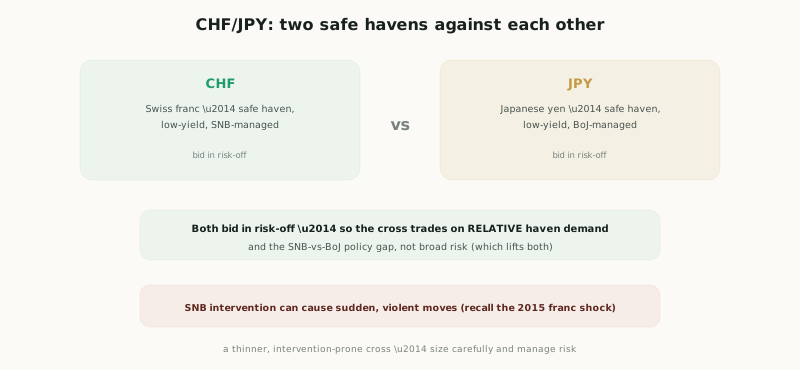
Two safe havens against each other
Understanding CHF/JPY starts with recognising what the two currencies have in common. Both the Swiss franc and the Japanese yen are classic safe havens: in times of global stress, capital flows into both, so they tend to strengthen together during risk-off episodes. Both are also persistently low-yield currencies, which makes them the market's favourite funding currencies for carry trades (borrow cheaply in CHF or JPY to buy higher-yielders). Because they share these traits so strongly, pairing them against each other means much of the broad risk-on/off movement cancels out — a fear spike that bids the franc usually bids the yen too — leaving a cross that is generally quieter than a risk pair and that moves on the relative difference between the two havens rather than on the global risk gauge itself. What's left to drive it is the SNB-versus-BoJ policy gap, relative Swiss-versus-Japanese data, and the subtler question of which haven the market prefers in a given episode (sometimes the franc leads, sometimes the yen, depending on the nature of the stress and relative central-bank stances).
The intervention tail-risk, and sessions
The defining danger of CHF/JPY is central-bank intervention, and it deserves serious respect. The Swiss National Bank has a long history of acting to manage the franc, which it views as prone to excessive safe-haven strength that hurts Swiss exporters — most dramatically in January 2015, when the SNB abruptly abandoned its EUR/CHF floor and the franc spiked violently in minutes, inflicting enormous losses on traders (and even brokers) caught the wrong way. The Bank of Japan has also intervened in the yen at various times to curb excessive moves. The lesson is that CHF/JPY can experience sudden, large, gap-like moves driven not by gradual fundamentals but by a policy decision — a genuine tail-risk that no stop-loss can fully protect against (a violent gap can blow straight through a stop). This makes careful position sizing non-negotiable: trade the pair small enough that an intervention shock can't be catastrophic, be wary of holding large positions over weekends or around known central-bank events, and never assume the franc or yen will move smoothly. The cross's relative quiet in normal conditions can lull traders into over-sizing — precisely the mistake the tail-risk punishes.
On sessions, CHF/JPY is most active when the relevant markets overlap. The Tokyo session drives the yen side (Japanese data, BoJ news, Asian risk sentiment), while the London session brings heavy European liquidity relevant to the franc and is generally the most liquid period for the pair, with the New York session adding global flows. As a cross between two relatively lower-volume currencies, CHF/JPY can have thinner liquidity and wider spreads than the majors, especially off-peak — another reason to size conservatively. In normal conditions it tends to be a comparatively range-bound, lower-volatility cross (the shared haven character keeping it calm), which can suit range traders — but the ever-present intervention tail-risk means that calm can shatter without warning. As always, no cross is magic: CHF/JPY offers a distinctive "relative safe-haven" view to analyse, not a guaranteed edge, and demands confirmation, conservative sizing and disciplined risk management above all. The honest framing: CHF/JPY pairs the two classic safe havens — both low-yield, both bid in risk-off, both carry-funding currencies — so broad risk largely cancels out, leaving a quieter cross driven by the SNB-vs-BoJ policy gap, relative data, and which haven the market favours. Its defining danger is central-bank intervention (the SNB especially, as in the 2015 franc shock; the BoJ at times), which can cause sudden violent gaps that stops can't fully contain — so size small and respect the tail-risk. Most liquid in the Tokyo–London–NY hours; thinner and wider-spread as a cross. Usually range-bound but capable of shattering calm — a relative-haven view to analyse, never a guarantee; manage risk.
Trading CHF/JPY safely
Every practical decision on CHF/JPY should be filtered through one overriding consideration: the intervention tail-risk demands conservative sizing. Because the pair can gap violently on a central-bank decision — in a way no stop-loss can fully contain — the prudent approach is to trade it smaller than a comparable major, so that even a shock move is survivable rather than catastrophic. This single discipline matters more than any entry technique: traders who blew up on the 2015 franc shock were generally not wrong about direction so much as over-sized for a tail event. Be especially cautious about holding meaningful positions over weekends or across known SNB/BoJ events, where gap risk concentrates, and never let the pair's usual calm seduce you into the over-leverage that the rare shock punishes.
Within that conservative frame, CHF/JPY's normal-conditions character — comparatively range-bound and lower-volatility, thanks to the two havens' shared behaviour cancelling out broad risk — lends itself to range-trading approaches: identifying levels and trading mean-reversion within them, while the relative SNB-versus-BoJ policy gap and shifts in relative haven demand drive the slower directional drift. Keep watch on both central banks (their policy stances and any intervention rhetoric), on relative Swiss-versus-Japanese data, and on the nature of any risk-off episode, since the franc and yen don't always respond identically — one may be favoured over the other depending on the source of stress. A note on carry: since both are low-yielders and classic carry-funding currencies, CHF/JPY usually has only a small interest differential, so it's more a relative-value and range pair than a carry play. And mind liquidity: as a cross between two lower-volume currencies, spreads widen off-peak, so favour the liquid Tokyo–London–New York windows. As always, CHF/JPY offers a distinctive relative-haven view to analyse, not a guaranteed edge — and here, more than almost anywhere, risk management and conservative sizing come first. The honest reminder: trade CHF/JPY small because of intervention gap-risk, lean on its range-bound calm for mean-reversion while watching the SNB–BoJ gap and relative haven flows, avoid over-leverage and risky event/weekend holds, and let prudent sizing — not cleverness — be your edge.
The funding-currency angle
A subtler feature worth understanding is that both the franc and the yen are the market's favourite carry-trade funding currencies — because both are persistently low-yield, traders borrow them cheaply to buy higher-yielding currencies (the essence of the carry trade). This shared role has an interesting consequence for CHF/JPY. When carry trades are working (calm markets, risk-on), both the franc and the yen tend to be sold as funding, weakening together — so again much of the move cancels and the cross stays quiet. But when carry trades unwind violently (a risk-off shock, a volatility spike), traders rush to buy back both the franc and the yen to close their funding legs, and both surge — a classic safe-haven, carry-unwind bid. Because both are bought in such episodes, CHF/JPY may not move dramatically against each other even during a big unwind, but the volatility within the pair can rise sharply, and the relative intensity of demand for one haven over the other (driven by the SNB-versus-BoJ stance and the nature of the shock) determines the direction. For a trader, the takeaway is that CHF/JPY is best understood as a relative bet between two funding havens whose common movements cancel — and that the moments of greatest interest are carry-unwind episodes, when both legs are in play and the relative-haven question (which is more bid?) comes to the fore. It reinforces why the pair is a relative-value and range instrument rather than a directional risk gauge.
CHF/JPY pairs the two classic safe havens — both low-yield, both bid in risk-off, both carry-funding currencies — so broad risk largely cancels out, leaving a quieter cross driven by the SNB-vs-BoJ policy gap, relative data, and which haven the market favours. Its defining danger is central-bank intervention (the SNB especially — recall the violent 2015 franc shock; the BoJ at times), which can cause sudden, gap-like moves that stops can't fully contain — so size small and respect the tail-risk, particularly around central-bank events and weekends. Most liquid in the Tokyo–London–New York hours; thinner and wider-spread as a cross. Usually range-bound, but the calm can shatter without warning. A distinctive relative-haven view to analyse — not a guaranteed edge; conservative sizing and risk management come first.