On one side, the vast, rate-driven euro; on the other, the small, high-beta New Zealand dollar that lives and dies by risk appetite and commodity demand. That mismatch is what makes EUR/NZD a wide-ranging cross with its own rhythm — a pair where much of the movement comes from the Kiwi's risk sensitivity playing out against the steadier euro. This guide explains trading EUR/NZD: what drives it, its character, and its best sessions.
It marries the euro's rate story with the risk-sensitive New Zealand dollar — a sibling of the EUR/AUD cross.
Key takeaways
Q: What is the EUR/NZD pair?
A: EUR/NZD is a cross pair (no US dollar) pairing the euro against the New Zealand dollar. It combines two quite mismatched currencies: the euro, a large, liquid, rate-driven currency shaped by the ECB and the eurozone, and the New Zealand dollar (the 'Kiwi'), a small, risk-sensitive commodity currency tied to dairy exports, Chinese and Asian demand, and global risk appetite.
Q: What drives EUR/NZD?
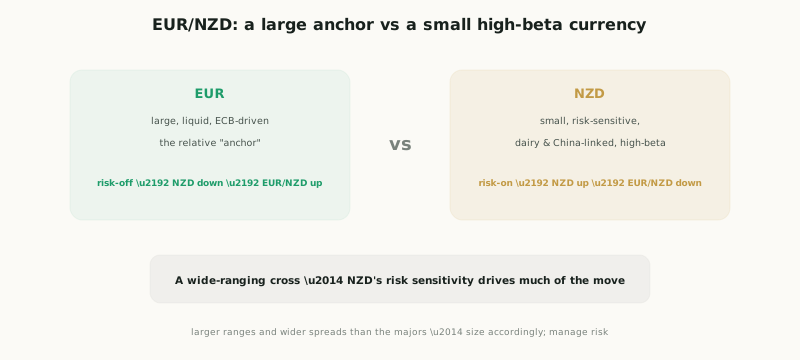
A: On the euro side, eurozone growth and ECB policy; on the Kiwi side, the Reserve Bank of New Zealand (RBNZ), New Zealand's commodity exports (notably dairy), Asian and Chinese demand, and — importantly — global risk sentiment, since the NZD is a high-beta risk currency. Risk-on tends to lift the NZD and push EUR/NZD lower; risk-off tends to lift EUR/NZD.
Q: Is EUR/NZD a volatile pair?
A: Yes — it's a wide-ranging cross with larger ranges and wider spreads than the major pairs. The mismatch between the large, relatively steady euro and the small, high-beta New Zealand dollar, combined with a cross's thinner liquidity, produces sizeable moves, with much of the volatility coming from the NZD's risk sensitivity. It should be sized to its wider ranges with proper risk management.
Pair snapshot
EUR/NZD is a cross combining a heavyweight rate-driven currency with a small high-beta one — a mismatch that shapes everything about it.
EUR/NZD at a glance
The euro side is the relative anchor: large, liquid and driven by ECB policy and the eurozone economy, the euro is the steadier of the two. The New Zealand dollar side is where most of the energy comes from: the Kiwi is a small, risk-sensitive commodity currency tied to New Zealand's dairy and agricultural exports, to Chinese and Asian demand, and to the Reserve Bank of New Zealand (RBNZ) — and, crucially, it's a high-beta risk currency that swings sharply with global risk appetite. That combination of a steady anchor and a volatile risk leg defines the pair.
What moves the pair, and its sessions
EUR/NZD is driven by the interplay of eurozone rate dynamics and the Kiwi's risk-and-commodity story. The ECB–RBNZ rate differential provides a slower-moving anchor for the pair's broad direction. Overlaid on it is the dominant short-term driver: global risk sentiment, transmitted through the high-beta NZD. In risk-on conditions, the Kiwi tends to strengthen (pushing EUR/NZD lower); in risk-off, the Kiwi weakens as capital flees risk currencies (pushing EUR/NZD higher) — so EUR/NZD often rises when markets are fearful and falls when they're greedy, a useful intuition. Commodity-specific news (notably dairy prices via New Zealand's exports) and Chinese/Asian data also move the NZD side, while eurozone data and ECB signals move the EUR side. Because the euro is comparatively steady and the NZD comparatively wild, a large share of the pair's movement is really a story about what the Kiwi is doing.
On sessions, the pair has active periods at quite different times. The NZD side is most relevant around the Sydney and Tokyo sessions (New Zealand and Asian data, Chinese figures, early risk sentiment), while the euro side and the deepest overall liquidity come during the London and New York hours. As a cross pairing a major with a smaller currency, EUR/NZD carries wider spreads and thinner liquidity than EUR/USD, and its wide ranges — driven by the Kiwi's volatility — mean positions should be sized conservatively with stops appropriate to its swings. It suits traders comfortable with a higher-volatility cross and interested in expressing a view that blends eurozone policy with global risk appetite. As always, no cross is magic: EUR/NZD offers a distinctive mix of a steady anchor and a high-beta risk leg to analyse, not a guaranteed edge, and demands confirmation and disciplined risk management. The honest framing: EUR/NZD pairs the large, rate-driven euro (eurozone growth, ECB policy — the anchor) with the small, high-beta New Zealand dollar (RBNZ, dairy/China, and above all global risk appetite). The ECB–RBNZ rate gap anchors broad direction, but the dominant short-term driver is risk sentiment via the Kiwi: risk-on lifts the NZD and pushes EUR/NZD down, risk-off lifts the pair. Much of the movement is really about what the Kiwi is doing. Active across Asian (NZD) and London/NY (EUR, deepest liquidity) hours; as a cross it has wide ranges and wider spreads, so size conservatively. A distinctive anchor-vs-risk-leg view to analyse, never a guarantee; manage risk.
How to approach EUR/NZD
The most useful mental model for EUR/NZD is that it's largely a risk-sentiment expression with a euro anchor — and once you internalise that the pair tends to rise in risk-off and fall in risk-on (because the volatile Kiwi leg drives most of the move), much of its behaviour makes sense. This gives the pair a particular use: a trader who expects deteriorating risk appetite (a flight from risk currencies) can express it by going long EUR/NZD, while someone expecting a risk rally can go short — effectively trading global risk sentiment through the Kiwi, with the steadier euro as the counterweight. It also means EUR/NZD often aligns with other risk-off moves (rising when stocks fall and havens bid), which a trader can use as confirmation — or as a warning not to stack correlated risk-off bets unknowingly.
Practically, the watch-list leans heavily on the NZD side: global risk sentiment first, then New Zealand drivers — the RBNZ's rate path, dairy prices (a major NZ export), and Chinese and Asian demand and data — with eurozone data and ECB signals moving the anchor. Keep an eye on the broader risk environment (equities, volatility, safe-haven flows) as a lead indicator for the Kiwi leg. On style, the pair's wide ranges suit trend and swing traders who can ride larger moves, and its risk-driven swings can trend strongly during sustained risk-on or risk-off regimes; in calmer periods it can also range. The essential mechanic, as with all these crosses, is sizing for volatility: EUR/NZD's wide ranges and wider spreads (as a major-vs-minor cross) mean smaller positions and roomier stops than a major would warrant, and the spread makes it poorly suited to scalping. Mind correlations too — it shares the NZD leg with NZD/USD and behaves similarly to EUR/AUD, so avoid doubling the same risk-sentiment bet. As always, EUR/NZD offers a distinctive anchor-versus-risk-leg view to analyse, not a guaranteed edge — confirm setups, respect the volatility through sizing, and control risk per trade. The honest reminder: treat EUR/NZD as a way to trade risk sentiment via the Kiwi against a euro anchor (it rises in risk-off), watch global risk plus NZ/China drivers, favour trend and swing approaches with volatility-aware sizing, and keep your risk-sentiment exposures from secretly overlapping.
The dairy and China angle
Beyond broad risk sentiment, the New Zealand dollar has two specific drivers that a EUR/NZD trader should track, because they move the volatile Kiwi leg that dominates the pair. The first is dairy: New Zealand is one of the world's largest dairy exporters, and dairy products are a huge share of its export earnings, so dairy prices matter for the Kiwi in a way few other developed currencies experience with a single commodity. Traders even watch the regular Global Dairy Trade auction results as a Kiwi input — strong dairy prices support the NZD (pushing EUR/NZD down), weak ones weigh on it. The second is China and Asia: China is a major destination for New Zealand's exports (dairy and other goods), so Chinese demand and data feed directly into the Kiwi's fortunes, much as they do for the Aussie — Chinese strength tends to lift the NZD, weakness to drag it. Layered on top is the RBNZ, whose rate decisions and guidance can move the Kiwi sharply (the RBNZ has at times been notably active). For a EUR/NZD trader, this means the NZD watch-list runs: global risk sentiment first, then dairy prices, Chinese/Asian demand, and the RBNZ — with eurozone data and the ECB moving the steadier anchor. Understanding these Kiwi-specific drivers helps explain moves that broad risk sentiment alone wouldn't, and sharpens the analysis of a pair where, ultimately, most of the action is a story about what the New Zealand dollar is doing.
Bringing the threads together, EUR/NZD is best read top-down: start with the global risk environment (the biggest lever on the Kiwi), then layer in New Zealand's specific drivers — dairy, Chinese demand and the RBNZ — against the steadier euro anchor of eurozone data and ECB policy. Because the volatile NZD leg dominates, the pair tends to rise when fear grips markets and fall when confidence returns, giving it real use as a risk-sentiment expression. Trade it on the trend and swing timeframes, size for its wide ranges, and the mismatch between a heavyweight anchor and a high-beta risk currency becomes a feature to analyse rather than a hazard.
EUR/NZD is a cross pairing the large, rate-driven euro (eurozone growth, ECB policy — the relative anchor) with the small, high-beta New Zealand dollar (RBNZ, dairy/China demand, and above all global risk appetite). The ECB–RBNZ rate gap anchors broad direction, but the dominant short-term driver is risk sentiment via the Kiwi: risk-on lifts the NZD and pushes EUR/NZD down; risk-off lifts the pair — so it often rises when markets are fearful. Much of the movement is really a story about what the Kiwi is doing. Active across Asian hours (NZD side) and London/New York (EUR side, deepest liquidity). As a cross it has wide ranges and wider spreads — size conservatively with stops fit for its swings. A distinctive anchor-vs-risk-leg view to analyse, not a guaranteed edge; trade with confirmation and risk management.