VWAP — the Volume-Weighted Average Price — is the average price weighted by how much volume traded at each level. It's a benchmark that big institutions live by and intraday traders use as a fair-value line, and on stocks and futures it's one of the most important reference points on the chart. In spot forex, though, it comes with a crucial asterisk that every forex trader needs to understand. This guide explains VWAP: how it works, how traders use it, and the all-important volume caveat for forex.
It's intimately tied to the realities of volume in forex, and sits alongside pivot points as an intraday reference and order-flow-adjacent concept.
Key takeaways
Q: What is VWAP?
A: VWAP stands for Volume-Weighted Average Price — the average price of an instrument over a period (usually the trading day), weighted by the volume traded at each price. It gives more weight to prices where more trading occurred, producing a benchmark that represents the volume-weighted 'average' or fair value for the session. It's typically plotted as a single line that resets each day.
Q: How do traders use VWAP?
A: As an intraday fair-value benchmark and bias tool: price trading above VWAP is often read as bullish (buyers in control) and below VWAP as bearish, with VWAP acting as a dynamic support/resistance or mean that price reverts toward. Institutions use it to benchmark execution quality (aiming to buy below or sell above VWAP), and intraday traders use it for bias, entries on reversion to VWAP, and as a reference for fair value.
Q: Does VWAP work in forex?
A: With a major caveat. VWAP depends on volume, but the spot forex market is decentralised and has no single, true volume figure — platforms can only show their own broker's tick volume (number of price changes), which is a rough proxy, not real traded volume. So VWAP in spot forex is approximate at best. It's far more reliable on centralised, volume-reported markets like futures and stocks; forex traders should treat forex VWAP cautiously or use it on FX futures.
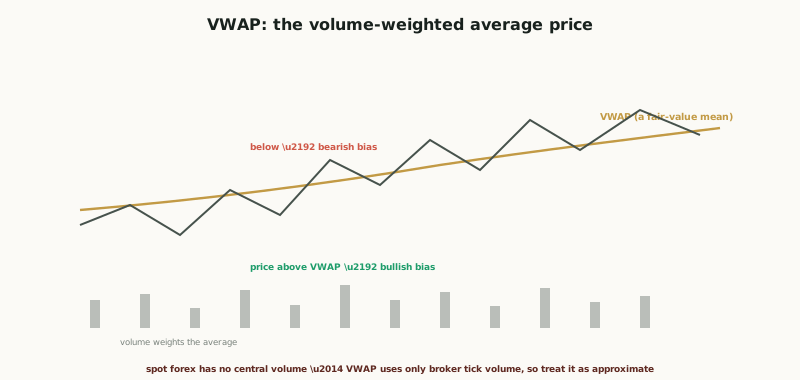
What VWAP is
VWAP is the average price of an instrument over a period — usually the trading day — weighted by the volume traded at each price. The weighting is the whole point: prices where a lot of trading occurred count for more in the average than prices that saw little activity. The result is a single line representing the volume-weighted "average" or fair value for the session — in effect, "what price did the typical traded unit change hands at today?" It's typically plotted as one line that resets at the start of each day (anchoring to the session), accumulating through the day as more volume prints. Conceptually, VWAP differs from a simple moving average in that an MA weights each period equally, whereas VWAP weights by volume — so VWAP reflects where the money actually traded, not just where price went.
How traders use it
VWAP serves two main audiences. For institutions, it's a benchmark for execution quality: a fund executing a large order over the day aims to buy below VWAP or sell above it, since beating VWAP means they transacted better than the session's volume-weighted average — this institutional usage is why VWAP matters so much, as large players actively reference and trade around it. For intraday traders, VWAP is a fair-value benchmark and bias tool. The common reads: price trading above VWAP suggests a bullish bias (buyers in control, paying up relative to the session average), while below VWAP suggests a bearish bias. VWAP often acts as a dynamic support/resistance or a mean that price reverts toward — so traders use it for bias (trade long above, short below), for mean-reversion entries (fading moves back toward VWAP), and as a general fair-value reference for whether the current price is "expensive" or "cheap" relative to the day's volume-weighted average. Because so many participants watch it, VWAP can become somewhat self-fulfilling as a level, especially on heavily-traded instruments.
The forex volume caveat
Here is the asterisk that every forex trader must understand: VWAP depends entirely on volume — and spot forex has no true, central volume figure. Unlike a stock exchange or a futures market (which are centralised and report actual traded volume), the spot forex market is decentralised and over-the-counter, with no single venue tallying total volume. So a "VWAP" on a spot-forex chart can only be calculated from your broker's own tick volume — the number of price changes in each period — which is a rough proxy for activity, not real traded volume (it counts how often price updated, not how much was traded). That makes spot-forex VWAP approximate at best, and potentially misleading if you treat it as the real volume-weighted price it claims to be — the same fundamental limitation that affects OBV, volume spread analysis and all volume tools in spot FX (see volume in forex). VWAP is far more reliable on centralised, volume-reported markets — stocks and especially FX futures (where real exchange volume is reported). So the honest guidance for forex traders: treat spot-forex VWAP cautiously, understanding it's built on tick-volume proxy data; consider using it on FX futures instead if you want genuine volume weighting; and don't lean on it as heavily as a stock or futures trader reasonably can. It can still offer a rough sense of an intraday mean using tick volume, but its theoretical foundation is compromised in spot FX, and pretending otherwise is a mistake.
So VWAP is a genuinely powerful, institutionally-important tool — but one whose value is market-dependent. On stocks and futures, it's a first-class intraday reference for fair value, bias and execution. In spot forex, its volume foundation is shaky, so it's a second-tier tool to use with full awareness of the tick-volume caveat (or to apply on FX futures instead). As with every indicator here, even where VWAP is reliable it's a reference and context tool, not a prediction — a line price tends to interact with, not a signal that price must do anything — and it works best combined with structure and confirmation, traded with disciplined risk management. Know what it measures, know where it's trustworthy, and use it accordingly. The honest framing: VWAP is the volume-weighted average price over a session (resetting daily), weighting prices by how much traded there to give a fair-value mean. Institutions benchmark execution against it (buy below, sell above) and intraday traders use it for bias (bullish above, bearish below), mean-reversion entries, and dynamic support/resistance. The crucial caveat: VWAP relies on volume, and spot forex has no true central volume — only broker tick volume (price-change counts), a rough proxy — so spot-forex VWAP is approximate and far less reliable than on centralised stocks/futures; consider FX futures for genuine volume. Even where reliable it's a reference, not a signal; confirm with structure and manage risk.
Anchored VWAP and VWAP bands
Two refinements extend VWAP's usefulness (on markets where it's reliable). Anchored VWAP lets you start the VWAP calculation from a specific point of your choosing — a significant high or low, an earnings or news event, the start of a move — rather than just the session open. This is powerful because it measures the volume-weighted average price since that meaningful event, answering "what's the average price everyone who traded since the big move has paid?" — a level that often acts as strong support/resistance, since it marks where the average participant since the anchor is at break-even. Anchoring to a major swing point or a key catalyst frequently produces a more relevant reference than the plain session VWAP. VWAP bands (or standard-deviation bands) add lines a number of standard deviations above and below the VWAP, much like Bollinger Bands around a mean — price reaching the upper band is stretched above fair value, the lower band stretched below, framing potential mean-reversion zones and showing how far price has deviated from the volume-weighted average. Together, anchored VWAP and bands turn VWAP from a single line into a richer framework for fair value and deviation.
For forex traders, though, every one of these refinements inherits the same volume caveat: they're only as sound as the volume data underneath, which in spot forex is mere tick volume, not true traded volume — so anchored VWAP and VWAP bands in spot FX are likewise approximate, and most trustworthy on FX futures or other centralised, volume-reported markets. The sensible stance: if you want to use VWAP and its refinements seriously, apply them where the volume is real (futures, stocks); on spot forex, use them only with full awareness that the volume weighting is a proxy, and lean more on price-based tools (support/resistance, pivot points, structure) that don't depend on volume you don't truly have. And, as ever, even a reliable VWAP is a reference for fair value and bias, not a predictive signal — combine it with structure and confirmation, and trade it with risk management. The honest reminder: anchored VWAP (calculated from a chosen significant point) and VWAP standard-deviation bands enrich VWAP into a fair-value-and-deviation framework — but in spot forex they inherit the tick-volume caveat and are approximate, so use them seriously only where volume is real (FX futures, stocks) and lean on price-based tools in spot FX, always treating VWAP as a reference, not a signal.
VWAP (Volume-Weighted Average Price) is the session's average price weighted by volume (resetting daily) — a fair-value mean reflecting where the money actually traded, unlike an equally-weighted moving average. Institutions benchmark execution against it (buy below, sell above); intraday traders use it for bias (bullish above, bearish below), mean-reversion entries, and dynamic support/resistance. The crucial caveat: VWAP relies on volume, and spot forex has no true central volume — only broker tick volume (counts of price changes), a rough proxy — so spot-forex VWAP is approximate and far less reliable than on centralised stocks/futures (consider FX futures for genuine volume). The same limit affects all forex volume tools. Even where reliable, VWAP is a reference, not a signal — confirm with structure and manage risk.