Most retail traders who "buy EUR/USD" never actually own a single euro — they're trading a CFD. Contracts for difference are the vehicle most retail forex (and much else) is traded through, yet many beginners use them without really understanding what they are. Knowing how a CFD works, how leverage amplifies it, and why it's high-risk is essential before you place a trade. This guide explains CFDs: what they are, how they differ from owning an asset, the costs, and the risks.
It's the instrument behind much of how forex is traded, depends entirely on leverage, and contrasts with UK-style spread betting.
Key takeaways
Q: What is a CFD?
A: A CFD, or contract for difference, is an agreement between you and a broker to exchange the difference in an asset's price between when you open and close the trade. You're speculating on the price movement without ever owning the underlying asset. CFDs are traded on leverage (margin), let you go long or short, and cover forex, indices, commodities, shares and more. Most retail forex trading is done via CFDs or similar margin products.
Q: How is trading a CFD different from buying the asset?
A: When you buy an asset outright (like shares), you own it and profit only if it rises. With a CFD you don't own anything — you simply profit or lose on the price difference, can go short (profit from falls) as easily as long, and trade with leverage so a small deposit controls a larger position. You also pay the spread and, for positions held overnight, a financing charge. CFDs offer flexibility and leverage, but no ownership and added cost and risk.
Q: Are CFDs risky?
A: Yes — they're high-risk products, mainly because of leverage. Leverage magnifies both gains and losses, so you can lose money far faster than with an unleveraged investment, and potentially lose your whole deposit quickly. Regulators require CFD providers to display warnings, and these typically show that a large majority of retail CFD accounts lose money. CFDs can be used responsibly with strict risk management, but they are not suitable for everyone, and beginners should treat the leverage with great caution.
What a CFD is, and how it differs from owning
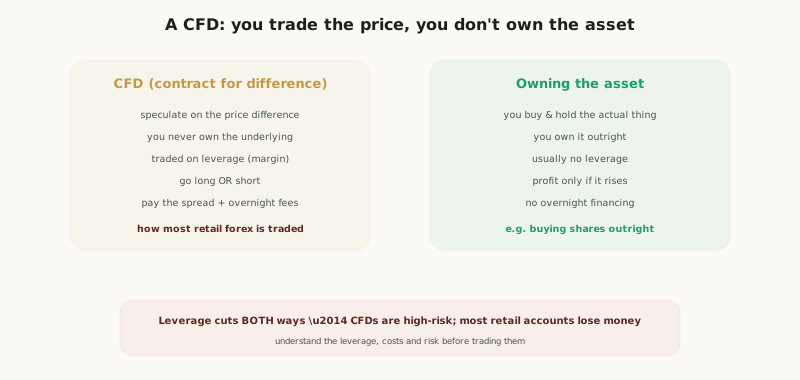
A CFD, or contract for difference, is an agreement between you and a broker to exchange the difference in an asset's price between when you open and close the trade. You're speculating on the price movement without ever owning the underlying asset. If you open a CFD "buy" on EUR/USD and the price rises, the broker pays you the difference; if it falls, you pay the broker — but at no point do you hold actual euros. CFDs are traded on leverage (margin), let you go long or short, and cover forex, indices, commodities, shares and more. Crucially, most retail forex trading is done via CFDs or similar margin products — so when a beginner "trades forex" through a typical retail broker, they're almost always trading CFDs, not exchanging physical currency.
How does this differ from buying the asset outright? When you buy an asset (like shares in a company), you own it and profit only if it rises (and you can sell it). With a CFD you don't own anything — you simply profit or lose on the price difference. This brings three practical differences. First, you can go short (profit from falls) just as easily as long, by opening a "sell" CFD — something far harder with outright ownership. Second, you trade with leverage, so a small deposit (margin) controls a much larger position (see pips, lots and leverage) — the defining feature, and the source of both the appeal and the danger. Third, you pay the spread and, for positions held overnight, a financing charge (swap) reflecting the cost of the leverage. So CFDs offer flexibility (long or short, many markets) and leverage (large exposure from small capital), but in exchange for no ownership and added cost and risk. They're a tool for speculation on price, not a way to invest in and hold an asset.
Why CFDs are high-risk
CFDs are high-risk products, mainly because of leverage. Leverage magnifies both gains and losses, so you can lose money far faster than with an unleveraged investment, and potentially lose your whole deposit very quickly (and, without protection, in some cases more — though many regulated brokers now offer negative balance protection). A modest adverse move on a heavily-leveraged CFD can wipe out your margin in moments. This is not a fringe warning: regulators require CFD providers to display risk warnings, and these typically show that a large majority of retail CFD accounts lose money (often cited figures are around 70–80%) — a sobering, regulator-mandated statistic that tells you plainly how this usually goes for retail traders. The leverage that makes CFDs attractive (big exposure from small capital) is exactly what makes them dangerous (big losses from small moves), and beginners consistently underestimate how quickly leveraged losses compound. CFDs can be used responsibly — with strict risk management, modest effective leverage, proper position sizing and stops — but they are not suitable for everyone, and the single most important thing a beginner can do is treat the leverage with great caution: use far less than the maximum offered, risk only a small fraction per trade, and never deploy money you can't afford to lose. Respect the leverage, and a CFD is a usable tool; ignore it, and it's the fastest route to a blown account.
The balanced beginner takeaway: CFDs are simply the mechanism most retail forex is traded through, and there's nothing inherently sinister about them — but they are leveraged, high-risk instruments that demand respect. Understand that you're trading the price, not owning the asset; understand that leverage is the whole game and cuts both ways; understand the costs (spread and overnight financing); and, above all, internalise the regulator-mandated reality that most retail CFD traders lose. Approach them with sound risk management and conservative leverage and they're a flexible tool; approach them as a get-rich-quick lever and they'll do the opposite. The honest framing: a CFD (contract for difference) is an agreement to exchange the price difference of an asset between opening and closing a trade — you speculate on the price without owning the underlying, trade on leverage, can go long or short, and pay the spread plus overnight financing; it's how most retail forex is traded. Unlike owning an asset, there's no ownership, you can short easily, and leverage means small capital controls a large position. That leverage makes CFDs high-risk — it magnifies losses, you can lose your deposit fast, and regulators' warnings show most retail accounts lose money — so use far less leverage than offered, manage risk strictly, and only ever risk what you can afford to lose.
The real costs, and CFDs versus other vehicles
Beyond the headline risk, it's worth understanding what a CFD actually costs to trade, because these costs quietly erode returns. The main ones are the spread (the gap between buy and sell price, paid on every trade), overnight financing (the swap, charged on leveraged positions held past the daily rollover — a direct consequence of the leverage), and, on some account types, a separate commission (common on raw-spread/ECN-style accounts that offer tighter spreads in exchange). For a beginner, the practical implication is that frequent trading and holding leveraged positions for long periods both rack up costs, so understanding the fee structure of your specific account matters as much as the strategy.
CFDs also aren't the only way to get leveraged exposure, and it helps to see them in context. In the UK, spread betting is a popular close cousin — functionally similar (leveraged, long or short, no ownership) but structured as a bet, with its own tax treatment. Futures are exchange-traded contracts that also offer leveraged exposure but are standardised and centrally cleared rather than traded against a broker. And buying the underlying outright (spot, shares) means ownership and no leverage. Each vehicle has different costs, tax, and risk characteristics, but the CFD's defining traits — no ownership, leverage, long-or-short, broker as counterparty — are what make it the dominant retail-forex vehicle and what you must keep front of mind. The unifying point: whichever vehicle, if it's leveraged, the same hard truth holds — leverage magnifies losses, so conservative sizing and strict risk control are non-negotiable. The honest reminder: CFDs carry real costs — the spread on every trade, overnight financing (swap) on leveraged holds, and sometimes a commission — so frequent trading and long holds add up; and CFDs are one of several leveraged vehicles (alongside UK spread betting and futures) versus owning an asset outright, all sharing the rule that leverage magnifies losses, so understand your account's specific costs and keep sizing conservative.
A CFD (contract for difference) is an agreement to exchange the price difference of an asset between opening and closing a trade — you speculate on the price without owning the underlying, trade on leverage, can go long or short, and pay the spread plus overnight financing. It's how most retail forex is traded. Versus owning an asset: no ownership, easy shorting, and leverage means small capital controls a large position. That leverage makes CFDs high-risk — it magnifies losses, you can lose your deposit fast, and regulators' warnings show most retail accounts lose money. So use far less leverage than offered, manage risk strictly with stops and small size, and only ever risk what you can afford to lose. Respect the leverage and a CFD is a usable tool; ignore it and it's the fastest way to blow up.