When you place a forex trade, who's on the other side? The currency market is a vast hierarchy of players — central banks, global banks, funds, corporations, and retail traders like you. Knowing who they are, and just how small a slice retail trading is, brings a useful dose of humility and helps explain why the market behaves as it does. This guide explains the forex market participants: who trades currencies, their roles, their relative size, and where you fit in.
It gives essential context for what moves the market, complements how brokers work, and explains the outsized influence of central banks.
Key takeaways
Q: Who are the main participants in the forex market?
A: The main players, roughly from most to least influential, are: central banks (which set monetary policy and can intervene), major commercial and investment banks (the interbank market that forms the core of trading), institutional players like hedge funds and asset managers, corporations (which trade currency for international business and hedging), brokers (who give smaller players access), and retail traders — individuals like you, the smallest segment by volume.
Q: Do retail traders move the forex market?
A: Barely, individually. Retail traders are a small fraction of total forex volume — the market is dominated by banks, institutions and central banks trading enormous sums. This means as a retail trader you're a price-taker in a market moved by far larger players; you can't move prices yourself, and you're trading alongside (and against) highly resourced professionals. That's a reason for humility and good risk management, not discouragement.
Q: Why does knowing the participants matter for a beginner?
A: It gives realistic context. Understanding that central banks and major institutions dominate helps explain why fundamentals like monetary policy move currencies so powerfully, why you can't 'beat' the market through size, and why edges for retail traders come from discipline, risk management and niche opportunities rather than muscle. It replaces the fantasy of easily outsmarting the market with a grounded view of where you actually fit.
Who trades currencies
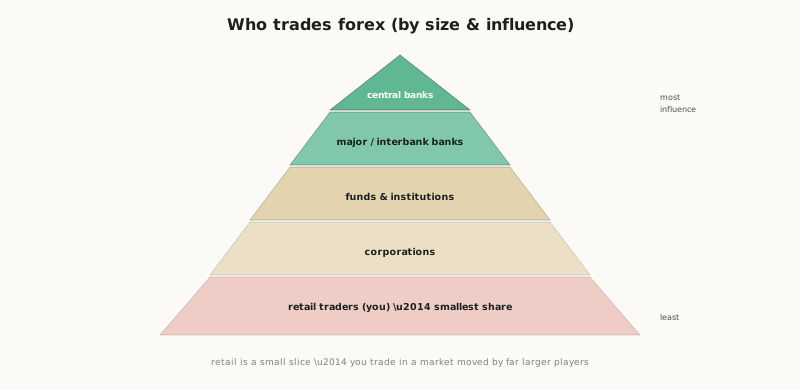
The forex market is made up of several distinct groups, which we can rank roughly by influence and size:
| Participant | Role / why they trade | Scale |
|---|---|---|
| Central banks | Set monetary policy; can intervene in their currency | Most influential |
| Major banks (interbank) | The core dealing market; huge daily volumes | Largest volume |
| Funds & institutions | Hedge funds, asset managers — speculation & investment | Very large |
| Corporations | Currency for trade, payments, hedging | Large |
| Retail traders | Individuals speculating (you) | Smallest slice |
Central banks sit at the top of the influence hierarchy: they set monetary policy (which is arguably the single biggest driver of currency values) and can directly intervene in their own currency — a few words from a central-bank governor can move a currency more than millions of retail trades. Major commercial and investment banks form the interbank market — the core of forex, where the largest volumes change hands as banks trade with each other and for clients; this is the deep pool of liquidity the rest of the market draws on. Institutional players — hedge funds, asset managers, pension funds — trade enormous sums for speculation and investment, and are the sophisticated professional speculators. Corporations trade currency out of necessity: a company doing international business must convert currencies to pay suppliers, repatriate profits, and hedge their currency exposure — commercial, not speculative, flows, but large. Brokers sit in between, giving smaller players access to the market (see how brokers work). And at the base, smallest by volume, are retail traders — individuals like you, speculating on price moves.
Where you fit, and why it matters
Here's the humbling but important reality: retail traders are a small fraction of total forex volume. The market is dominated by banks, institutions and central banks trading sums that dwarf the entire retail segment. This has direct consequences for how you should think about trading. You are a price-taker, not a price-maker — you cannot move prices yourself (your trade, however large it feels to you, is a drop in an ocean), and you're trading alongside and against highly resourced, professional players with better information, faster execution, and vastly more capital. The fantasy that you can easily "outsmart the market" runs straight into the fact that the market is these sophisticated giants. This isn't a reason for discouragement — plenty of retail traders are profitable — but it is a strong reason for humility and good risk management: you win not by overpowering the market (impossible) but by disciplined execution of a sound edge, careful risk control, and exploiting opportunities that suit a small, nimble participant.
Knowing the participants also explains a lot of market behaviour, which is why it's genuinely useful rather than mere trivia. It clarifies why fundamentals like monetary policy move currencies so powerfully — because the biggest players (central banks, institutions) trade on those fundamentals, so a policy shift redirects enormous flows (see what moves the market and central bank divergence). It explains why liquidity is so deep in the major pairs (the banks and institutions concentrate there) and thinner in exotics. And it reframes your own role realistically: your edge comes from discipline, risk management, and niche opportunities — the advantages a small player can have (flexibility, no market impact, the freedom to sit out) — rather than from size or muscle you don't possess. Replacing the beginner's fantasy of easily beating the market with this grounded picture of where you actually sit in the ecosystem is one of the more valuable early lessons: it sets realistic expectations, encourages the humility that keeps you cautious, and points you toward the kind of edge that's actually available to a retail trader. The honest framing: forex is a hierarchy — central banks (most influential, set policy and intervene), major banks (the interbank core, biggest volume), funds and institutions (large-scale speculators), corporations (currency for business and hedging), and retail traders like you (the smallest slice). Retail barely moves prices, so you're a price-taker trading alongside resourced professionals — a reason for humility and risk management, not discouragement. Knowing this explains why monetary policy moves currencies so strongly and reframes your edge as discipline, risk control and niche opportunities, not size.
How their flows shape the market
Understanding why these participants trade reveals a lot about how the market moves. Their flows split broadly into commercial and speculative. Commercial flows come from corporations and others trading currency out of necessity — paying overseas suppliers, converting foreign revenue, hedging exposure — motivated by business needs, not a view on price, and often relatively price-insensitive (a firm needs the currency regardless). Speculative flows come from banks' trading desks, hedge funds and other institutions (and retail) seeking profit from price moves, motivated by a view on direction. The biggest directional moves typically come from the giant speculative and policy players repositioning on shifts in the fundamentals — when a major central bank turns more hawkish, institutions redirect enormous capital to chase the new yield outlook, and that flow, not retail activity, drives the trend. This is precisely why monetary policy and policy divergence are such dominant forces: they move the largest participants.
The structure also explains how your own order reaches the market. At the core is the interbank market — the deep pool of liquidity where the major banks deal — and everyone else accesses prices that ultimately derive from it. As a retail trader, you don't trade directly in the interbank market; your broker gives you access, either by acting as a market maker (taking the other side of your trade itself) or by routing your order to liquidity providers (an ECN/STP model) — a distinction worth understanding when choosing a broker. Either way, you're a small participant drawing on liquidity created by the giants, which is why the major pairs (where the big players concentrate) have such deep liquidity and tight spreads, while exotics are thin. The practical upshot for a retail trader is liberating once accepted: you can't compete on size, information or speed with the institutions, so your edge must come from the advantages a small, nimble player genuinely has — the freedom to trade or not trade with no market impact, to wait patiently for high-quality setups, to exploit niches too small for the giants to bother with, and above all to apply ironclad risk management and discipline. You're a minnow among whales — but minnows that respect that fact, and play to their own strengths, can still thrive. The honest reminder: participants' flows are commercial (necessity-driven, price-insensitive) or speculative (profit-seeking, view-driven), with the biggest directional moves coming from giant institutions and central banks repositioning on fundamentals — which is why monetary policy dominates; your retail order reaches the market via a broker (market-maker or ECN) drawing on interbank liquidity, so your edge lies in a small player's strengths (patience, no market impact, niches, discipline and risk management), not size.
Seen as a whole, the participant picture is one of the more grounding things a beginner can learn. It dispels the lone-genius fantasy and replaces it with reality: you're one small voice in a market dominated by institutions trading on the world's economic fundamentals. Far from discouraging, that clarity points you straight at what actually works for someone in your position — not trying to outmuscle the market, but trading a disciplined edge, managing risk relentlessly, and respecting that the big players and their fundamentals set the tone you're trading within.
Forex is a hierarchy: central banks (most influential — set policy, can intervene), major banks (the interbank core, biggest volume), funds & institutions (large-scale professional speculators), corporations (currency for trade and hedging), and retail traders like you — the smallest slice. Retail barely moves prices, so you're a price-taker trading alongside (and against) far larger, better-resourced professionals — a reason for humility and risk management, not discouragement. Knowing this explains why monetary policy and fundamentals move currencies so powerfully (the giants trade on them), and reframes your edge realistically: it comes from discipline, risk control and niche opportunities a nimble small player can exploit — not from size you don't have.